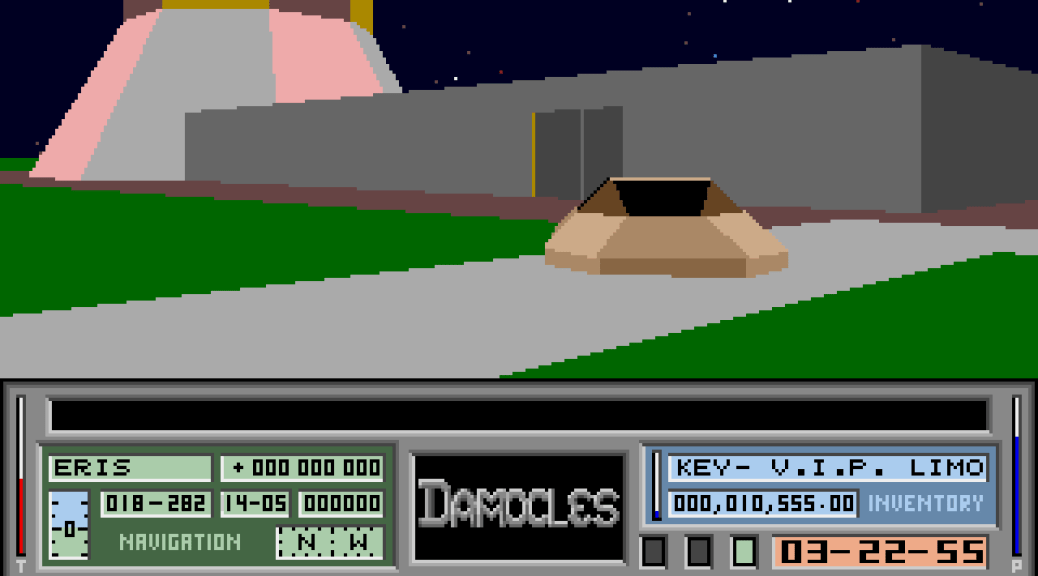
Developer Paul Woakes takes the Mercenary series much further in Damocles (1990) – the second game in the series.
Tag Archives: puzzles
Half-Life 2, PC
Half-Life 2 was first released by Valve Corporation in 2004. It was such a giant leap forward for games in general – not just first-person shooters – that its reverberations are still being felt today.
Half-Life (one) is a brilliant game, but Half-Life 2 completely blows it out of the water.
The Legend of Zelda: The Wind Waker, GameCube
Nintendo‘s 2002 release of their tenth Legend of Zelda game (if you count Oracle of Seasons and Oracle of Ages as two games, which I do) was a real leap, in terms of graphical presentation.
Continue reading The Legend of Zelda: The Wind Waker, GameCube
Mercenary, Commodore 64
Novagen‘s classic 3D exploration game, Mercenary, was first released for the Commodore 64 in 1985. It was designed and coded by Paul Woakes.
Impossible Mission, Commodore 64
Dennis Caswell‘s brilliant 1984 platform game, Impossible Mission, has lost little of its appeal over the decades. There is something so gloriously timeless about it, and the challenge it presents is difficult, but do-able.
Dungeon Master II: The Legend of Skullkeep, PC
The sequel to the mighty Dungeon Master is a great game in its own right. First released by Interplay in 1995.
Continue reading Dungeon Master II: The Legend of Skullkeep, PC
Portal 2, PC
Valve really outdid themselves with Portal 2. Following on from a game as brilliant as Portal, they knew it had to be good. And it is better than good. Portal 2 is incredible.
Knight Lore, ZX Spectrum
Knight Lore by Ultimate Play The Game, first released for the ZX Spectrum in 1984, changed the way games were viewed, and played at the time.
The Legend of Zelda: A Link To The Past, Super Nintendo
The Legend of Zelda: A Link To The Past on the Super Nintendo was a watershed moment in gaming history back in 1991.
Continue reading The Legend of Zelda: A Link To The Past, Super Nintendo
Alien 8, Amstrad CPC
The famous Ultimate ZX Spectrum game, converted skilfully to the Amstrad CPC and eclipsing the original in the process. More colour – less slowdown! 🙂