
Dizzy 3 and a Half was released for free on a Crash magazine cover tape (issue 84, January 1991) and basically serves as an introduction to (and a sales device for) Magicland Dizzy, the fourth Dizzy adventure.
Tag Archives: sequel

Magicland Dizzy, ZX Spectrum
Magicland Dizzy is the fourth Dizzy adventure game and the first game in the series not designed and coded by The Oliver Twins. Instead it was designed by Neal Vincent and coded by Big Red Software, with The Oliver Twins retaining creative oversight.

Fantasy World Dizzy, ZX Spectrum
The third Dizzy adventure, Fantasy World Dizzy, was again designed by The Oliver Twins with graphics by Neil Adamson. It was published by Codemasters in 1989, initially for the ZX Spectrum, but also later for all the major formats at the time (Amstrad CPC, C64, Amiga, ST, and MS-DOS).

Treasure Island Dizzy, ZX Spectrum
Treasure Island Dizzy is the second game in the Dizzy series and was first released by Codemasters in 1988. It was again designed and coded by The Oliver Twins and once again features everyone’s favourite anthropomorphic egg, Dizzy.

River Raid II, Atari 2600
Based on Carol Shaw‘s classic vertically-scrolling shooter, but not created by her, River Raid II is a more challenging and slightly more complex take on the River Raid concept.

Strider 2, PlayStation
A port of an arcade sequel by Capcom, released for the PlayStation in 2000. The original Strider is rightly revered by gamers and the sequel pays homage to it by retaining the original’s look and feel.

Ganbare Goemon: Uchū Kaizoku Akogingu, PlayStation
Yippee! A Goemon game on the PlayStation! This one called Ganbare Goemon: Uchuu Kaizoku Akogingu (in English: “Ganbare Goemon: Space Pirate Akogingu“), and it’s apparently a direct sequel to Ganbare Goemon 3 although Sasuke and Yae are not playable characters in this game. This was the first Goemon game on the PlayStation and it was first published by Konami in 1996.
Thankfully this game was given an English fan translation in 2020 by Adventurous Translations, which makes it playable to non Japanese speakers. According to the readme file on the translation patch the game was not much fun to translate (mostly for technical reasons), and isn’t seen as being a very good game by the person who translated it. That said: I got the translation patch to work fine and am overjoyed that I can now play it in English, so a big thank you to Adventurous Translations for their efforts (they are much appreciated).
Continue reading Ganbare Goemon: Uchū Kaizoku Akogingu, PlayStation

Hunchback: The Adventure, ZX Spectrum
Rather than produce another platform game, Ocean Software chose to make a graphical adventure for their third Hunchback game. Which was an unusual choice.
Hunchback: The Adventure again features Quasimodo trying to rescue Esmeralda, this time from the evil Cardinal of Notre Dame. It’s a three-part game, requiring the same number of loads. In part one Quasimodo must escape from Notre Dame itself, and from the Cardinal’s many guards who are trying to stop him. In part two he must make his way under the city of Paris until he reaches the Cardinal’s mansion. And finally, in part three, he must challenge the Cardinal and escape with Esmeralda in tow.
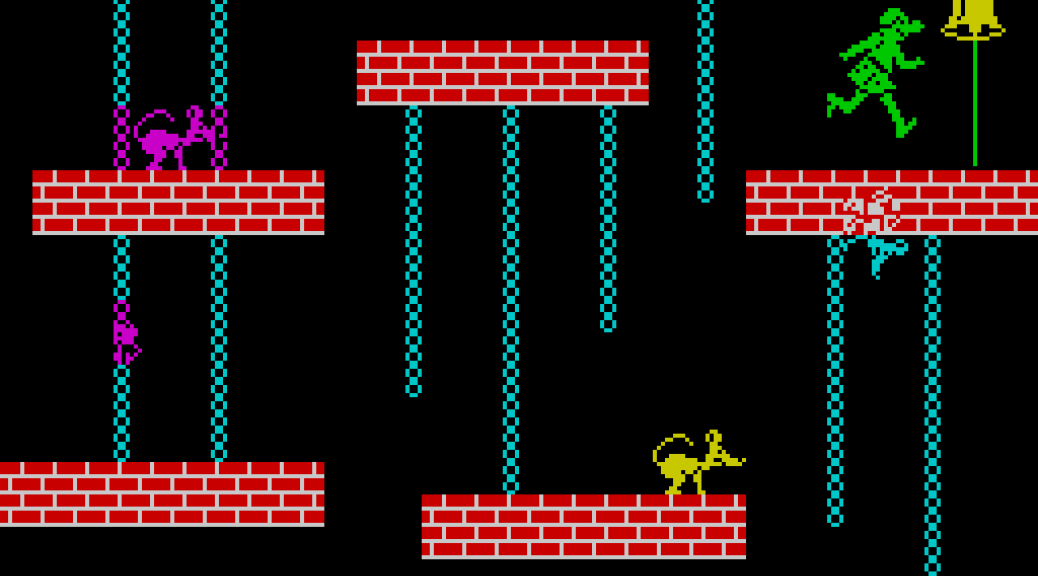
Hunchback II: Quasimodo’s Revenge, ZX Spectrum
The sequel to the hit game Hunchback was released in 1985 by Ocean Software. Hunchback II is another platform game where you control Quasimodo on a mission to collect bells and survive through seven screens of conveyors and climbing ropes. Make it to the end and again rescue Esmeralda as she waits patiently for her green-coloured hero.
Continue reading Hunchback II: Quasimodo’s Revenge, ZX Spectrum

Metal Gear 2: Solid Snake, MSX
Metal Gear 2: Solid Snake is a direct sequel to the original Metal Gear and was first released for the MSX2 by Konami in 1990. It was again written and designed by Hideo Koijima and is much better than the half-baked pseudo sequel, Snake’s Revenge, by Ultra Games on the NES.
 The King of Grabs