Tag Archives: 3D graphics

Three-dimensional graphics, usually constructed of polygons. Not two-dimensional.

Doom, 3DO

The beleaguered 3DO port of id Software‘s classic Doom is often referred to as “the worst port of Doom” by fans of the game, but it’s actually not a bad conversion at all. Yes: it is relatively slow, compared to other Doom ports, and yes: the game runs in a reduced-size window, but it still plays pretty well and does have its plus points.

Continue reading Doom, 3DO

Ghoul Panic, Arcade

First released into arcades in 1999, Ghoul Panic by Namco is a spooky Halloween-style lightgun shooter for one or two players that is heavily inspired by Namco‘s Point Blank series. The game was developed by Eighting/Raizing and features colourful, well-animated 3D graphics throughout.

Continue reading Ghoul Panic, Arcade

Time Crisis, Arcade

Time Crisis is a classic lightgun shooter, developed and distributed into arcades by Namco in 1995. The game is played in a 3D environment, with all the locations, characters and cut scenes fully-modelled as texture-mapped polygons. Unlike many lightgun shooters of the time, Time Crisis is a single-player only game, because it utilizes a foot pedal for taking cover.

Continue reading Time Crisis, Arcade

Crypt Killer, Arcade

Crypt Killer is a three-player, horror-themed lightgun shooter that was first distributed into arcades by Konami in 1995. It uses 3D polygonal graphics for the backgrounds and 2D scaled sprites for the enemies and objects. In some respects it is Konami‘s attempt at producing a House of the Dead-style shooter, although in my humble opinion it isn’t as good as Sega‘s famous horror shooter series.

Continue reading Crypt Killer, Arcade

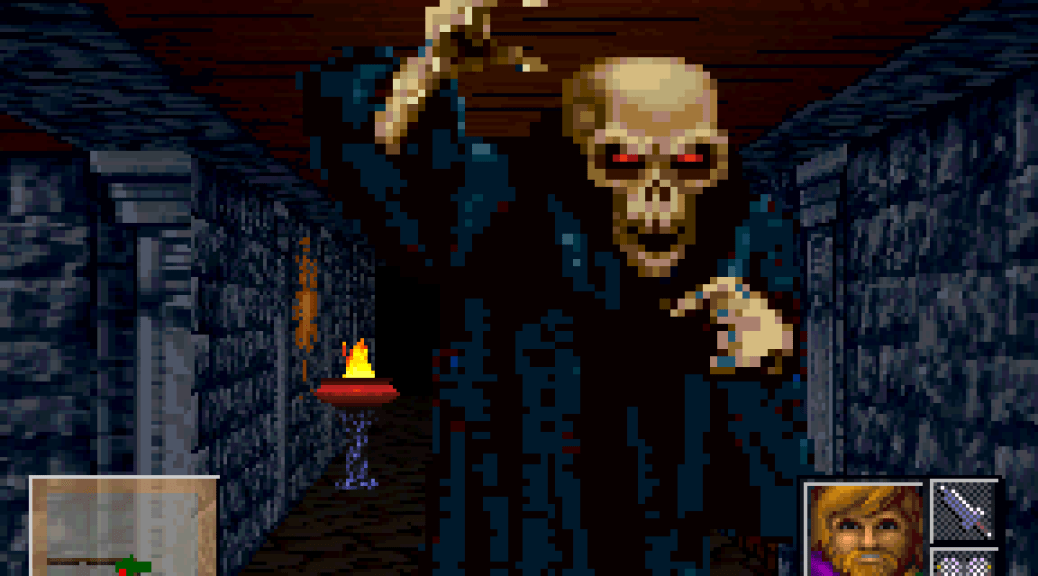
Ultima Underworld: The Stygian Abyss, FM Towns

Origin/Blue Sky Productionsclassic MS-DOS RPG, Ultima Underworld: The Stygian Abyss, was released for the FM Towns in 1993 by Electronic Arts Victor, Inc.*

*= Electronic Arts Victor was a joint venture between Electronic Arts and the Victor Musical Industries subsidiary of JVC, established in September 1992 in Tokyo. Electronic Arts Victor‘s mission was to translate Electronic Arts‘ library of games to Japanese language and to distribute them in Japan, as well as to create original titles for the Japanese market.

Continue reading Ultima Underworld: The Stygian Abyss, FM Towns

The Sentinel, Amstrad CPC

Geoff Crammond‘s classic The Sentinel was first released for the Amstrad CPC by Firebird in 1987, and it is one of the best 8-bit versions of this weird and wonderful game.

Continue reading The Sentinel, Amstrad CPC

Doom, Sega Saturn

The Sega Saturn port of Doom was developed by Rage Software and distributed by GT Interactive in 1997. Like the PlayStation version (on which this port is based) it contains both Ultimate Doom and Doom II, but is a little disappointing in terms of performance and presentation.

Continue reading Doom, Sega Saturn

Doom, Sega 32X

The Sega 32X port of id Software‘s Doom was developed and published by Sega of America in 1994. While the game doesn’t run in a full window (there’s a permanent border around the screen, probably to keep the frame rate up, which is unfortunate), it is an otherwise very good conversion, with smooth movement and decent controls.

Continue reading Doom, Sega 32X

Castlevania: Symphony of the Night, Sega Saturn

Konami‘s brilliant PlayStation game, Castlevania: Symphony of the Night, was released for the Sega Saturn in 1998, but it was only ever released in Japan (under the title “Akumajou Dracula X: Gekka no Yasoukyoku“). Thankfully, an English translation patch is available to make the game playable to those who can’t read Japanese. The patch – created by ‘Knight of Dragon’ – also features numerous bug fixes and improvements.

For those who’ve never played Symphony of the Night before: it is a direct sequel to Rondo of Blood and is rightly regarded as one of the best Castlevania games in the long-running series (if not THE best).

Continue reading Castlevania: Symphony of the Night, Sega Saturn

Doom II, Game Boy Advance

The Game Boy Advance port of id Software‘s classic first-person shooter sequel, Doom II, was developed by Torus Games and first published by Activision in 2002. Unlike the first Doom on the GBA this port doesn’t use the original Doom engine, but instead uses the Southpaw Engine, that was designed for native use on the GBA and has been used in a number of other games. Torus Games had to therefore recreate all the levels from scratch for this port, and I have to say that they did a great job.

Continue reading Doom II, Game Boy Advance