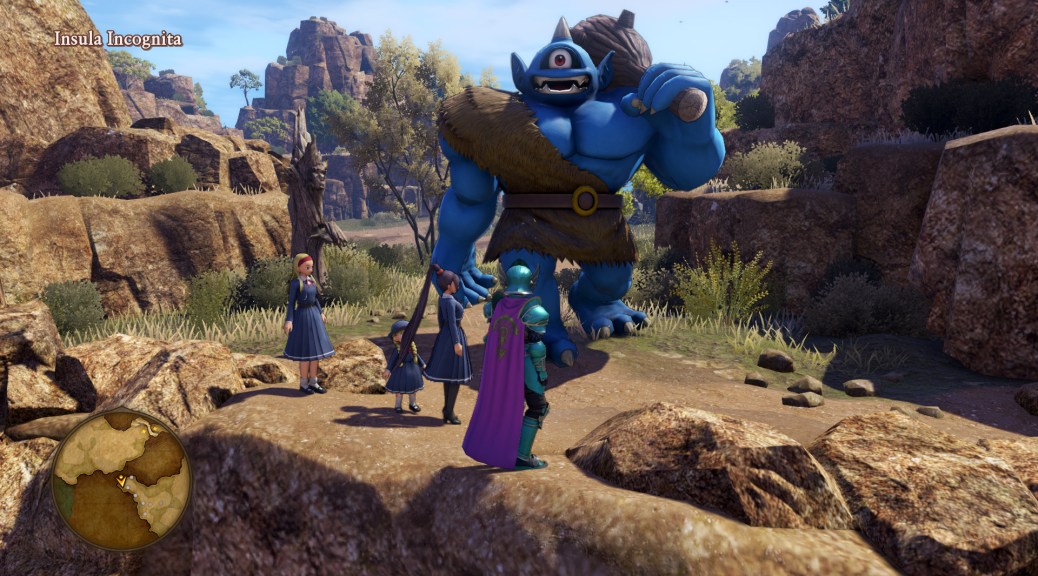
Dragon Quest XI: Echoes of an Elusive Age is the eleventh – and reportedly final – game in the long-running Dragon Quest series, from Square Enix. With the passing of character designer Akira Toriyama in March 2024, and composer Koichi Sugiyama in September 2021, this will now likely to be the case. But what a stunning game to end on, because Dragon Quest XI is one of the best, most vibrant, and most rich JRPGs I’ve ever played…
Dragon Quest XI was initially released in Japan in 2017, with a localised English release made in 2018. In 2019 the “Definitive Edition” was released for the Nintendo Switch, and in 2020 it was also released for Windows PCs.
The Definitive Edition, which I’m showing here, has a number of enhancements, including an optional 2D mode, which was developed by ArtePiazza, the company that made the brilliant Nintendo DS remakes of Dragon Quests five through seven. The Definitive Edition also includes: optional original Japanese voice acting (as well as the English voice acting); an optional symphonic soundtrack; and extra quests and scenarios.
The story revolves around you – a named player character from the humble village of Cobblestone – who is rumoured to be a returning hero called “The Luminary“, who is fated to save the world from a great catastrophe. The local King, who for some reason believes The Luminary to be a “harbinger of doom”, throws you in jail and sends his forces out to destroy your home village in reprisal. You, of course, escape, and must then evade the King’s men, who are from that point on constantly on your tail. You’re also trying to find out why the King believes what he does.
Dragon Quest XI is split into four distinct ‘Acts’, or parts, each of which have their own spin on the gameplay; cause a bump in the difficulty (and a change of monsters), and also provide some surprises and real drama. Plus, there’s a seriously good post-game adventure available for those who want to get the most out of it.
The gameplay follows the familiar Dragon Quest template: third-person exploration; turn-based combat; earning Experience Points to level up; acquiring Skill Points by levelling-up; collecting anything and everything you find (and not really selling any of it*), and building up your characters so that you are able to beat the many bosses in the game.
*= Usually in an RPG you’ll spend time selling stuff you’ve collected that you don’t need, but in this game (and since Dragon Quest VIII, really) it’s always been a good idea to keep everything** you collect, so that items can be used in crafting. Thankfully the game has individual inventories for characters (with limited capacity), and an Item Bag and an Equipment Bag with unlimited capacity, so managing items is easy.
**= Later in the game you will have many multiple copies of items you no longer need, so can safely sell them, but earlier in the game it’s a good idea to keep all your items in case they’re needed for crafting newer, more effective gear.
One important (improved) feature of this game is the Party System: for recruiting NPCs, and switching party members. Like in Dragon Quest VIII, at key points in the story you will meet other characters who will join you, and they will each bring their own unique skills to the party. There are seven other NPCs to recruit in total. Making a maximum party of eight, but only four can be active in combat. You can switch party members in and out at will, even when in combat. It’s a very useful feature. Gone is the job system from Dragon Quest IX, and also gone is the ability to reset your maximum level to start levelling again (also in Dragon Quest IX). The level cap for all characters in Dragon Quest XI is 99, and you will reach that if you make it to the end of the third act. At that point your level will no longer matter, but there will still be many things post-game you can do.
The “Character Builder” is basically a fancy name for a skill tree, where you can unlock new abilities for each character. By spending skill points you can unlock various branches for each character – improving weapon skills, or each character’s innate skill. Each character has their own specialisation trees (daggers, swords, axes, whips, boomerangs etc.), plus an ‘innate’ skill (“Luminary” for you; “Guile” for Erik; “Vim” for Veronica and “Harpistry” for Serena, and so on). Unlocking certain important skills depends on how many other skills you’ve unlocked around them on the honeycomb grid, which means being careful with your skill point spending. Some, rare skills award bonus skill points when unlocked; others reveal hidden skills; and some unlock special party moves called “Pep Powers“. You can also reset/regain all your skill points, and re-spend them, if you choose “Rectification” at a church. It costs 20 gold coins per skill point, though.
During combat, when you or another party member becomes ‘pepped-up‘, they will cry out and glow blue, and will then be able to perform special attacks called “Pep Powers“. These Pep Powers can be used alone, or combined with other party members, to create some bizarre, powerful and useful moves that can be deployed in battle. Each Pep Power has its own animation sequence in combat too. Some of which are hilarious. While this might seem like a minor addition to the game on the face of it, it’s actually quite significant, but you won’t really see how much so until you face-off against some of the tougher bosses in the game. Using the Character Builder you can also increase the rate of ‘Peps’ activating, or their effectiveness.
Combat in Dragon Quest XI is a turn-based RPG-lover’s dream. The in-game menu system is swift, precise and beautifully designed, and all the click timings have been honed to pretty much perfection. The UI and control system is reminiscent of Dragon Quest VIII and Dragon Quest IX, but is definitely more refined when using a mouse and keyboard.
One difference to most of the previous Dragon Quest games is that this one doesn’t have many random encounters. Enemies can be seen as you explore the landscape, and if you want to fight them, you usually have to touch them (or sneak up on them and attack them in a pre-emptive attack). Some battles are unavoidable (usually ones where an enemy is guarding something you need to pick up), some are scripted, but most are optional. There ARE random battles when sailing the sea, but these don’t come for a while. This will no doubt please those who don’t much like the combat, although you do need to grind a little to make beating bosses easier.
End of the first act:
Reaching The Sword of Light at the heart of The World Tree.
Next: Part 2 – Second Act
More: Dragon Quest XI on Wikipedia
Steam: Dragon Quest XI on Steam
More: Akira Toriyama on Wikipedia
More: Koichi Sugiyama on Wikipedia


2 thoughts on “Dragon Quest XI: Echoes of an Elusive Age, PC [Part 1 – First Act]”