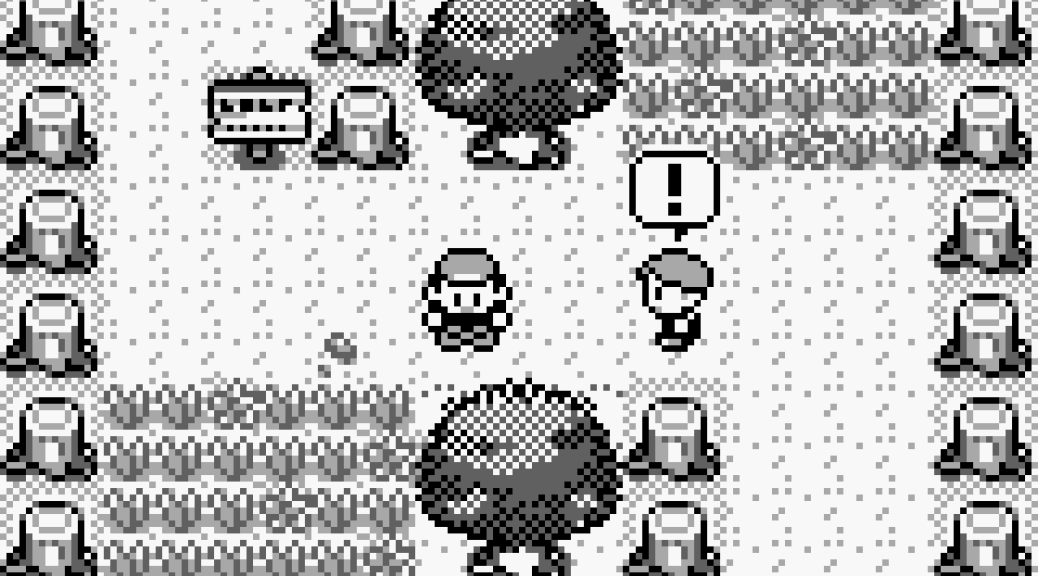
Pokémon Yellow (aka Pokémon Yellow Version: Special Pikachu Edition) is a remake of Pokémon Red/Blue/Green that was released for the Game Boy Colour in 1998.
Tag Archives: Retro Gaming History
Pokémon Red Version, Game Boy
Pokémon Red Version was the very first Pokémon game and it was released for the original black and white Game Boy in 1996.
Like all subsequent Pokémon games it came as a pair of releases, so that players could have Pokémon exclusive to their version of the game and so that trading was required between versions – if you wanted to catch every single available Pokémon. Some might view that as cynical, but it wasn’t really intended to make people buy both versions, just to encourage link-up play and trading between them. It does however mean that you can’t catch all the available Pokémon if you only have one version of the game, and have no way of trading with someone else who has the other version.
In Japan, Pokémon Red (originally titled Pocket Monsters: Red) was accompanied by Pokémon Green (Pocket Monsters: Green), but in North America and Europe Pokémon Red was accompanied by Pokémon Blue, which is basically a remake of Green.
Wonder Boy III: The Dragon’s Trap, Sega Master System
Wonder Boy III: The Dragon’s Trap is a platform adventure with RPG elements and it is considered to be one of the best games on the Master System. It was developed by Westone and published by Sega in 1989.
Continue reading Wonder Boy III: The Dragon’s Trap, Sega Master System
Acorn Archimedes Special
The Acorn Archimedes is a family of home computers designed by Acorn Computers of Cambridge, England. The systems are based on Acorn‘s ARM RISC (Reduced Instruction Set Computer) architecture with a 32-bit CPU (using 26-bit addressing) and were manufactured from 1987 until the mid-1990s.
10 Best Bubble Bobble Conversions
LISTS: as decided by The King of Grabs, in order of greatness:
Taito‘s classic 1986 arcade hit, Bubble Bobble, has been converted to pretty much every format on the planet. We played through them all recently and have compiled a list of the best. Click a link to view each conversion individually. Do you agree with our choices? Let us know in the comments.
1. Sega Saturn (1996)
2. Nintendo DS (2005)
3. Game Boy Advance (2003)
4. X68000 (1990)
5. FM Towns (1990)
6. Sega Master System (1988)
7. NES/Famicom Disk System (1987)
8. PC MS-DOS (1989)
9. Atari ST (1989)
10. Amiga (1989)
See also:
MSX (1987)
Commodore 64 (1988)
ZX Spectrum (1987)
Amstrad CPC (1987)
Game Gear (1994)
Game Boy Color (1999)
Game Boy (1991)
BBC Micro (1989)
Apple II (1988)
See also: BB4CPC (2014) on the Amstrad CPC and Super Bubble Bobble MD (1995) on the Megadrive/Genesis.
Did we miss any official conversions of Bubble Bobble? Please let us know in the comments.
In memory of Fukio Mitsuji (1960-2008), the designer of the great Bubble Bobble.
More: Bubble Bobble on Wikipedia


Metal Gear Solid 2: Substance, XBox
Metal Gear Solid 2: Substance is an expanded version of Metal Gear Solid 2: Sons of Liberty (which was released for the PlayStation 2 in 2001). Substance was released for the XBox by Konami in 2002.
It’s the fourth Metal Gear game co-written and designed by Hideo Koijima and the seventh game in the series as a whole.
Ridge Racer, PlayStation
A launch title on the PlayStation and the first game I ever played on the system, Ridge Racer is a conversion of the classic arcade racing game from Namco.
Metal Gear Solid, PlayStation
Metal Gear Solid is an award-winning tactical espionage action game focusing on stealth gameplay and it was first released by Konami in 1998. It was directed, produced and written by Hideo Koijima and follows on from the MSX games Metal Gear and Metal Gear 2: Solid Snake.
You play as codename “Solid Snake“, a legendary American soldier who infiltrates a nuclear weapons facility in order to neutralise a terrorist threat who are threatening a nuclear strike on The White House. Snake must sneak around, liberate hostages and stop the terrorists from launching the strike, all the while avoiding enemy contact as much as possible and gathering information about the situation.
Sony PlayStation Special
The Sony PlayStation was the first machine in the PlayStation series of video game consoles and it came out in Japan first, in 1994, and in 1995 everywhere else. It is widely seen as being the console that changed gaming forever; the console that marked the transition from cartridge-based console gaming to CD-ROM based games, and also the console that ushered in a new era of 3D gaming. It was also the console that made Sony a major player in the video game business.
Over its eleven-year lifespan 7,918 individual games were released for the PlayStation, accumulating just under a billion sales overall. The console itself became the first to sell over 100 million units.
This week I’m going to be featuring screenshots from a number of my favourite PlayStation games. Some you might have heard of (or even played), others you might never have seen before. One thing is for sure, though: interest in the original PlayStation is still going strong, some 27 years after its initial release. And that’s because these great games endure, and because emulation has breathed new life into the format.
Oh, and if you’re wondering what the blue PlayStation is: that is a development PlayStation – used by developers to create and test the games themselves. The photos are of my very own console, taken by myself, specifically for this blog.
Here’s a full list of what was published:
Rapid Reload
Kula World
No One Can Stop Mr. Domino!
Ganbare Goemon: Uchuu Kaizoku Akogingu
Devil Dice
Revelations: Persona
Ultima Underworld: The Stygian Abyss
Pepsiman
Metal Gear Solid
Ridge Racer
Croc: Legend of the Gobbos
Strider 2
Jumping Flash!
Vib-Ribbon
Enjoy,
The King of Grabs
Metal Gear 2: Solid Snake, MSX
Metal Gear 2: Solid Snake is a direct sequel to the original Metal Gear and was first released for the MSX2 by Konami in 1990. It was again written and designed by Hideo Koijima and is much better than the half-baked pseudo sequel, Snake’s Revenge, by Ultra Games on the NES.