
The Sega 32X port of id Software‘s Doom was developed and published by Sega of America in 1994. While the game doesn’t run in a full window (there’s a permanent border around the screen, probably to keep the frame rate up, which is unfortunate), it is an otherwise very good conversion, with smooth movement and decent controls.
Tag Archives: Gory

Doom II, Game Boy Advance
The Game Boy Advance port of id Software‘s classic first-person shooter sequel, Doom II, was developed by Torus Games and first published by Activision in 2002. Unlike the first Doom on the GBA this port doesn’t use the original Doom engine, but instead uses the Southpaw Engine, that was designed for native use on the GBA and has been used in a number of other games. Torus Games had to therefore recreate all the levels from scratch for this port, and I have to say that they did a great job.

Doom, Game Boy Advance
The Game Boy Advance version of Doom was developed by David A. Palmer Productions and published by Activision in 2001. It is a playable and enjoyable version of id Software‘s shooter classic on Nintendo‘s capable handheld.

Barbarian II: The Dungeon of Drax, Commodore 64
The sequel to 1987’s cult hit Barbarian, Barbarian II: The Dungeon of Drax is a similar fighting game, but with more variety than the first game, and the possibility of exploring the actual world by moving from screen to screen (“wow! What a technological advancement!“). Barbarian II was first released in 1988 by Palace Software. The game was later licensed by Epyx for distribution in North America under the title of “Axe of Rage“.
Continue reading Barbarian II: The Dungeon of Drax, Commodore 64

Barbarian, Commodore 64
Palace Software‘s Barbarian: The Ultimate Warrior is a fondly-remembered and controversial one-on-one fighting game from 1987, where two gladiatorial combatants slug it out to the death in a variety of different locations. Actually, there are two different versions of this game, each with different backgrounds. The first version has a throne room and then a pit. The second version has a meadow and a clearing in a forest. I’m not sure why there are two versions of this game, but that definitely seems to be the case.

Total Carnage, Atari Jaguar
A conversion of the 1992 arcade shooter from Midway, the Atari Jaguar port of Total Carnage was developed by Hand Made Software and first published by Midway Manufacturing in 1995.

Doom, Atari Jaguar
The Atari Jaguar conversion of id Software‘s classic Doom is actually pretty good. It’s a lot better than the Super Nintendo port, which should be expected. It was first released in November 1994 by Atari Corporation. id‘s John Carmack programmed the bulk of the engine, with Dave Taylor handling multiplayer code, and with Atari‘s help on the production and testing side of things.

Doom, PlayStation
The PlayStation version of Doom was was coded by Aaron Seeler for Williams Electronics and first published in 1995. The game runs on a modified version of the Atari Jaguar Doom engine and was the first time Ultimate Doom and Doom II were packaged together in one release.
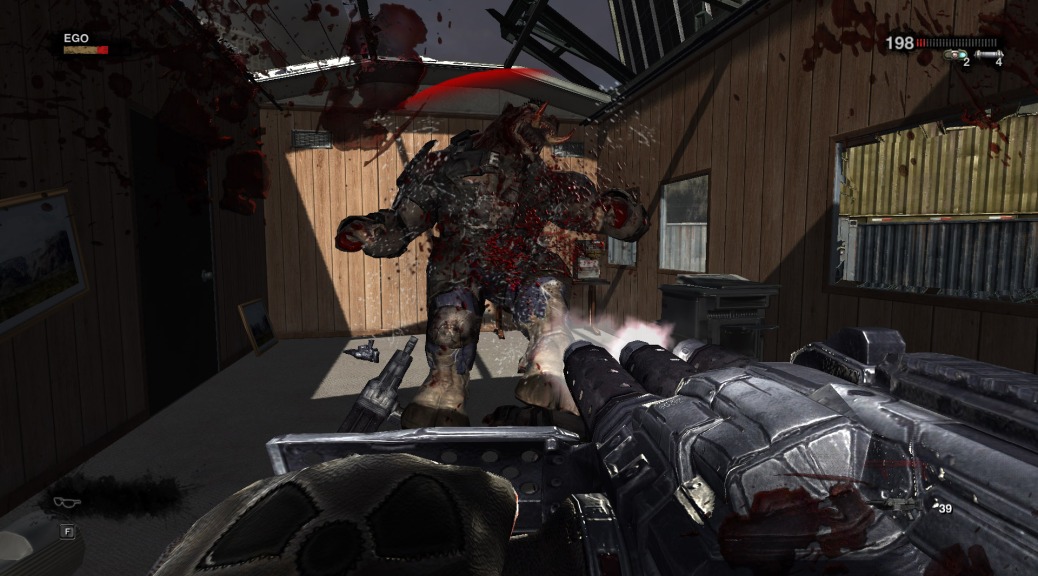
Duke Nukem Forever, PC
Duke Nukem Forever is the long-awaited sequel to Duke Nukem 3D that was in “development hell” for over a decade and was finally released in 2011. It was developed by 3D Realms and Gearbox Software (with contributions from Triptych Games and Piranha Games) and published by Take-Two Interactive. The game is a first-person shooter that satirises all-American action heroes, with over-the-top weapons, giant explosions, and puerile humour. Jon St. John once again returns to voice Duke himself.

Ultima VIII: Pagan, PC
Ultima VIII: Pagan is the eighth entry in the Ultima series and was developed and published by Origin Systems for PC MS-DOS in 1994. Like its predecessor (The Black Gate), Pagan goes for a darker, more mature tone than most of the previous Ultima games, and it is also more puzzle and action-oriented.

