Tag Archives: mushrooms

Evil Dead: Hail to the King, Dreamcast

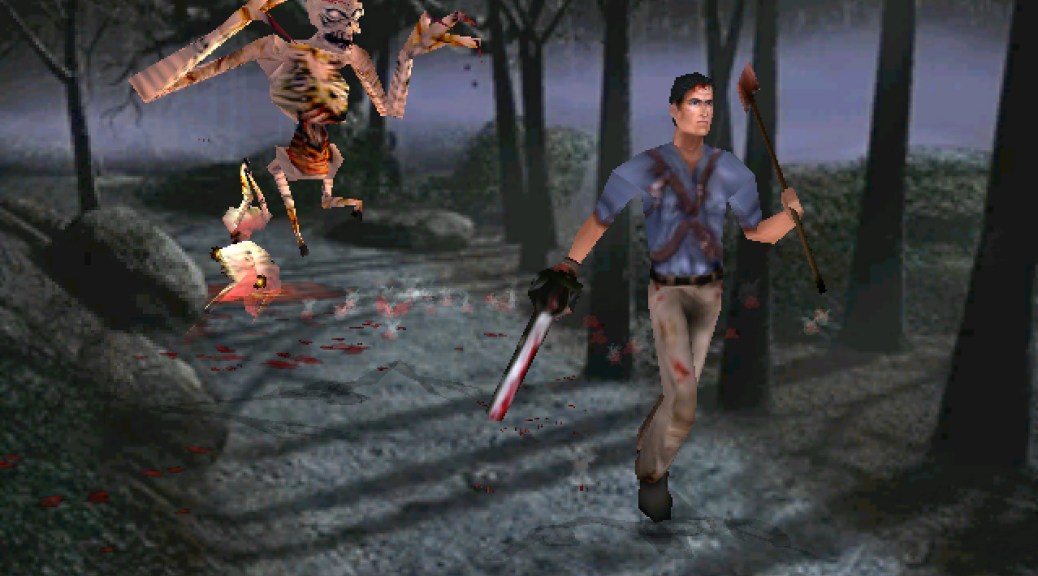
Evil Dead: Hail to the King was developed by Heavy Iron Studios and published by THQ in 2000. It is a survival horror game based on Sam Raimi‘s classic cabin-in-the-woods horror film, and – to be honest – it’s pretty bad. Which is a pity because I’m a big horror film fan (have been since I was a teenager), and this game should be right down my street.

Continue reading Evil Dead: Hail to the King, Dreamcast

Ultima Underworld: The Stygian Abyss, FM Towns

Origin/Blue Sky Productionsclassic MS-DOS RPG, Ultima Underworld: The Stygian Abyss, was released for the FM Towns in 1993 by Electronic Arts Victor, Inc.*

*= Electronic Arts Victor was a joint venture between Electronic Arts and the Victor Musical Industries subsidiary of JVC, established in September 1992 in Tokyo. Electronic Arts Victor‘s mission was to translate Electronic Arts‘ library of games to Japanese language and to distribute them in Japan, as well as to create original titles for the Japanese market.

Continue reading Ultima Underworld: The Stygian Abyss, FM Towns

The Legend of Zelda: A Link to the Past and Four Swords, Game Boy Advance

The Legend of Zelda: A Link to the Past and Four Swords is a two-game package developed by Nintendo EAD and Capcom and first released for the Game Boy Advance in 2002 in North America and 2003 in Japan and Europe. It features a slightly modified port of the 1991 SNES classic, A Link to the Past, plus an all-new, multiplayer-only adventure called Four Swords.

Continue reading The Legend of Zelda: A Link to the Past and Four Swords, Game Boy Advance

Chiller, ZX Spectrum

The 1985 ZX Spectrum version of Mastertronic‘s Chiller was coded by Richard Wright, and is pretty much the same as the original C64 version, except that it doesn’t have any music (which was probably a good thing, from a legal standpoint), and the graphics are even worse.

Continue reading Chiller, ZX Spectrum

Chiller, Commodore 64

Chiller is a simple platform game set over five different screens, and the aim is to rescue your girlfriend who is located in a haunted house at the end of the game. You jump around and collect ‘magic crosses’ to transition to the next screen. An energy bar indicates the player’s health. Touching enemies, or red mushrooms, depletes health, and collecting pink mushrooms increases it. If the bar reaches zero it’s game over – you only have one life.

Continue reading Chiller, Commodore 64

Ultima VIII: Pagan, PC

Ultima VIII: Pagan is the eighth entry in the Ultima series and was developed and published by Origin Systems for PC MS-DOS in 1994. Like its predecessor (The Black Gate), Pagan goes for a darker, more mature tone than most of the previous Ultima games, and it is also more puzzle and action-oriented.

Continue reading Ultima VIII: Pagan, PC

King’s Field IV, PlayStation 2

King’s Field IV was developed and published by FromSoftware in Japan in 2001 for the PlayStation 2. It was later released as King’s Field: The Ancient City in North America in 2002, and in Europe (as simply King’s Field IV) in 2003. It is another first-person RPG and is the fourth and final game in the King’s Field series.

Continue reading King’s Field IV, PlayStation 2

King’s Field III, PlayStation

King’s Field III is the second sequel in FromSoftware‘s classic first-person RPG series and was first released in Japan in 1996. It was published in North America by ASCII Entertainment under the title of “King’s Field II” (because the original King’s Field was only released in Japan).

For my money, King’s Field III is the best of the three PlayStation King’s Field games, with larger, more interesting environments, and a bigger scope than the previous two games. The graphics are still borderline laughable, and the controls are still cumbersome, but the gameplay has evolved reasonably well in the space of a couple of years.

Continue reading King’s Field III, PlayStation

Wonder Boy in Monster Land, Arcade

The 1987 sequel to Wonder Boy, Wonder Boy in Monster Land, is a platform adventure game with RPG elements. It was developed by Westone and manufactured for arcades by Sega.

Continue reading Wonder Boy in Monster Land, Arcade