
On the face of it, Quarantine sounds like a fun game: you’re a post apocalypse taxi driver, eking a living out on fares and the odd bigger payday mission – to buy BIG GUNS to put on your car and therefore blow the opposition to smithereens.
Tag Archives: 3D graphics
Three-dimensional graphics, usually constructed of polygons. Not two-dimensional.
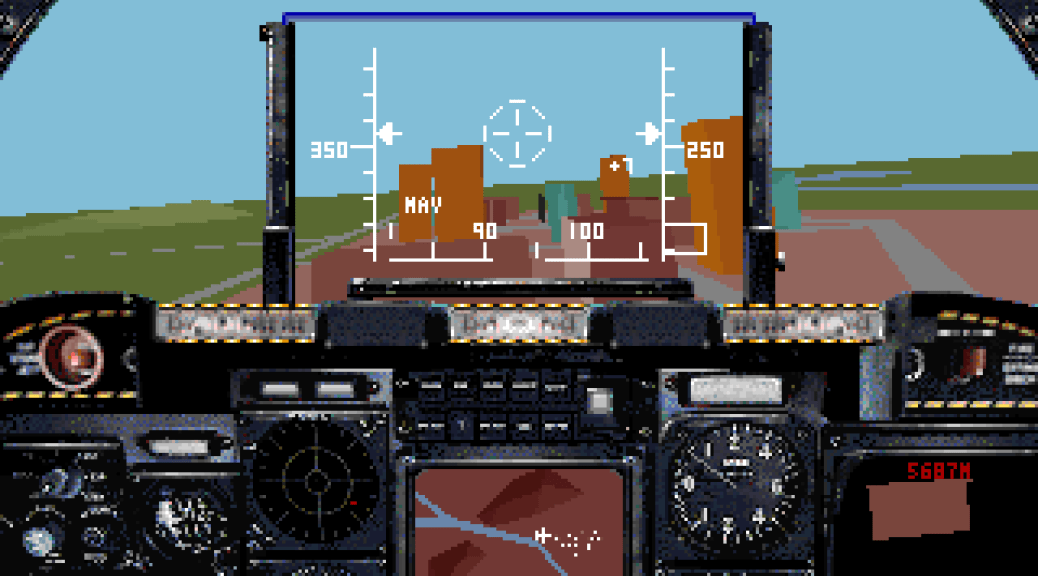
A-10 Tank Killer, PC
Dynamix‘s 1989 combat flight sim, A-10 Tank Killer, is fast and fluid on the PC, making it one of the first serious combat flight sims to offer more than 20 frames a second to games-players. In the early days of combat flight sims: the games were battling against weaker machine specs and lower CPU cycles. When 386 and 486 type PCs entered the market (in 1989), and VGA graphics cards became affordable, only then did the genre finally have the power to be “fast” and “fluid”.

Alone In The Dark 2, PC
Alone In The Dark 2 is a suitably frantic, scary and chilling sequel to 1992’s Alone In The Dark.
Part two came out just over a year after the first game, in 1993, and French developer Infogrames made it bigger and more challenging than the first game.

Driller, Commodore 64
The Commodore 64 version of Incentive‘s classic Driller is surprisingly good, considering that the machine isn’t particularly suited to this kind of game.

Capcom vs. SNK 2 EO, XBox
The “EO” part of Capcom vs. SNK 2 EO means: “Easy Operation”. Basically, this is the same game as the classic arcade beat ’em up of 2001, but with controls better suited to a gamepad. So, rather than hitting buttons to perform special attacks, you can now move the right analogue stick in a certain direction to activate them instead.

Driller, PC
American publisher Epyx released UK hit game Driller onto US PC markets under the title of Space Station Oblivion in 1988.
There was no need for a title change really. Driller says it all.

Driller, Atari ST
Driller and Freescape started life on the ZX Spectrum in 1987 – performing miracles on Sir Clive’s humble little machine. Creating 3D worlds where previously there were none…
And, being more than just a graphics engine, Freescape (and Driller) lived on into the 16-bit realm, and beyond.

Driller, ZX Spectrum
Driller first appeared on the ZX Spectrum in 1987. This version is where it all began.
Driller‘s engine – called Freescape – was to go down in history as one of the first to make 3D gaming a real possibility.

Driller, Amstrad CPC
Driller was the very first Freescape game. A very important game for its time. It first came out in 1987.
It was one of the first ever games that allowed you to explore a full 3D environment, and Freescape was the engine that made it possible.

Darkwatch, XBox
Developed by High Moon Studios, Darkwatch is a First-Person Shooter/survival horror game that crosses the American “Wild West” with ghosts, zombies and werewolves and that kind of material.
When it was first released, back in 2005, is was quite impressive for the time. In this day and age Darkwatch looks and plays very simply, but is not entirely without its redeeming features.
 The King of Grabs