
Developed by The Bitmap Brothers and published by Renegade Software for the Amiga in 1991, Gods is a stylised platform game in which you play as Hercules, on a quest to make his way through five large stages, themed with Greek mythological motifs.
Tag Archives: 16-bit

Ultimate Qix, Megadrive/Genesis
Released as “Volfied” in arcades, this sequel to the original Qix was re-named Ultimate Qix for its Sega Genesis release in North America in 1991. And – let’s face it – “Volfied” is a crappy name anyway, so it’s no great loss.

Vixen, Atari ST
Vixen, by Martech, was released for a number of 8 and 16-bit home computer platforms in 1988, and it proved to be somewhat controversial. Mainly because the game used glamour model Corinne Russell as both reference for the lead character, and to plaster all over the packaging and marketing for the game, which upset a lot of vocal, prudish people in the UK, leading to calls for it to be banned. Retailer Boots even refused to stock the game unless Martech changed the game’s packaging…

Starglider, Amiga
Argonaut Software‘s Starglider, when it first came out, was a flashy release. It came in a big blue box, with a novella, a manual, and a single floppy disk. Magazines were raving about it, and I remember buying it… for the ZX Spectrum. LOL.

Starglider, Atari ST
The Atari ST version of Argonaut Software‘s pioneering 3D shooter, Starglider, first came out in 1986 – a year before the Amiga version (for some reason – I don’t know why).
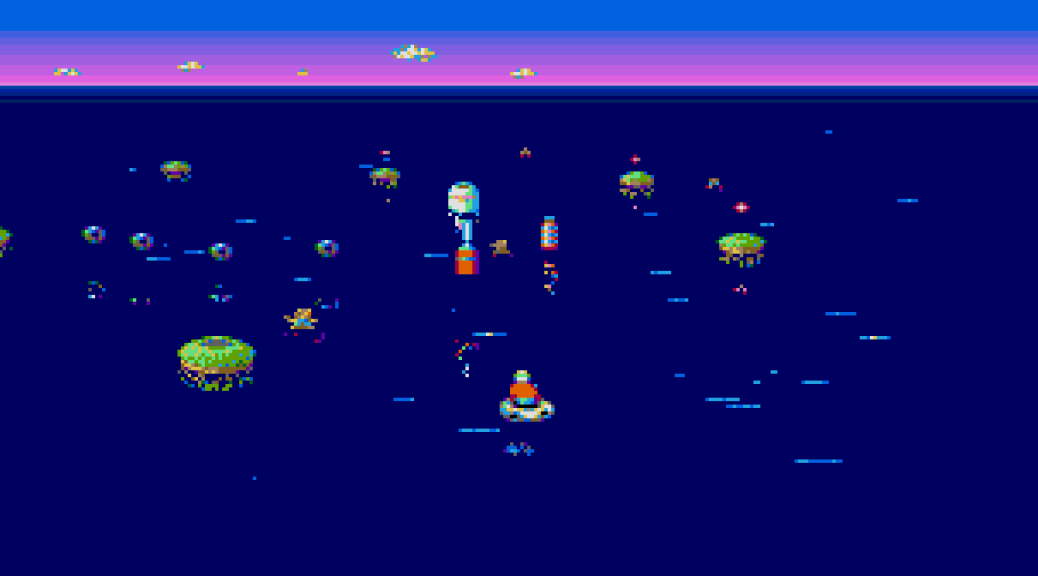
Typhoon Thompson in Search for the Sea Child, Atari ST
Developed by Dan Gorlin Productions and originally released for the Atari ST by Brøderbund in 1988, Typhoon Thompson in Search for the Sea Child is a simple but brilliant shooter/collect ’em up with analogue controls.
Continue reading Typhoon Thompson in Search for the Sea Child, Atari ST

RoboCop, Amiga
Ocean Software‘s Amiga port of RoboCop was fairly impressive when it first came out in 1989, but – playing it now – it hasn’t stood the test of time particularly well. It’s a scrolling run-and-gun shooter that is loosely-based on the Data East arcade game of the same name (although the arcade game and the home computer versions were developed in parallel).

Rainbow Islands Extra Version, Megadrive/Genesis
The “Extra Version” of Taito‘s classic Rainbow Islands is a modified version of the original arcade game, where the levels have been rearranged and the enemies changed to make the game more challenging. There are some new power-ups to discover, and the bosses have also been changed too. Rainbow Islands Extra was released into arcades in limited quantities in 1988, and was also released on the Sega Megadrive in 1990 and the FM Towns in 1992.
Continue reading Rainbow Islands Extra Version, Megadrive/Genesis

Paperboy II, Megadrive/Genesis
The Megadrive/Genesis version of Paperboy 2 (or Paperboy II, as the title screen shows) is a real surprise, because it seems to be an attempt by developer Tengen to actually create a real sequel to the Paperboy arcade game. This game doesn’t strictly follow the rather lacklustre template of the Mindscape version of Paperboy 2, but instead does its own thing, which IMHO makes it special.

Paperboy 2, Amiga
The Amiga version of Paperboy 2 is pretty much identical to the MS-DOS version, except that the scoring and newspaper count are displayed outside the play area (in the PC version they’re overlaid over the play area), and the water in the game is bluer. The game was first published by Mindscape in 1992.

