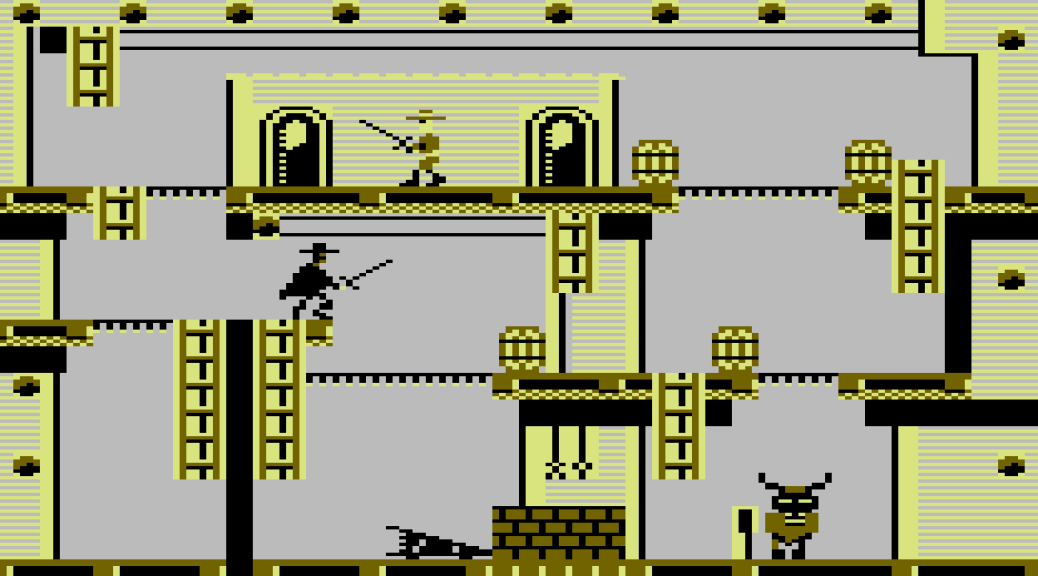
Zorro (Spanish for ‘fox’) is an 8-bit platform game developed by Datasoft and published by US Gold in 1985. It was written by James Garon, with graphics by Kelly Day, and is based on a fictional character created by American writer Johnston McCulley.
Tag Archives: puzzles
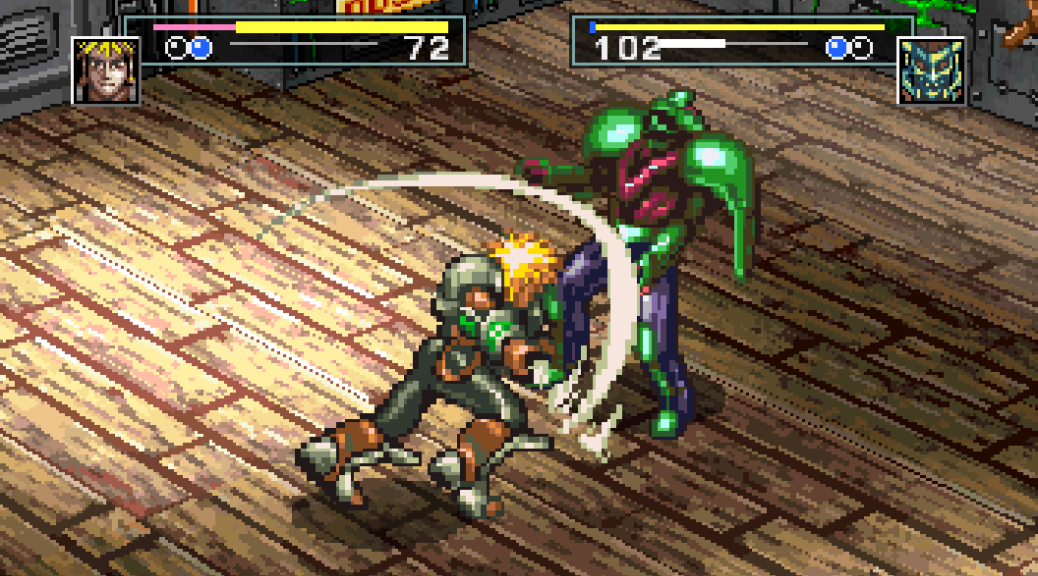
Dark Savior, Sega Saturn
Dark Savior is an isometric action game developed by Climax Entertainment and published by Sega for the Saturn in 1996. In my opinion the game is a bad idea, badly translated, poorly executed, and with some pretty awful story-telling.

Hydrofool, ZX Spectrum
Hydrofool was developed by Gargoyle Games and published by Faster Than Light in 1987. It’s the sequel to Sweevo’s World which was released in 1986.

Sweevo’s World, ZX Spectrum
Sweevo’s World is an isometric adventure/puzzle game developed and published by Gargoyle Games in 1986. The initial release was for 48K Spectrums although an enhanced version for the Spectrum 128K, called Sweevo’s Whirled, was also released later.
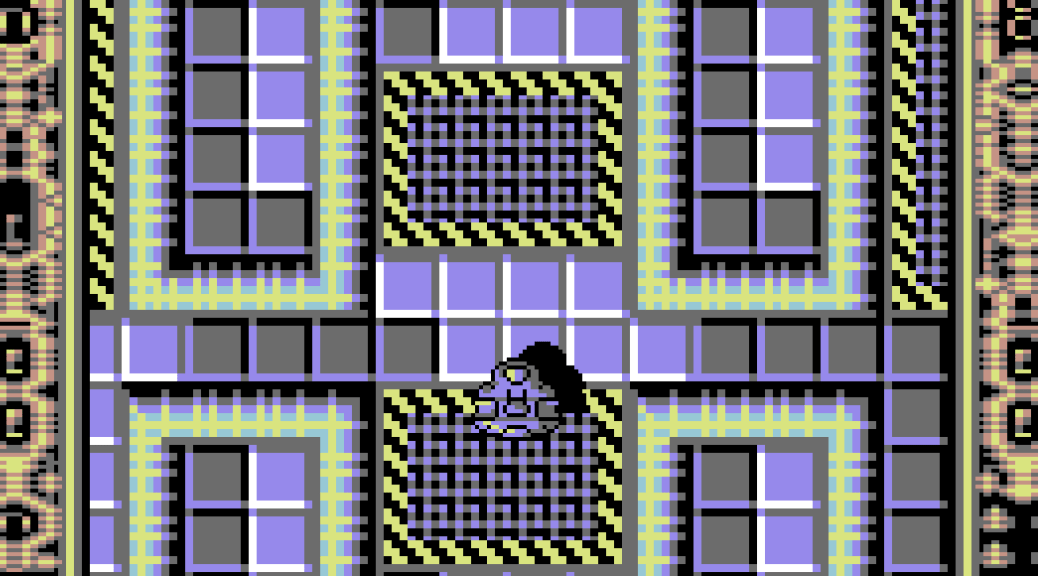
Snare, Commodore 64
Snare is a game show of the future where the contestant puts their life at risk trying to crack the secrets of a deadly maze inside the temporal cavity of a dead billionaire’s garden. The game was written by Rob Stevens and was first published by Thalamus in 1989.

Ranarama, ZX Spectrum
Steve Turner‘s classic Ranarama originated on the ZX Spectrum in 1987. The game is an overhead Gauntlet derivative where you play as a frog (actually a wizard’s apprentice, called Mervyn, whose botched spell has turned him into a frog), who must fight his way through various levels of a maze, defeating warlocks and taking their runes.

Half-Life 2: Episode Two, PC
The second episodic chapter in the Half-Life 2 series is arguably the best of the adventures of Gordon Freeman, and maybe even one of the best games of all-time. Half-Life 2: Episode Two was first released by Valve in 2007.

Half-Life, PlayStation 2
This conversion of the classic PC game, Half-Life, to the PlayStation 2 was handled by Gearbox Software and it features the main single-player game, Half-Life: Decay (a cooperative multiplayer version of the main game), and a head-to-head deathmatch component that uses split screen. It was first published by Sierra On-line in 2001.

Half-Life, PC
Half-Life is a classic first-person shooter (FPS) that is regarded as one of the best video games ever made. It was Valve‘s first game and was first published in 1998 by Sierra On-line. Half-Life came out at a time when the market was becoming saturated by FPSes, and it completely changed the way video games were made by developers – and were perceived by the general public.

Fade to Black, PlayStation
Fade To Black is a 3D action adventure game developed by Delphine Software and published for the PlayStation by Electronic Arts in 1996 (the MS-DOS version came out earlier, in 1995). It is the sequel to the classic 1992 platform game, Flashback.

