
It might look like an outdated pile of crap by today’s standards but Addictive Software‘s 1982 game, Football Manager, was a massive hit on the ZX Spectrum at the time.
Monthly Archives: March 2022
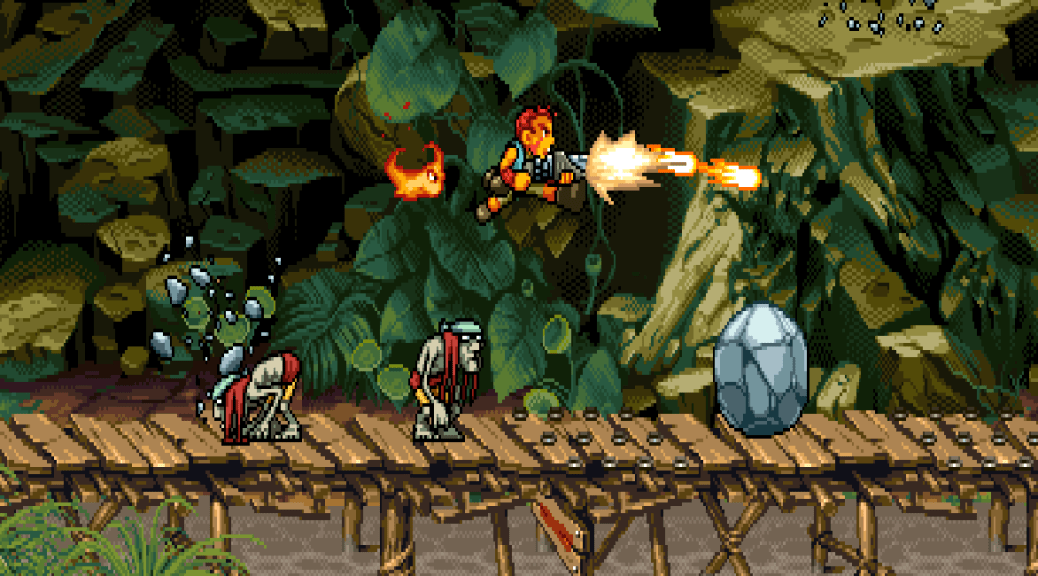
Demon Front, Arcade
Demon Front is a 2002 arcade game developed and manufactured by Taiwanese company International Games System. It is a scrolling run-and-gun shooter that is basically a shameless clone of Metal Slug, but with a few unique ideas of its own.
You can play either single player or two player simultaneous and can choose between four different characters at the start of the game. There are three different buttons on the arcade cabinet – shoot, jump, and shield – and the basic idea is to run left to right, blasting everything that gets in your way.

Orc Attack, Atari 8-bit
The classic Orc Attack was originally developed by Dean Lock for the Atari 8-bit family of home computers and published by Thorn EMI in 1983.
You play a guy defending a castle rampart from attacking orcs that are trying to climb up using ladders. The orcs plant the base of the ladder on the ground then bring in sections to raise it up, taking just three connected sections to reach the top. You must run and grab rocks, placed at either side of the battlement, to throw down at the attackers. If the attackers reach the top of the rampart the stones temporarily turn into swords, which you must grab to hack down the invaders that are threatening your castle. When a round is complete you can throw burning oil onto them to torch the remainder.

The Kristal, Amiga
The Kristal is an obscure British adventure game based on an un-produced theatre play written in 1976 (called “The Kristal of Konos“), developed by Fissionchip Software and published by Addictive Games in Europe and Cinemaware in North America. The fact that Cinemaware picked up The Kristal for distribution in the US and Canada is a surprise in itself, as that kind of thing didn’t happen very often back in 1989 when this game was first released.

Jackie Chan’s Action Kung Fu, PC Engine
Jackie Chan’s Action Kung Fu is a scrolling beat ’em up with platforming elements, first released for the NES by Hudson Soft in 1990, and was later released for the PC Engine in 1991.
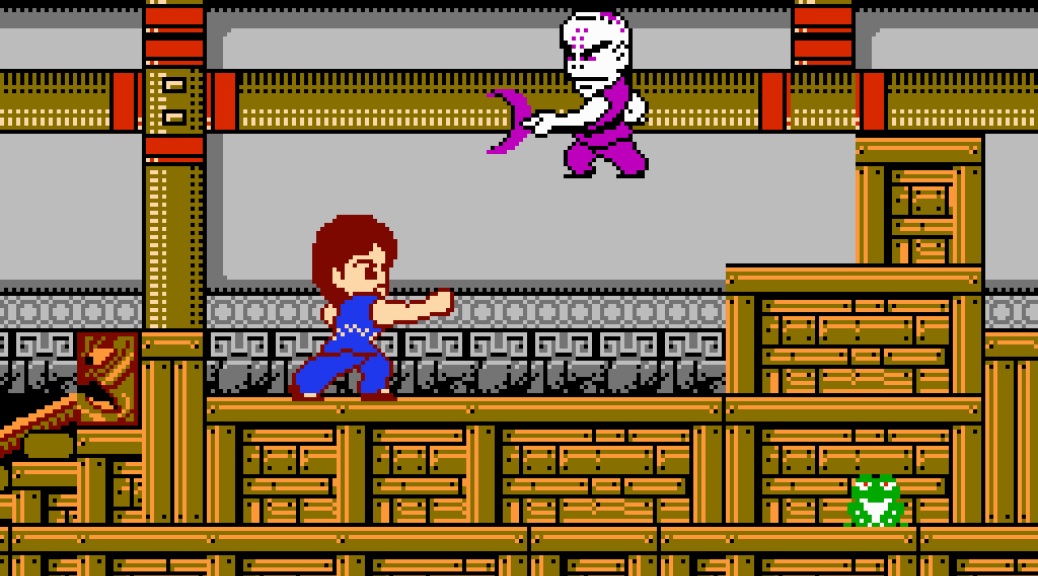
Jackie Chan’s Action Kung Fu, NES
The Famicom/NES version of Jackie Chan’s Action Kung Fu was developed by Now Production (who made Splatterhouse: Wanpaku Graffiti and Splatterhouse 3, among others) and was published by Hudson Soft in 1990. It’s a side-scrolling beat ’em up with platforming elements based around the famous movie actor Jackie Chan.

Pitfall II: Lost Caverns, Atari 8-bit
This Atari 8-bit conversion of David Crane‘s classic Atari 2600 platform game is subtitled the “Adventurer’s Edition” because it contains a whole new second level that becomes available after you complete the first.

Pitfall II: Lost Caverns, Atari 2600
Activision‘s 1984 sequel to Pitfall! – Pitfall II: Lost Caverns – was again designed and programmed by David Crane. This time, though, the cartridge had a custom display processor chip inside, which allowed for improved visuals and continuous four channel music (the Atari 2600 is normally only capable of two channel sound).
Gameplay is similar to Pitfall!, although in this follow-up the world you can explore is much bigger than previously and is made up of eight screens in width, by 27 screens in height, making 216 screens in total. When you walk from one screen to another the new screen scrolls smoothly into view.

SimCity, Commodore 64
This classic city-building game was originally devised by creator Will Wright while he was working on the classic C64 shooter, Raid On Bungeling Bay. Wright found that he enjoyed making the overhead cities for the game – using his self-made editor – more than he enjoyed playing the game itself, so he set to work creating a game that would allow players to do the same.
SimCity was originally developed for the Commodore 64 and was initially released for that system in August of 1989, but was quickly ported to pretty much every video gaming system known to man at the time. It also spawned a long-running series, and provided a strong base from which developer/publisher Maxis would grow – specialising in “sim“-type games that would become its main market for decades to come.

Microcosm, Amiga CD32
Microcosm was much-hyped upon release in 1993, but in essence is a very limited ‘rail shooter’ set inside a human body – with pre-rendered video sequences used to depict the third-person viewpoint.
The game was originally developed by Psygnosis for the FM Towns, with some investment from Fujitsu, and was later ported to MS-DOS, the Sega Mega-CD, the 3DO, and the Amiga CD32.
 The King of Grabs