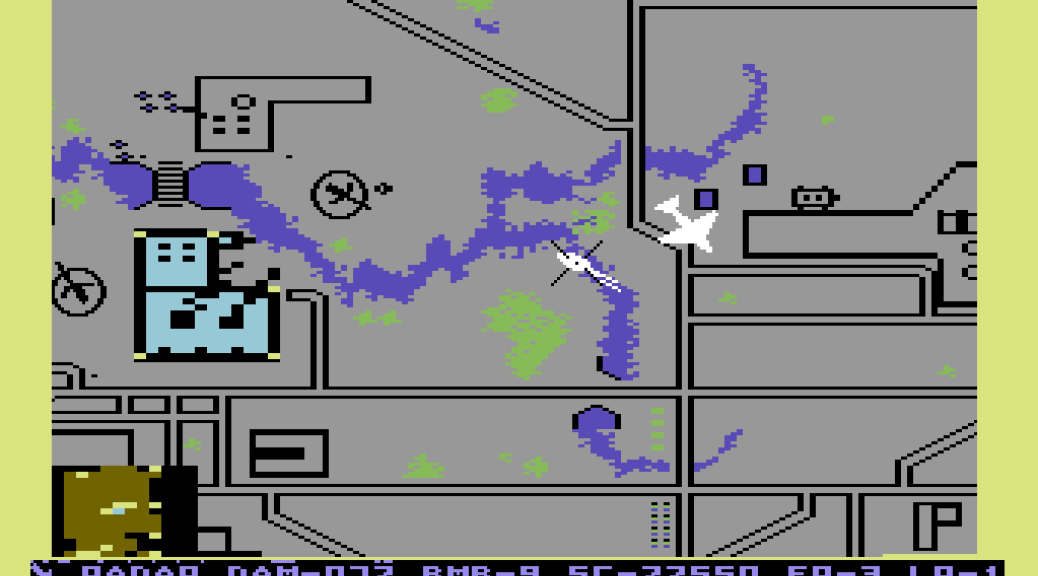
Raid on Bungeling Bay was Will Wright‘s first ever video game and it was released for the Commodore 64 by Brøderbund in 1984. Will Wright – in case you didn’t know – was a co-founder of Maxis and also designer of SimCity and The Sims.
Tag Archives: scrolling

Offendron Warrior, PC
Offendron Warrior is a superb retro gaming tribute to Eugene Jarvis‘s arcade classic Defender, using modern pixels and effects, by talented and prolific Korean Hijong Park. It’s currently available for free or donationware on Steam.
If you don’t know Defender – look it up, then go play it. Then come back and continue reading this.

Rolling Bird, PC
Rolling Bird is a modern tribute to the classic arcade game Rolling Thunder.
Graphically it looks a bit like an NES game, or an old arcade game. The colours are bold and the animation simple, but still excellent.

Tales of Phantasia, Game Boy Advance
This 2003 remake of Namco‘s SNES classic Tales of Phantasia was the first time the game had been officially translated into English.
While much of the game remains the same, there are a few differences.

Tales of Phantasia, Super Nintendo
Tales of Phantasia is an RPG developed by Wolf Team, and first published for the Super Nintendo by Namco in 1995. As JRPGs go, it is quite memorable.

Secret of Mana, Super Nintendo
Although many people seem to dismiss Secret of Mana (known in its native Japan as Seiken Densetsu 2) – at least when compared to its superior sequel – it does still have quite a bit going for it.

Desert Falcon, Atari 7800
Desert Falcon is an obscure isometric shooter with an Egyptian theme, released exclusively for the Atari 7800 in 1987.
You play as a falcon, flying diagonally over the landscape, shooting stuff as you go, in a way similar to that seen in Sega‘s classic coin-op, Zaxxon.

Super Mario Bros. 3, NES
Of the three Super Mario Bros. games released for the Nintendo Entertainment System, this 1988 release must surely rate as the best.

Super Mario Bros. 2, NES
The North American release of Super Mario Bros. 2 was controversial because it was not the same Super Mario Bros. 2 that was released in Japan – it was a re-skinned game; made into a Mario game, because the Nintendo bigwigs thought the original was too difficult for western gamers.

Super Mario Bros. 2, Famicom Disk System
Super Mario Bros. 2 was initially released on the Famicom Disk System in Japan in 1986, but was not released in North America or Europe in its original form, as you might have expected. It was instead decided that the gameplay was “too difficult” for Western gamers (and also the video games market in North America was undergoing a crash at the time), so Nintendo decided not to release it in English language territories – at least until it was later re-branded as Super Mario Bros.: The Lost levels – and released a different Super Mario Bros.2 in North America instead.
 The King of Grabs