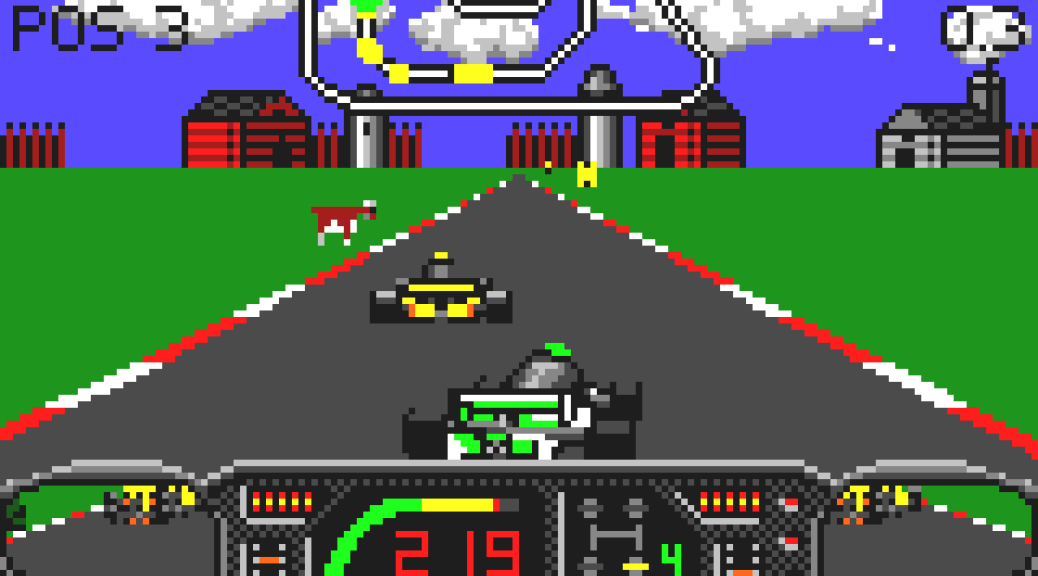
Checkered Flag is a “formula-style” racing game, initially released by Atari Corporation for the Atari Lynx in 1991.
Tag Archives: 2D graphics
Flat, two-dimensional graphics, usually constructed of pixels. Not three-dimensional.

Halloween, Atari 2600
Halloween on the Atari 2600 is another “classic” horror movie license [that was sarcasm, by the way], developed by VSS, Inc. and published by Wizard Video Games in 1983. It is based on John Carpenter‘s classic 1978 film of the same name, and in it you play as a babysitter, trying to save children from the unstoppable murderer, Michael Myers.
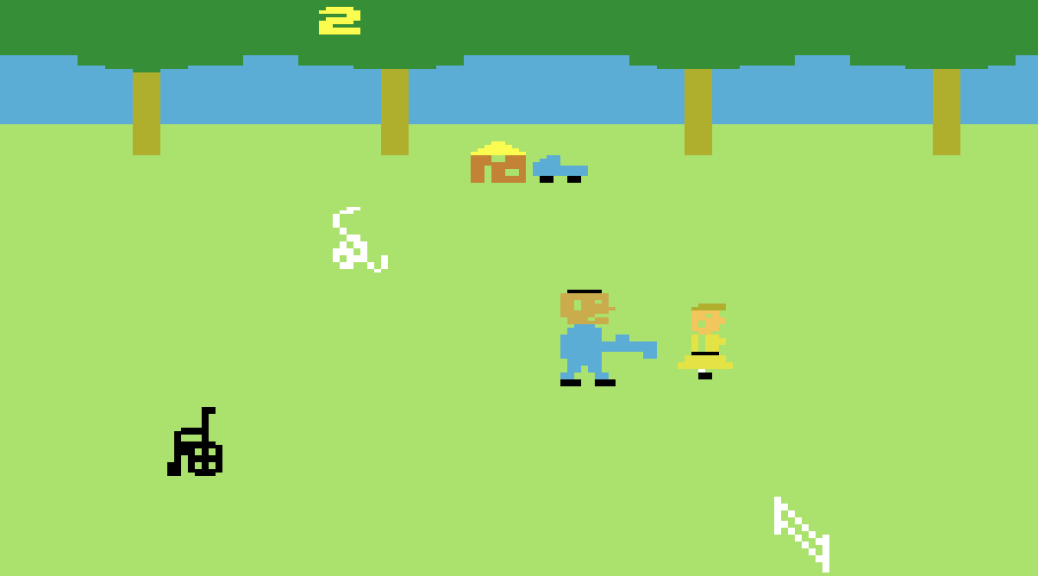
The Texas Chain Saw Massacre, Atari 2600
Developed by VSS, Inc. (of Texas), and published by Wizard Video Games in 1983, the Atari 2600 version of The Texas Chain Saw Massacre* is a travesty of a video game, and a perfect example of the kind of careless rubbish being released to market that triggered the North American video game market crash of the mid-Eighties.
*= The correct title of Tobe Hooper‘s classic 1973 film is “The Texas Chain Saw Massacre” (note the words “Chain” and “Saw” are separate), and NOT “The Texas Chainsaw Massacre“. Wizard Video Games got the title wrong, so I’m sticking with the correct title for the film, rather than bastardising it incorrectly, like they did.

RoboCop, Commodore 64
The Commodore 64 version of RoboCop was first released by Ocean Software in 1988, and it is well-presented, but does have one major fault that I find completely puzzling…

Crime Wave, Atari ST
Crime Wave is a side-scrolling run-and-gun shooter, developed by The Code Monkeys for Access Software and first published in 1990. It is reminiscent of the 1989 arcade game, Narc, and could in fact be described as a clone of that game.

Crime Wave, PC
Developed and published by Access Software in 1990, Crime Wave is a side-scrolling run-and-gun shooter for MS-DOS that uses digitised graphics for the backgrounds, sprites, and cut scenes. Crime Wave – it has to be said – looks and plays like a clone of Williams Electronics‘ 1989 arcade game, Narc, which it almost certainly is.

Commando, Intellivision
I’ve been wanting to add the Intellivision version of Commando for some time now, but every time I tried to play it, I could never get the controls to work properly. Until now…

Gauntlet 4, Megadrive/Genesis
Gauntlet 4 (aka Gauntlet IV) was developed by M2 and published by Tengen in 1993, exclusively for the Megadrive/Genesis. In some respects the development of this game is just as interesting as the game itself.
Gauntlet 4 began life as a homebrew remake of Gauntlet, among a small group of friends in Japan, for the Sharp X68000 home computer. Atari Games, the developer of the original Gauntlet, eventually caught wind of the project and commissioned the group (now named M2) to produce a sequel instead.

Gauntlet III: The Final Quest, Amiga
Developed by Software Creations and published by US Gold in 1991, Gauntlet III: The Final Quest is a home computer-only sequel to the classic arcade games, Gauntlet and Gauntlet II.

Gex: Enter the Gecko, 3DO
Gex: Enter the Gecko is a platform game developed by Crystal Dynamics and first released on the 3DO in 1995. In it, you play an agile gecko that can jump, whip with its tail, and walk on walls and ceilings.
 The King of Grabs