
The MSX version of Ultimate Play the Game‘s Gunfright is identical to the Spectrum original, except for the lack of a loading screen. It was initially released in 1986.
Tag Archives: 1986

Gunfright, Amstrad CPC
The Amstrad CPC received a conversion of Ultimate Play the Game‘s Filmation II game Gunfright in 1986 and it unfortunately suffers from the same problems that the previous Amstrad Filmation II conversion (Nightshade) did, namely: colour issues and slowdown problems.
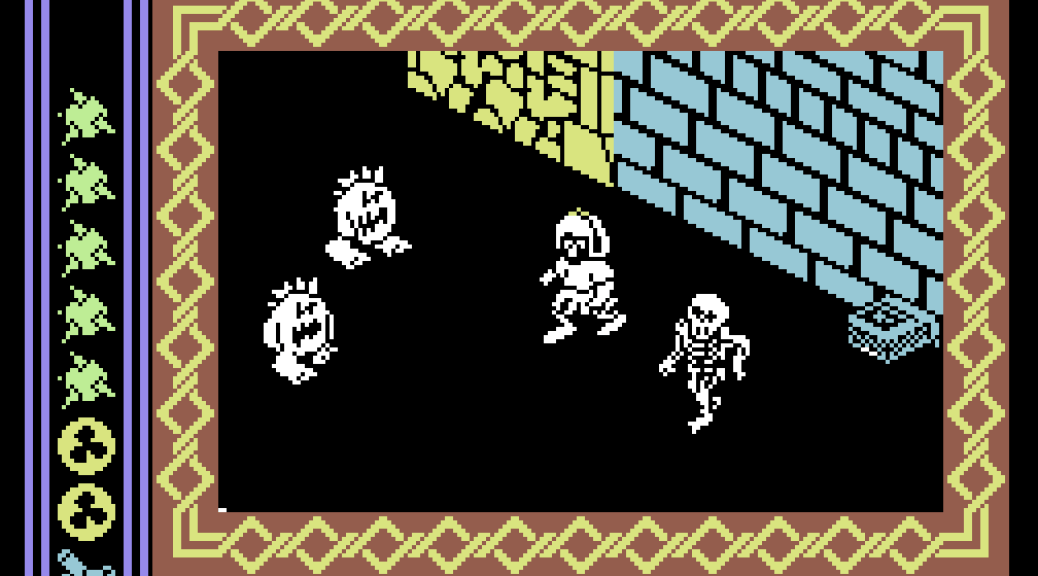
Nightshade, Commodore 64
The Commodore 64 conversion of Nightshade was coded by Shahid Ahmad and published by Firebird in 1986. It is a reasonable, if slower, version of the original game from Ultimate. What is more interesting, though, is the enhanced version, released by Nostalgia in 2016.

Secret Commando, Sega Master System
Known in North America as “Rambo: First Blood Part II” (complete with movie licensed characters), and “Ashura” in Japan. Also known as: “Not-So-Secret Commando“, since this is an unsubtle clone of Capcom‘s classic 1985 arcade game, Commando (and SNK‘s 1986 game, Ikari Warriors – since it has a simultaneous two-player mode and level designs that echo that game). Joking aside: it’s a pretty good clone of Commando, although it does play rather slowly.

Ghosts ‘N Goblins, Commodore 64
This 1986 Commodore 64 conversion of Capcom‘s classic Ghosts ‘N Goblins was programmed by Chris Butler. Chris also created the graphics, which are pretty good overall, if a little spartan in places. Mark Cooksey created the music.

Infiltrator, Atari 8-bit
Infiltrator is a classic helicopter action game designed and programmed by Chris Gray and published in 1986 by US Gold (in Europe) and Mindscape (everywhere else).
The aim is to fly a chopper (called the Gizmo DHX-3) to an enemy compound, then infiltrate the base on one of three separate missions. Each mission is split into two halves: a first-person flying game, then an isometric stealth/exploration game.

Gradius, MSX
Gradius – also known as Nemesis in some regions – was one of the first progressive weapons shooters to come out in arcades, and it was a big hit in 1985 when it was first released.
This led to the game being converted to many home computer systems, including the MSX, which was programmed by Konami themselves. So the game is unsurprisingly very good; very authentic, and with graphics and gameplay that push the MSX quite hard (I wouldn’t say “to its limits”, because I’m not a marketing a-hole, but it does push first-generation MSXes a fair degree).

Wonder Boy, Arcade
Developed by Escape (who would later become Westone), Wonder Boy is a straightforward run-and-jump-left-to-right-to-reach-the-goal platform game featuring a blonde-haired, semi-naked cave-boy who is trying to rescue his girlfriend, Tina, from the clutches of the “The Dark King”.

Slap Fight, Arcade
Slap Fight is a vertically-scrolling, progressive weapons shoot ’em up developed by Toaplan and manufactured by Taito 1986. It’s also known as “Alcon” in the US.

The Lord of the Rings, ZX Spectrum
Developed by Beam Software and published by Melbourne House in 1986, The Lord of the Rings is a text adventure game made by essentially the same team who created the classic Spectrum text adventure, The Hobbit.
Was it the first official Lord of the Rings game ever made? Possibly. There were definitely many unofficial Lord of the Rings rip-off games on the market before this, but this is arguably the first properly-licensed Lord of the Rings game for home computers.
 The King of Grabs