
The second episodic chapter in the Half-Life 2 series is arguably the best of the adventures of Gordon Freeman, and maybe even one of the best games of all-time. Half-Life 2: Episode Two was first released by Valve in 2007.
Tag Archives: pioneering

Half-Life 2: Episode One, PC
The first sequel to the classic Half-Life 2 takes the form of an episodic chapter in the adventures of Gordon Freeman. It carries on directly from the end of Half-Life 2, with Gordon and Alyx actually going back into the crumbling Citadel to try to stop the reactor from exploding. Half-Life 2: Episode One was first released in 2006.

Half-Life, PlayStation 2
This conversion of the classic PC game, Half-Life, to the PlayStation 2 was handled by Gearbox Software and it features the main single-player game, Half-Life: Decay (a cooperative multiplayer version of the main game), and a head-to-head deathmatch component that uses split screen. It was first published by Sierra On-line in 2001.

Half-Life, PC
Half-Life is a classic first-person shooter (FPS) that is regarded as one of the best video games ever made. It was Valve‘s first game and was first published in 1998 by Sierra On-line. Half-Life came out at a time when the market was becoming saturated by FPSes, and it completely changed the way video games were made by developers – and were perceived by the general public.

Syndicate, PC
Syndicate is a classic isometric action game with point-and-click gameplay. It was developed by Bullfrog Productions and published by Electronic Arts in 1993.

Rogue, Atari 8-bit
I was hoping that the Atari 8-bit version of Rogue might be better than the other 8-bit versions (or at least a balance between the awful C64 version and the half-decent Amstrad version), but I was hoping for too much – especially as it’s another Mastertronic “special” (ie. a good example of a publisher not giving a sh*t about what they released).
Rogue, Amstrad CPC
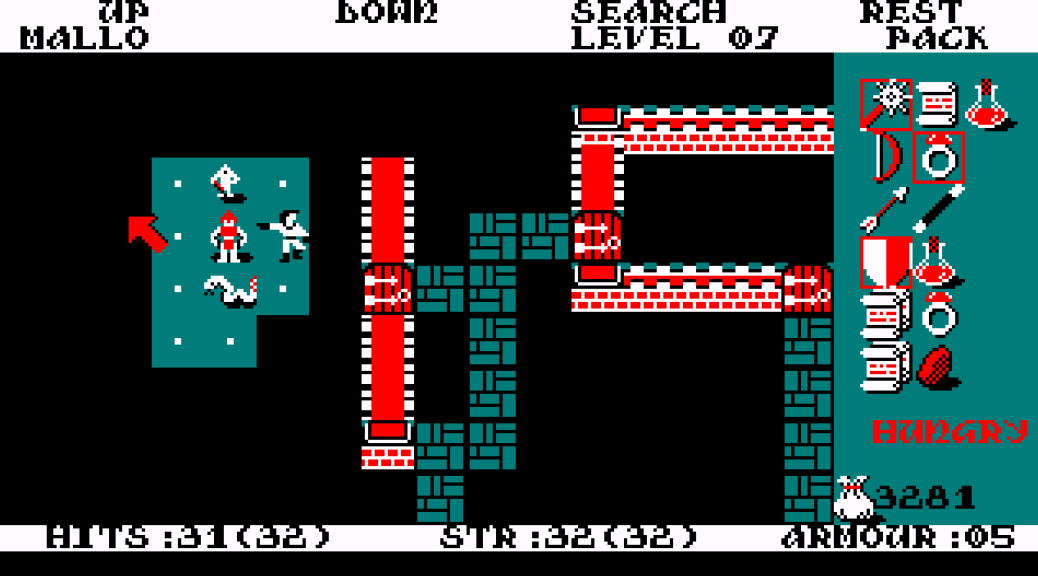
The Amstrad CPC version of Rogue is arguably the best of the 8-bit conversions from Mastertronic, although it’s not without its problems. It was developed by Icon Design and first published in 1988.

Rogue, ZX Spectrum
Rogue on the ZX Spectrum was developed by Icon Design and published by Mastertronic Added Diminsion in 1988. And it’s a pretty poor conversion of the classic dungeon-crawler.

Rogue, Commodore 64
The Commodore 64 conversion of Rogue was developed by Icon Design and published by Mastertronic in 1988, and it is a bugged, incomplete, and un-finishable version of the game that demonstrates the utter contempt for which Mastertronic held for both the game, and for gamers who paid money for it.

Rogue, Atari ST
The Atari ST version of the classic dungeon-crawler, Rogue, is arguably the best conversion of the game out there. It was developed by A.I. Design and published by Epyx in 1986 and combines the best bits from the original with new graphics and a few new features of its own.
 The King of Grabs