
Blue Print is a strange arcade maze game developed by Ashby Computers and Graphics (A.C.G.). It was licensed to Bally Midway in North American and European markets, and Jaleco in Japan, in 1982. A.C.G. would later became famous for their Ultimate Play the Game home computer games (Atic Atac, Sabre Wulf, Knight Lore, et cetera), and became even more famous as Rare (Goldeneye, Perfect Dark, et cetera).
Tag Archives: 2D graphics
Flat, two-dimensional graphics, usually constructed of pixels. Not three-dimensional.

Ghosts ‘N Goblins Arcade, Commodore 64
Ghosts ‘N Goblins Arcade is another 2015 release from Nostalgia that re-makes the original (flawed) Elite port of Ghosts ‘N Goblins, and it features completely new graphics, sound, and gameplay features that bring it more into line with the original Ghosts ‘N Goblins arcade game.

Ghosts ‘N Goblins, Commodore 64
This 1986 Commodore 64 conversion of Capcom‘s classic Ghosts ‘N Goblins was programmed by Chris Butler. Chris also created the graphics, which are pretty good overall, if a little spartan in places. Mark Cooksey created the music.

Commando Arcade, Commodore 64
Created by Nostalgia in 2015, Commando Arcade is a reworking of the original C64 Commando port by Elite, but with completely new graphics, sound, and levels. So, rather than it being written from scratch, the game was built around the framework of an existing game.
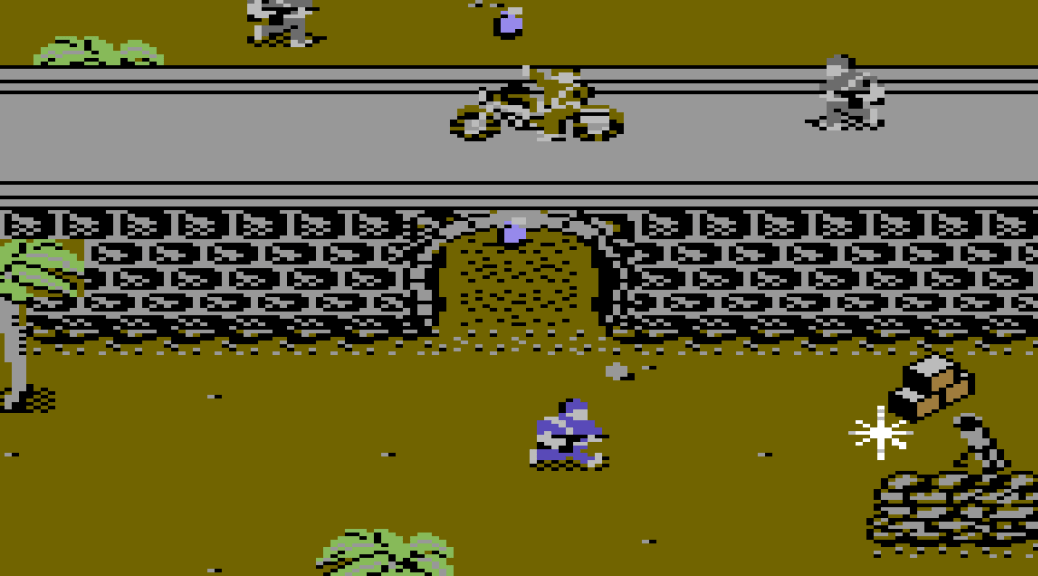
Commando, Commodore 64
Programmed by Chris Butler, with graphics by Rory Green and Chris Harvey, and music by Rob Hubbard, the Commodore 64 conversion of Capcom‘s arcade game Commando is considered to be a classic 8-bit game, even though it was put together very quickly (ie. rushed-out) by publisher Elite Systems.
After acquiring the official license they wanted it out in time for Christmas 1985, which gave the coders around four months to make the game. As a result Commando on home computer systems was a cut-down version of the arcade game, with fewer levels than the original and somewhat bare-bones graphics.

Astroclone, ZX Spectrum
This 1985 release from Hewson Consultants is basically a futuristic variation of the classic Avalon/Dragontorc games by Steve Turner. It uses similar presentation and game mechanics to those games, with a central character moving around pseudo 3D rooms, exploring and solving puzzles.

Wario: Master of Disguise, Nintendo DS
Wario: Master of Disguise was developed by Suzak and published for the Nintendo DS by Nintendo in 2007. It utilises dual screens (of course), and also requires use of the DS touchscreen when playing.

Wario Land 4, Game Boy Advance
The fourth game in the Wario Land series (after Wario Land, Wario Land II, and Wario Land 3) is arguably the best one at this point, having been released for the Nintendo Game Boy Advance in 2001.
All three of the previous games were fun, varied, and beautifully-designed, but the enhanced graphics and power of the Game Boy Advance definitely gives this the edge over its predecessors.

Wario Land 3, Game Boy Color
Wario Land 3 is the sequel to Wario Land II and was developed and published for the Game Boy Color by Nintendo in 2000. It once again features Mario‘s rival, Wario, doing what he does best: shoulder-barging things and cheekily going about his destructive platform business.

Wario Land II, Game Boy Color
The follow-up to Wario Land: Super Mario Land 3 on the Game Boy is this 1998 release for the Game Boy and Game Boy Color.
Wario Land II was initially released for the black and white Game Boy, but was re-released for the Game Boy Color six months after its initial release and it is the Game Boy Color version that I’m focusing on here (because it looks much better in colour than in monochrome).
 The King of Grabs