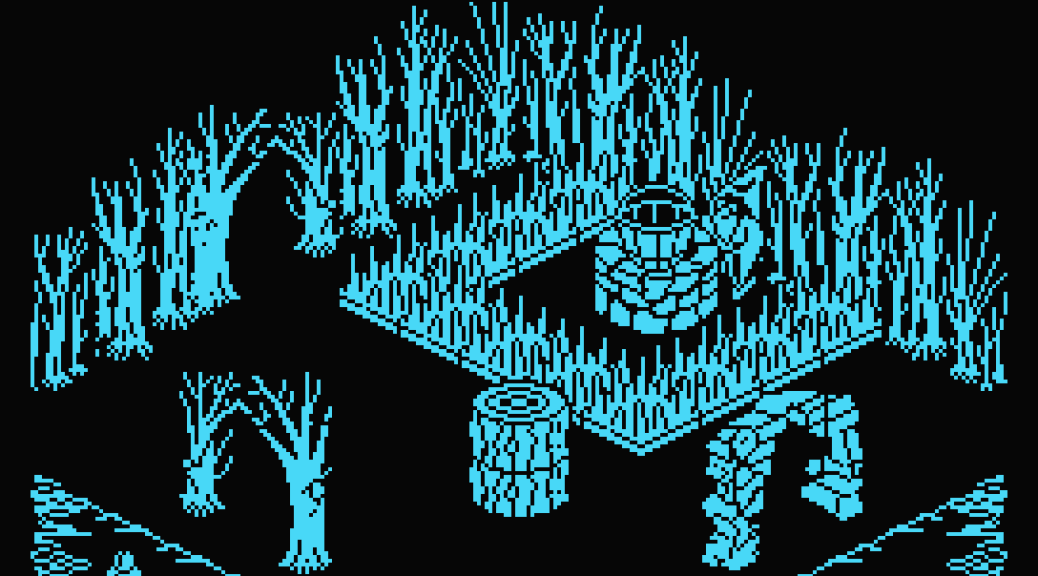
Pentagram was released for the MSX in 1986, and it’s not really an Ultimate game, in truth, because it wasn’t written by the original Ultimate team; it’s a US Gold game. It’s not a bad game, though, even though it doesn’t have the flair or humour of an authentic Ultimate game.
Tag Archives: items
Alien 8 MSX2 Remake, MSX
This 2009 homebrew remake of Ultimate Play the Game‘s classic Alien 8 was created for the MSX2 by Manuel Pazos and Daniel Celemin. The graphics have obviously had a serious make-over and look beautiful, but the gameplay seems to be the same as the original, with noticeable (some might say “game-crippling”) slowdown.
Alien 8, Atari 8-bit
This Atari 8-bit homebrew conversion of Ultimate Play the Game‘s Alien 8 was created by Fandal, Miker, and Emkay in 2013. It wasn’t written from scratch, though; it was ported from the BBC Micro version (according to various sources online), but unfortunately it doesn’t play as well as the Beeb version. It has a fundamental flaw that completely ruins the game…
Alien 8, Commodore 64
This homebrew conversion of Ultimate‘s classic Alien 8 was released for the Commodore 64 in 2020. The original game was only ever officially released for the ZX Spectrum, BBC Micro, MSX, and Amstrad CPC, but never for the C64. And the ironic thing is that this conversion is arguably the best version of Alien 8 out there.
Alien 8, BBC Micro
Alien 8 is a classic isometric platform puzzle game that was released by Ultimate Play the Game on four formats – ZX Spectrum (the original), BBC Micro, Amstrad CPC, and MSX.
The BBC Micro conversion of Alien 8 has responsive controls and runs slightly faster than the original Spectrum version. It still suffers from slowdown when there are a number of moving objects on screen at once.
Knight Lore, Commodore 64
This 2019 Commodore 64 homebrew conversion of the classic Knight Lore is arguably even better than the brilliant ZX Spectrum original. Spectrum owners will not want to hear that, but – being objective – this port does make the game more enjoyable to play. I also managed to get further into the game than I ever managed on the Spectrum, although I did use quick saves (but no cheats).
Pokémon XD: Gale of Darkness, GameCube
Pokémon XD: Gale of Darkness is the successor to Pokémon Colosseum and is another third-generation spin-off from the main Pokémon series. It was developed by Genius Sonority and published by The Pokémon Company exclusively for the Nintendo GameCube in 2005.
Pokémon Colosseum, GameCube
Pokémon Colosseum was developed by Genius Sonority and published by The Pokémon Company in 2003 in Japan and 2004 everywhere else. It is not considered part of the main Pokémon series, but is a third-generation spin-off made exclusively for the Nintendo GameCube.
Emerald Dragon, Super Nintendo
Emerald Dragon is a Japan-only RPG that was developed by Alfa System and published by MediaWorks for the Super Nintendo in 1995. It was given an English fan translation (by Translation Corporation) in 2014, which is great because it is an excellent game!
Pokémon Gold Version, Game Boy Color
Pokémon Gold and Silver Versions were developed by Game Freak and published by Nintendo in 1999 in Japan and 2000 everywhere else. They are ‘second generation’ Pokémon games and were released simultaneously as twin titles, as has become the norm with Pokémon games.
These were the first proper, full-colour Pokémon games, with graphics that have been created to take advantage of the Game Boy Color‘s extended palette (Pokémon Yellow, which preceded this game, didn’t really do that; the graphics were simply colourised from the black and white originals). And you can tell from the very beginning that the visuals in Gold/Silver are a step-up from what we saw previously.