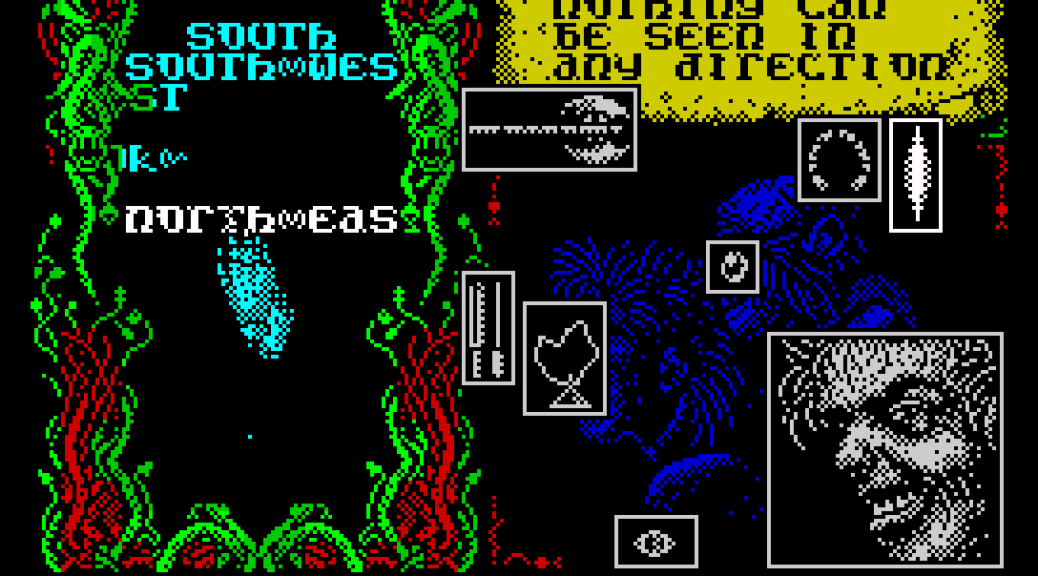
The sequel to the classic Amstrad adventure, Get Dexter, is more of the same isometric puzzle-solving, and weird futuristic adventuring, except that this time the game world is comprised of interlinked exterior screens rather than a simple maze of rooms.
Tag Archives: 8-bit
Get Dexter, Amstrad CPC
Get Dexter is an isometric action puzzle game originally released for the Amstrad CPC in 1986. It was programmed by Remi Herbulot with graphics by Michel Rho. In its native France the game is known as “Crafton & Xunk“, which I always thought was a bizarre title for a video game.
Amstrad CPC Special
The Amstrad Colour Personal Computer (CPC) is a family of 8-bit home computers that were designed and manufactured by British company Amstrad (the infamous one led by Alan Sugar), and marketed as competition to the Commodore 64 and ZX Spectrum from 1984 onward.
Sorcery, ZX Spectrum
Martin Wheeler‘s 1984 Spectrum game, Sorcery, was a decent hit for publisher Virgin Games. Enough at least for Virgin to convert the game to various other systems, including for the Amstrad CPC, which is the better version.
Fred, ZX Spectrum
Written by famous Spanish software house Indescomp, Fred is a scrolling platform/maze game where you control a cartoon Indiana Jones-type character plundering treasures from an Egyptian tomb, while avoiding contact with ghosts and mummies.
Fred was first released in 1984. In its native Spain the game was published by Investronica, while in the UK and other parts of Europe the game was published by Quicksilva.
Moon Cresta, ZX Spectrum
The Spectrum conversion of Nichibutsu‘s classic 1980 arcade game Moon Cresta was published by Incentive Software in 1985 and it is considered to be very good, considering the machine’s limitations.
Jumpman Junior, Atari 8-bit
Jumpman Junior is the Atari 8-bit cartridge version of Randy Glover‘s classic 8-bit platform game, Jumpman. It was first published by Epyx in 1983.
Since the game came on cartridge the number of levels has been reduced, down to 12, but they are at least all-new levels and not recycled levels from the disk version.
Deathchase XE, Atari 8-bit
Based on the classic 1983 ZX Spectrum game by Mervyn Escourt, Deathchase XE is an Atari 8-bit remake first released in 2013. It is a first-person bike shooting game where the aim is to speed through a forest full of trees, shooting enemy bikers, helicopters and tanks, while at the same time avoiding collisions with arboreal obstacles that come zooming towards you.
Orc Attack, Atari 8-bit
The classic Orc Attack was originally developed by Dean Lock for the Atari 8-bit family of home computers and published by Thorn EMI in 1983.
You play a guy defending a castle rampart from attacking orcs that are trying to climb up using ladders. The orcs plant the base of the ladder on the ground then bring in sections to raise it up, taking just three connected sections to reach the top. You must run and grab rocks, placed at either side of the battlement, to throw down at the attackers. If the attackers reach the top of the rampart the stones temporarily turn into swords, which you must grab to hack down the invaders that are threatening your castle. When a round is complete you can throw burning oil onto them to torch the remainder.
SimCity, Commodore 64
This classic city-building game was originally devised by creator Will Wright while he was working on the classic C64 shooter, Raid On Bungeling Bay. Wright found that he enjoyed making the overhead cities for the game – using his self-made editor – more than he enjoyed playing the game itself, so he set to work creating a game that would allow players to do the same.
SimCity was originally developed for the Commodore 64 and was initially released for that system in August of 1989, but was quickly ported to pretty much every video gaming system known to man at the time. It also spawned a long-running series, and provided a strong base from which developer/publisher Maxis would grow – specialising in “sim“-type games that would become its main market for decades to come.