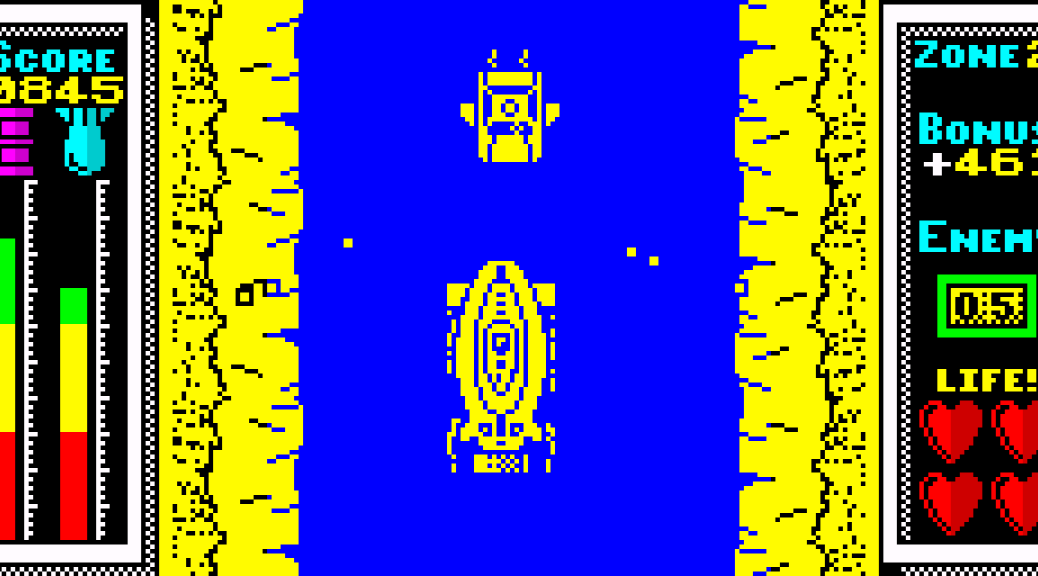
In Stainless Steel you are Ricky Steel – a teenage superhero with a flying car called ‘Nightwind‘ – on a mission to defeat the android troops built and controlled by the evil Dr. Vardos. What that basically means is that you have to drive/fly and shoot your way through a variety of overhead scrolling levels, collecting fuel to constantly top-up your ever-diminishing life bar and avoiding bullets like the plague.
Tag Archives: overhead

Strontium Dog: The Killing, ZX Spectrum
Quicksilva‘s second attempt at a Strontium Dog video game in 1984 – released the same year as the awful Death Gauntlet on the C64 – is only marginally better than their first attempt.
The Killing, on the ZX Spectrum, was written by Paul Hargreaves and once again sees you playing mutant bounty hunter Johnny Alpha, trying to survive a gauntlet of hostility on an alien planet. This time, though, he’s voluntarily participating in a contest where vicious murderers fight to the death for cash, in a tournament called “The Killing“.

Quedex, Commodore 64
Quedex is scrolling action game programmed by Stavros Fasoulas and published by Thalamus for the Commodore 64 in 1987.

Rogue, Atari 8-bit
I was hoping that the Atari 8-bit version of Rogue might be better than the other 8-bit versions (or at least a balance between the awful C64 version and the half-decent Amstrad version), but I was hoping for too much – especially as it’s another Mastertronic “special” (ie. a good example of a publisher not giving a sh*t about what they released).
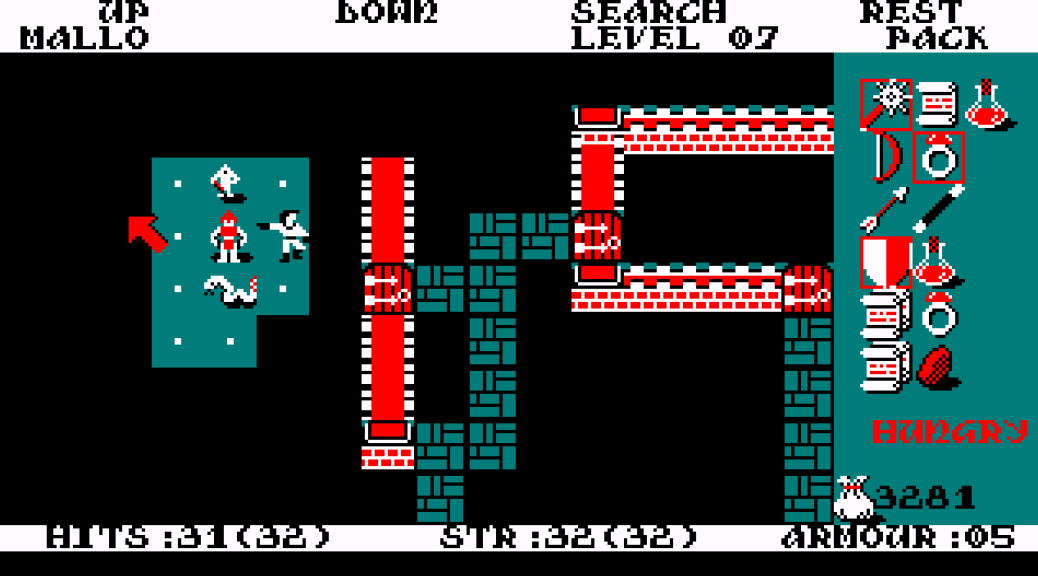
Rogue, Amstrad CPC
The Amstrad CPC version of Rogue is arguably the best of the 8-bit conversions from Mastertronic, although it’s not without its problems. It was developed by Icon Design and first published in 1988.

Rogue, ZX Spectrum
Rogue on the ZX Spectrum was developed by Icon Design and published by Mastertronic Added Diminsion in 1988. And it’s a pretty poor conversion of the classic dungeon-crawler.

Rogue, Commodore 64
The Commodore 64 conversion of Rogue was developed by Icon Design and published by Mastertronic in 1988, and it is a bugged, incomplete, and un-finishable version of the game that demonstrates the utter contempt for which Mastertronic held for both the game, and for gamers who paid money for it.

Rogue, Atari ST
The Atari ST version of the classic dungeon-crawler, Rogue, is arguably the best conversion of the game out there. It was developed by A.I. Design and published by Epyx in 1986 and combines the best bits from the original with new graphics and a few new features of its own.

Crusader of Centy, Megadrive/Genesis
Crusader of Centy is a Zelda-like action/adventure game developed by Nextech and published by Atlus in North America and Sega in Japan and Europe. The game was released in Japan first – in 1994 – and everywhere else in 1995. In Europe the game was re-named as “Soliel“.
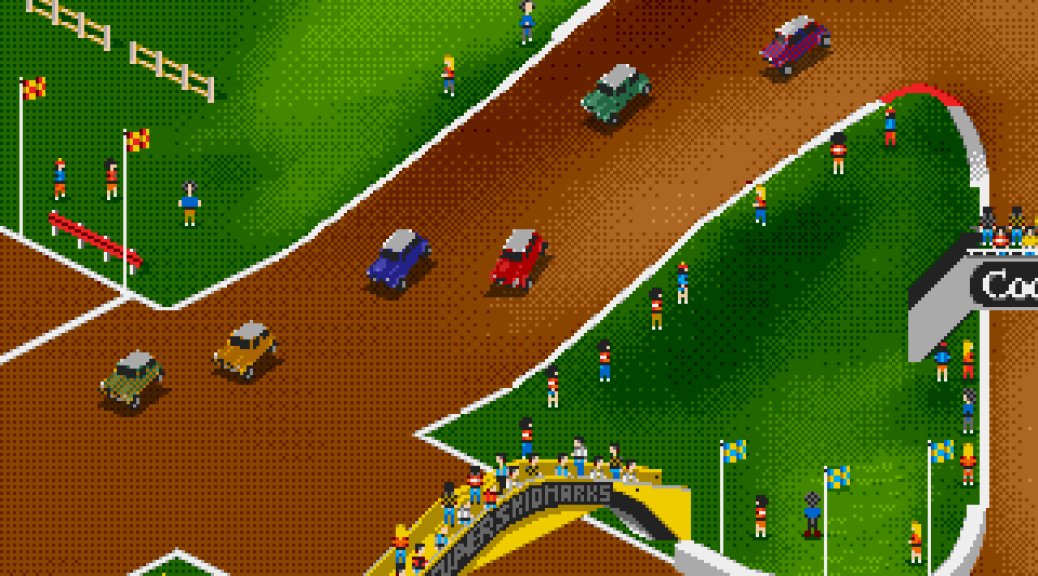
Super Skidmarks, Megadrive/Genesis
Super Skidmarks is an isometric racing game developed by New Zealand-based Acid Software and published by Codemasters for the Sega Megadrive/Genesis in 1995. It was originally released for the Amiga and Amiga CD32 and is the sequel to the 1993 game Skidmarks.

