
The PC Engine version of Salamander was first released by Konami in 1991, and it demonstrates why NEC‘s small-form console was so ahead of everything else at the time. It has great graphics and sound, smooth scrolling, large objects moving around the screen, very little sprite tearing, responsive controls, and a simultaneous two-player gameplay mode.
Tag Archives: lasers

Salamander, MSX
The MSX port of Konami‘s classic arcade shooter, Salamander, was first released in Japan – on cartridge – in 1987. And although it shares the name and certain elements from the arcade game, this is a completely new version of Salamander, with a new storyline, new characters, ships and levels. It is sometimes referred to as “Salamander: Operation X“.
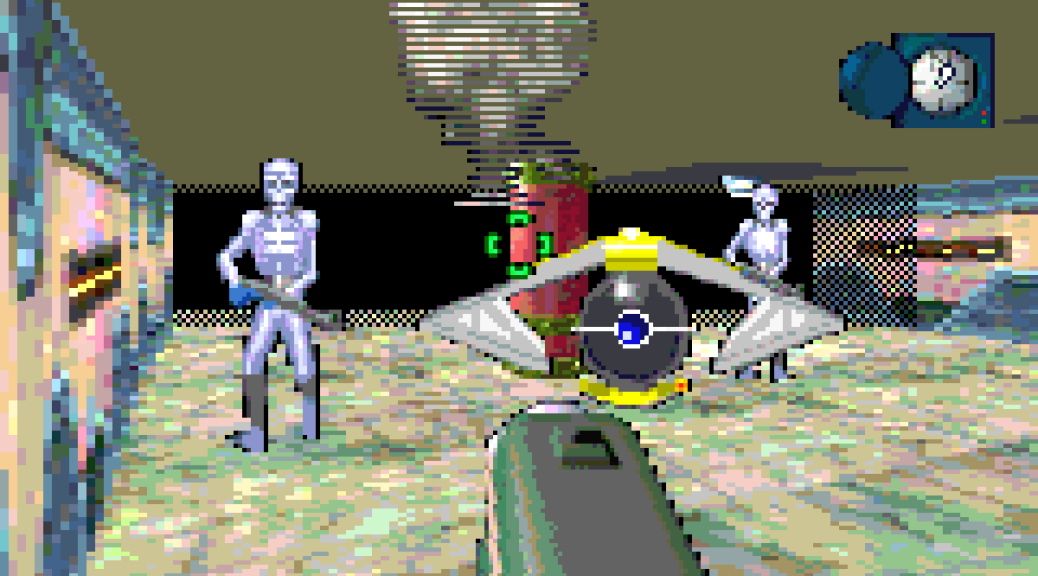
Back Track, Game Boy Advance
When I first played Back Track, my instincts screamed at me that this was a terrible game. The graphics are messy; the enemies look awful; the explosions have a really bad horizontal raster-style visual effect; health packs are called “Band-Aids“; the weapons are unimpressive; the draw distance is masked with a solid black shadow, which is disconcerting; the environments appear flat, empty and uninteresting, and the premise of the game – to rescue kidnapped humans from inside tubes – doesn’t seem very exciting. BUT… I persisted with it and found Back Track to actually be quite absorbing and challenging, when I eventually got into it.

Star Wars Episode I: Obi Wan’s Adventures, Game Boy Color
Developed by HotGen and published by THQ and LucasArts for the Game Boy Color in 2000, Star Wars Episode I: Obi Wan’s Adventures presents you with the opportunity to play as Obi Wan Kenobi, the young Jedi apprentice, during the events of Star Wars Episode I: The Phantom Menace.
Continue reading Star Wars Episode I: Obi Wan’s Adventures, Game Boy Color

Starglider, Apple II
The Apple II version of Argonaut Software‘s classic cockpit shooter, Starglider, was ported by Solid Image, the same developer who made the flawed C64 version. And – unsurprisingly – it retains all the flaws of the C64 version, and brings a few problems of its own to the party, just for good measure…

Starglider, PC
The 1987 PC MS-DOS version of Argonaut Software‘s classic 3D shooter, Starglider, was ported by Realtime Games Software, who did the excellent Amstrad and ZX Spectrum ports. Unfortunately, the game is available only with four-colour CGA graphics, which does diminish the look of the game significantly.

Starglider, Commodore 64
The Commodore 64 version of Starglider was ported by Solid Image and published by Rainbird in 1986. Unfortunately, the developers didn’t manage to convert Starglider‘s unique control method over to the C64 – instead they chose to use a fixed aiming reticule in the centre of the screen, and this results in a rather degraded gameplay experience.

Starglider, Amstrad CPC
The Amstrad CPC version of Argonaut Software‘s classic 3D shooter, Starglider, was developed by Realtime Games Software, who also coded the excellent ZX Spectrum version. It could be argued that it is even better than the Spectrum version, because it runs faster and also uses more colours in the polygons, although the game does have a smaller cockpit and play window than the Spectrum version.

Starglider, ZX Spectrum
The ZX Spectrum version of Argonaut‘s classic Starglider is actually surprisingly good. Or, rather: the 128K version is very good (the 48K version plays well enough, but it lacks the digitised speech and other enhancements, so is a little plain). And the main reason Starglider on the Speccy is respectable, is because it was converted by Realtime Games Software, who were pioneers in the field of Spectrum-based 3D games, having created the legendary Starstrike, Starstrike II and Carrier Command (among others).

Starglider, Amiga
Argonaut Software‘s Starglider, when it first came out, was a flashy release. It came in a big blue box, with a novella, a manual, and a single floppy disk. Magazines were raving about it, and I remember buying it… for the ZX Spectrum. LOL.
 The King of Grabs