
The fifth episode in the Dragon Slayer series – Sorcerian – was originally released in 1987 for the PC-88. The MSX2 version was ported by Tierheit and published – in Japan only – by Brother Industries (on their Takeru label) in 1991. A fan translation into English is available, but I did notice that there are still a few untranslated passages in the game.
Category Archives: MSX
MSX games.

Dragon Slayer IV: Draslay Family, MSX
Originally released in Japan as “Dragon Slayer IV: Drasle Family“, the version I’m showing here is the fan-translated MSX2 version of the fourth game in the Dragon Slayer series. The game was developed and published by Falcom in 1987, and the fan translation was released by “MSX Translations” in 2010 under the title of “Dragon Slayer IV: Draslay Family“.

Romancia: Dragon Slayer Jr., MSX
Romancia: Dragon Slayer Jr. is the third game in the Dragon Slayer series and was developed and published by Nihon Falcom in 1986. This game was designed to be “cute”, and more attractive to younger players (thus the “Jr.” suffix), and is therefore more simplistic than Xanadu, the previous Dragon Slayer game.

Xanadu: Dragon Slayer II, MSX
Xanadu: Dragon Slayer II (aka just “Xanadu“) is the 1987 sequel to 1984’s Dragon Slayer. It was developed and published by Falcom in Japan only, but the game is entirely in English so is playable by non-Japanese speakers/readers.
Xanadu is an action RPG that looks and plays similarly to Falcom‘s own Ys series, with side-scrolling town and dungeon sections and overhead, real-time combat taking place on a separate screen. Xanadu was a much bigger hit than its predecessor and was released in MSX and MSX2 versions.

Dragon Slayer, MSX
Although it may look extremely basic, Dragon Slayer is an important game in the development of Japanese Role-Playing Games. It is a real-time action/exploration game where you control a fighter who must collect gold, orbs, potions, and various other useful items, inside a scrolling maze that is crawling with deadly monsters.
Dragon Slayer was initially released in 1984 for the PC-8801, PC-9801, X1 and FM-7, and the MSX version followed in 1985, being ported and published by Square. It was, in fact, one of the earliest releases from Square.
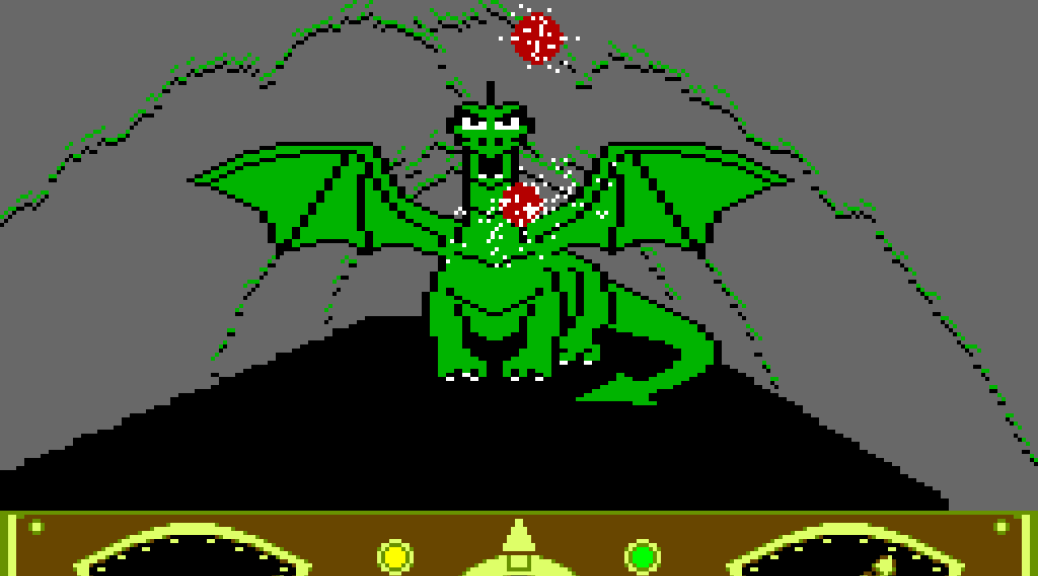
The Eidolon, MSX
The MSX version of Lucasfilm Games‘ The Eidolon was published in Japan only – on cartridge – by Pony Canyon in 1986, and it is on-par with the original Atari 8-bit and Commodore C64 originals of this classic cave exploration game.

H.E.R.O., MSX
The MSX version of John Van Ryzin‘s H.E.R.O. was ported by The Softworks and published by Activision in 1984.

Yellow Submarine, MSX
It’s not often you get a game that’s based on a Beatles song, and Yellow Submarine for the MSX is one such rare example. Published by Takeru in 1987 Yellow Submarine is of course not an official license and was slipped out to the Japanese MSX market – on cartridge – in the hope that no one at Apple Records would notice. If they did, it appears that nothing was done about it.

Yie Ar Kung-Fu 2: The Emperor Yie-Gah, MSX
The sequel to the classic Konami arcade game, Yie Ar Kung-Fu, Yie Ar Kung-Fu 2: The Emperor Yie-Gah was only ever released for home computers and was never produced as an arcade game. It was first released for MSX compatible computers, on cartridge, in 1985.

Commando, MSX
The 1987 MSX version of Commando was a Japan-only release through ASCII Corporation, and – the truth be told – it’s a pretty awful conversion.
If you’re searching for the game you need to look for the title “Senjō no Ōkami” [“Wolf of the Battlefield“], which is the game’s Japanese title, as you’ll not find it under the name “Commando“.

