Konami‘s Frogger was released into video game arcades in 1981 and was an instant hit with gamers.
The basic premise of Frogger is to guide a hopping frog over a road and a river, to reach a safe haven on the other side.
Konami‘s Frogger was released into video game arcades in 1981 and was an instant hit with gamers.
The basic premise of Frogger is to guide a hopping frog over a road and a river, to reach a safe haven on the other side.
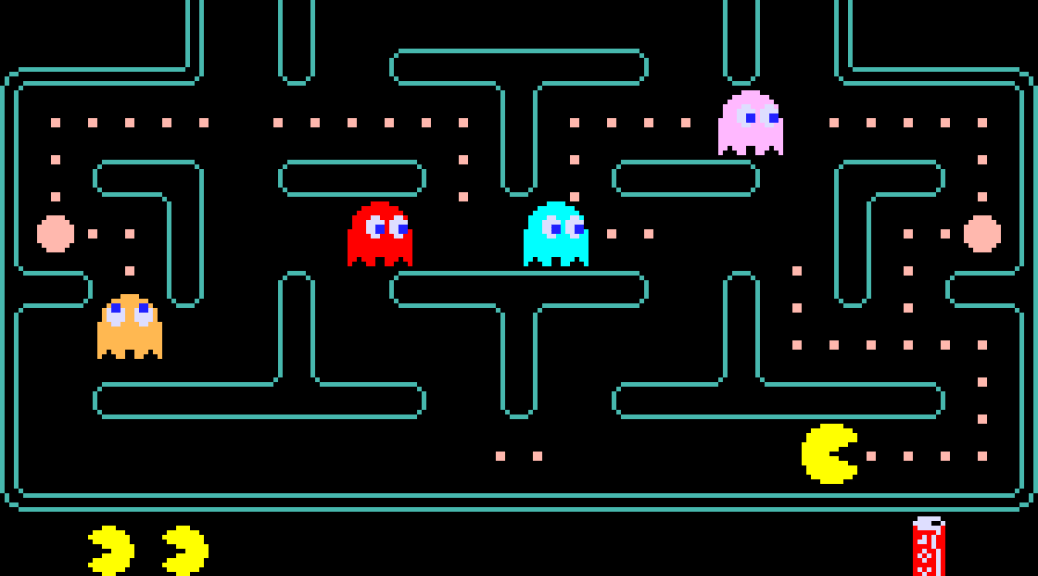
Known as “Puck Man” in its native Japan, and renamed as “Pac-Man” in the West*, this 1980 video game is one of the most iconic brands ever created in the history of the human race. And I’m not being funny here – Pac-Man is actually seen by historians as exactly that: instantly recognisable to most people and indelibly fixed in our consciousness.
The fifth and final Wally Week game, Three Weeks in Paradise was published by Mikro-Gen in 1986, for the ZX Spectrum and Amstrad CPC.
Herbert’s Dummy Run is the fourth game in the Wally Week series and was published by Mikro-Gen in 1985. It was written by Dave Perry and features Herbert Week – Wally’s baby son.
Pyjamarama is the 1984 follow-up to Automania, and features the same lead character – Wally Week. Which makes it the second game in the Wally Week series.
Dragon Quest VI: Realms of Revelation was developed by Heartbeat for Enix and released for the Super Nintendo in 1995 in Japan. It is the sixth instalment in the Dragon Quest series, if you aren’t familiar with Roman numerals.
First released in 1992 by Enix, Dragon Quest V (five – or, to give the game its full title: Dragon Quest V: Hand of the Heavenly Bride) is another fun-to-play JRPG that is simple but engaging, and also contains enough detail and surprises to feel worthwhile.
It was the first Dragon Quest game released for the Super Nintendo and sold over three million copies in Japan.
Like its successor, Dragon Quest VI, it wasn’t officially released in the West until decades later, but English fan translation patches for the game do exist and that is what I’m showing here.
This is the first game in the Lufia series – developed by Neverland and published by Taito in 1993 for the Super Nintendo.
Lufia and the Fortress of Doom is a cute and colourful Japanese Role-Playing game with Zelda-style presentation and turn-based combat.
Continue reading Lufia and the Fortress of Doom, Super Nintendo
As Final Fantasy Legend games go this third instalment in the series is a little weird. It plays just as good as the previous two games (maybe even better because it has the advantage of refinement), but the way it’s presented is somewhat strange.
This pioneering Japanese RPG was first released in 2007 and paved the way for one of the greatest series in the history of level-grinders… The Etrian Odyssey series.
Number three is my favourite, but one and two are excellent too (see also the Nintendo 3DS fourth instalment), and all follow the same credo. Which is: to base a game around exploration, mapping, and turn-based combat. And to make the party system flexible, so that adventurers can take out different parties and experiment with character skills.