
Creative Reality developed and Martech published this adaptation of the famous 2000AD comic character, Nemesis the Warlock, in 1987. It is a simple platform action game where the aim is to kill as many Terminators as possible in order to open up the exit to the next level.
Tag Archives: ammunition

Nemesis the Warlock, ZX Spectrum
The ZX Spectrum version of Nemesis the Warlock was developed by Creative Reality and published by Martech in 1987. And it is another relatively poor adaptation of a classic 2000AD comic character.

Nemesis the Warlock, Commodore 64
Nemesis the Warlock was developed by Creative Reality and first released by Martech in 1987. It is based on the 2000AD comic character of the same name, although the connection is tentative to say the least.

Zombi, ZX Spectrum
Ubisoft‘s point-and-click Dawn of the Dead rip-off originally came out for the Amstrad CPC in 1986, and this ZX Spectrum version followed four years later, in 1990. It was converted by a three-man team: Geoff Phillips, Colin Bradshaw-Jones, and S. Chance and is a faithful recreation of the Amstrad original, with the same clunky controls and zombie-bashing combat.

Zombi, Amstrad CPC
The Amstrad CPC version of Ubisoft‘s Zombi was the first version of the game released, in 1986, and also Ubisoft‘s first ever published game. And – considering the giant that Ubisoft is now – it’s pretty amazing to think that this weird movie rip-off on the Amstrad was the one that started it all for them…
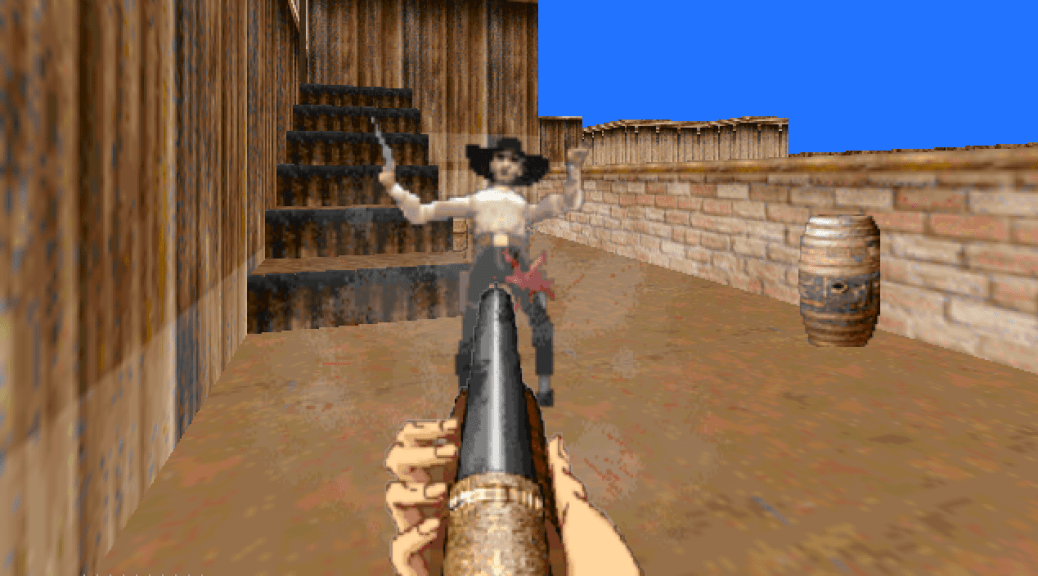
Outlaws, PC
Developed and published by LucasArts in 1997, Outlaws is a first-person shoot ’em up set in the Wild West. The graphics are cartoony and the music is very much inspired by Ennio Morricone‘s classic The Good the Bad and the Ugly soundtrack, which gives it a distinct atmosphere that made it stand out against many of its peers of the time.

Fred, ZX Spectrum
Written by famous Spanish software house Indescomp, Fred is a scrolling platform/maze game where you control a cartoon Indiana Jones-type character plundering treasures from an Egyptian tomb, while avoiding contact with ghosts and mummies.
Fred was first released in 1984. In its native Spain the game was published by Investronica, while in the UK and other parts of Europe the game was published by Quicksilva.
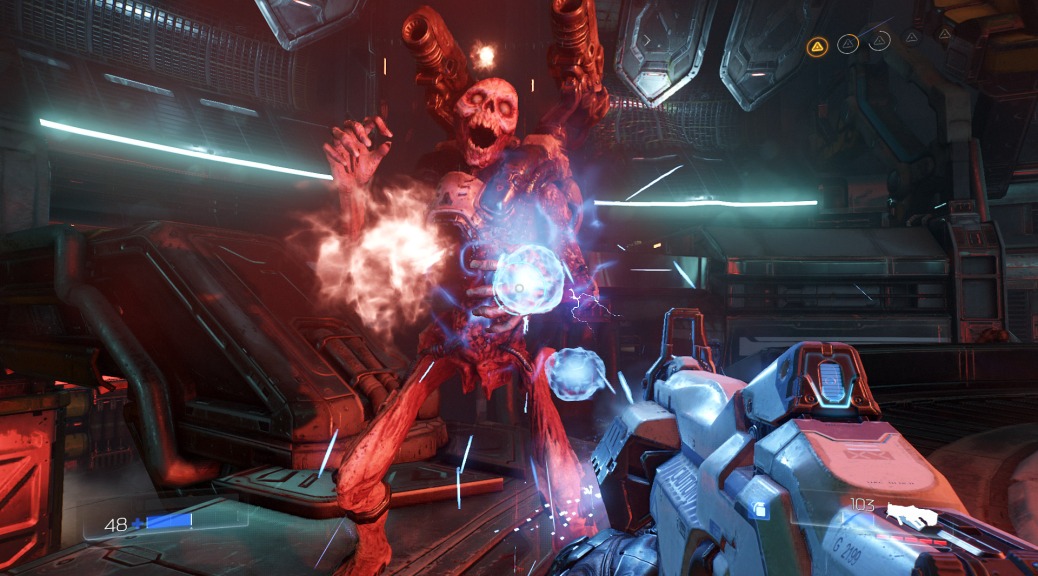
Doom, PC
This is the 2016 version of Doom, sometimes referred to as “Doom 4“, because it is essentially the fourth iteration of the classic id Software first-person shooter.
And: it really is quite something…
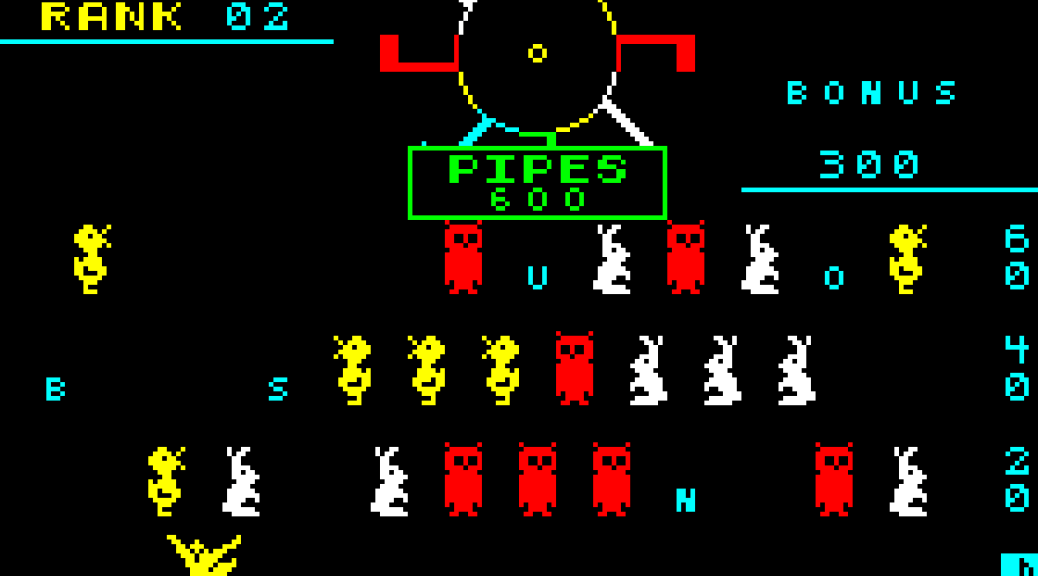
Carnival, Arcade
The classic 1980 arcade game, Carnival, was developed by Gremlin Industries (not to be confused with Gremlin Graphics) – an American company – and manufactured by Sega in 1980. It’s a funfair-themed game where the aim is to shoot moving targets while conserving your limited supply of ammunition for as long as possible.

Arena, Game Gear
The game’s full North American title is Arena: Maze of Death, but it was released as just Arena in Europe so that’s what I’m going to call it. It’s an isometric shoot ’em up with you playing a “pro-democratic freedom fighter” called Guy Freelander who must fight his way through a variety of industrial locations in order to reach a television station to broadcast proof of an evil corporation’s wrongdoings.
 The King of Grabs