
The Super Nintendo version of Cannon Fodder was coded by Andy Onions, John Rocke and Steve Caslin, with graphics conversion by Doug Townsley and sound and music adaptation by Allister Brimble. The SNES port was published by Virgin Interactive Entertainment in 1994 and you’ll be pleased to know that it does indeed support the use of the SNES mouse, which makes all the difference.
Tag Archives: ammunition

Cannon Fodder, 3DO
Sensible Software‘s classic point-and-click shooter, Cannon Fodder, was ported by Krisalis Software and released for 3DO systems in 1994 by Virgin Interactive. And it is a playable and accurate port of the original, but unfortunately there doesn’t seem to be any mouse support – you can only play the game using a gamepad. Which is a little disappointing because Cannon Fodder was designed to be played with a mouse. Thankfully it still works okay with a gamepad*.

Cannon Fodder, PC
The MS-DOS version of Cannon Fodder was ported by Audio Visual Magic Ltd., and was not the first version of Cannon Fodder released (as some seem to think – I’m looking at you, Moby Games). No – the original version of Cannon Fodder was the Amiga version, which was developed by Sensible Software themselves.

Doom, 3DO
The beleaguered 3DO port of id Software‘s classic Doom is often referred to as “the worst port of Doom” by fans of the game, but it’s actually not a bad conversion at all. Yes: it is relatively slow, compared to other Doom ports, and yes: the game runs in a reduced-size window, but it still plays pretty well and does have its plus points.

Ghoul Panic, Arcade
First released into arcades in 1999, Ghoul Panic by Namco is a spooky Halloween-style lightgun shooter for one or two players that is heavily inspired by Namco‘s Point Blank series. The game was developed by Eighting/Raizing and features colourful, well-animated 3D graphics throughout.

Under Fire, Arcade
I’ve played a number of bad lightgun shooters with digitised graphics recently and Taito‘s 1994 arcade game, Under Fire, is probably the worst of the bunch.

Time Crisis, Arcade
Time Crisis is a classic lightgun shooter, developed and distributed into arcades by Namco in 1995. The game is played in a 3D environment, with all the locations, characters and cut scenes fully-modelled as texture-mapped polygons. Unlike many lightgun shooters of the time, Time Crisis is a single-player only game, because it utilizes a foot pedal for taking cover.

Operation Wolf 3, Arcade
Developed by East Technology for Taito, and first distributed into arcades in 1994, Operation Wolf 3 is – as the title suggests – the third game in the famous Operation Wolf series. It’s a lightgun shooter for one or two players, and it goes the route of using digitised graphics, which I personally think was a mistake, because the hand-drawn 2D graphics of Operation Wolf, and the sequel, Operation Thunderbolt, are much better than the dodgy visuals in this.

Maximum Force, Arcade
Maximum Force is the ‘spiritual successor’ to Atari Games‘ hit lightgun shooter, Area 51. It was developed by Mesa Logic (the same company who made Area 51) and features the same style of gameplay and graphics – pre-rendered backgrounds and environments; fixed, on-rails camera movement, and shot-on-video digitised characters. The game was first released into arcades in 1997 and caters for one or two players.
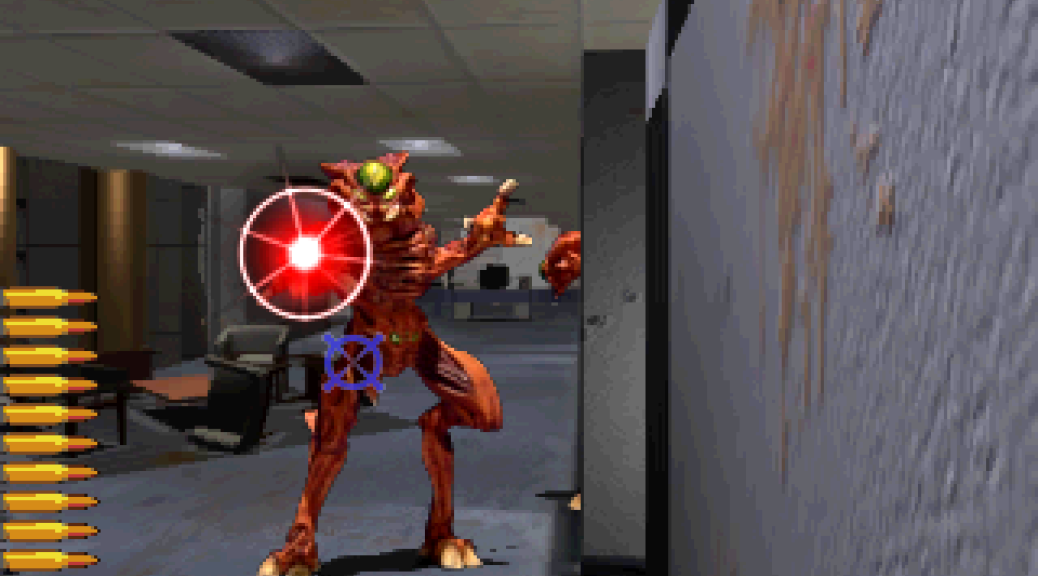
Area 51, Arcade
Developed by Mesa Logic and distributed into arcades by Atari Games in 1995, Area 51 is a lightgun shooter for one or two players where you play as a member of a military incursion team, called the Strategic Tactical Advanced Alien Response (STAAR), which has been sent in to prevent aliens – known as The Kronn – and alien-created zombies, from taking over the infamous Area 51 military facility.
 The King of Grabs