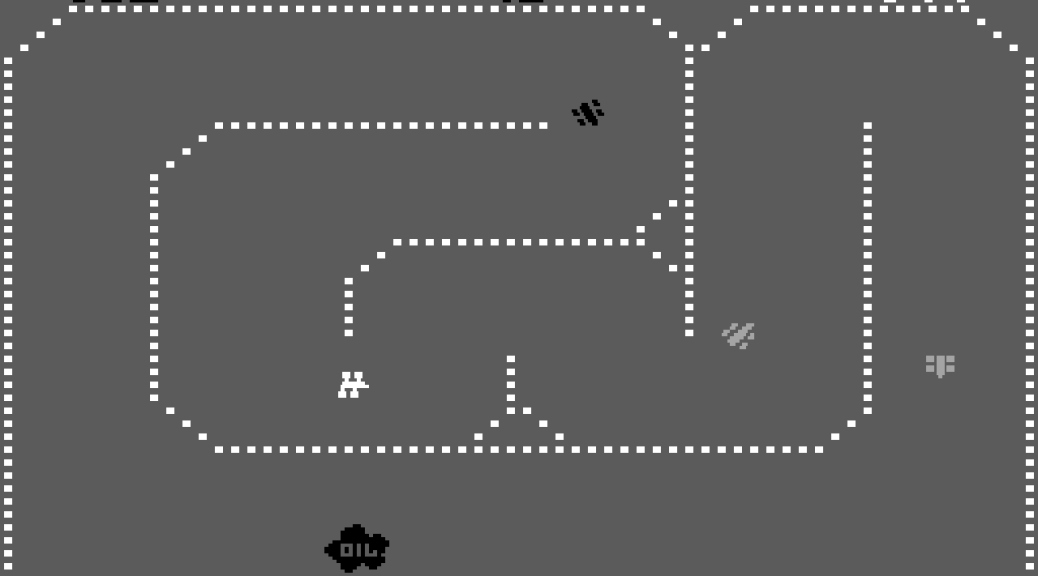
Both Mega Man II and Mega Man III were published in 1992. Capcom was really knocking them out for the Game Boy in the early 1990s.
Tag Archives: monochrome
Mega Man II, Game Boy
A 1992 Game Boy conversion of a 1988 Nintendo Famicom game, Mega Man II is a cut-down version of the original.
Mega Man: Dr. Wily’s Revenge, Game Boy
In essence: a cut-down version of the first Mega Man game, but with graphics made to fit the monochromatic Game Boy. First published in 1991 by Capcom.
Airball, Dragon 32
Microdeal‘s isometric adventure/puzzle game Airball originated on the Dragon 32 in 1987. This is the original version.
Basketball, Arcade
This is the 1979, black and white arcade game, Basketball, as developed and manufactured by Atari Inc. It had two trackballs on the cabinet – one for each player.
Pong, Arcade
Atari‘s Pong is a legendary black and white ‘bat and ball’ game from 1972, and was one of the earliest video game successes.
It’s basically a two-player table tennis simulation, with two ‘bats’ on either side of the screen, moving vertically to return a bouncing ball. If you fail to return the ball your opponent scores a point, and the first to eleven points wins.
Revolution, ZX Spectrum
Costa Panayi‘s Revolution was published by U.S. Gold in 1986. It is an isometric puzzle/action game with well-designed, monochrome graphics and a bouncing ball that you control around a series of rooms, levels, and puzzles.
Final Fantasy Legend III, Game Boy
As Final Fantasy Legend games go this third instalment in the series is a little weird. It plays just as good as the previous two games (maybe even better because it has the advantage of refinement), but the way it’s presented is somewhat strange.
For The Frog The Bell Tolls, Game Boy
Known in Japan as Kaeru no Tame ni Kane wa Naru, this intriguing monochrome adventure game was developed by Nintendo and Intelligent Systems and released on the original Game Boy in 1992.
While it never got a release outside of Japan, a fan translation into English was released in 2011, finally making the game playable for non-Japanese-speaking gamers.
Inside Outing, ZX Spectrum
The ZX Spectrum conversion of Michael St. Aubyn‘s Inside Outing was programmed by Pamela Roberts with graphics by Mike Smith.