
Lucky & Wild is a one or two-player lightgun shooter from Namco that is incorporated into a driving game. Not only does each player hold a handgun in one hand, but they also have a steering wheel and two pedals (accelerate and brake) to contend with. That might sound like too much to handle, but it works well in the context of a car chase shoot ’em up. Which is what this game is. Imagine Chase HQ crossed with Operation Wolf, and you get Lucky & Wild.
Tag Archives: grenades
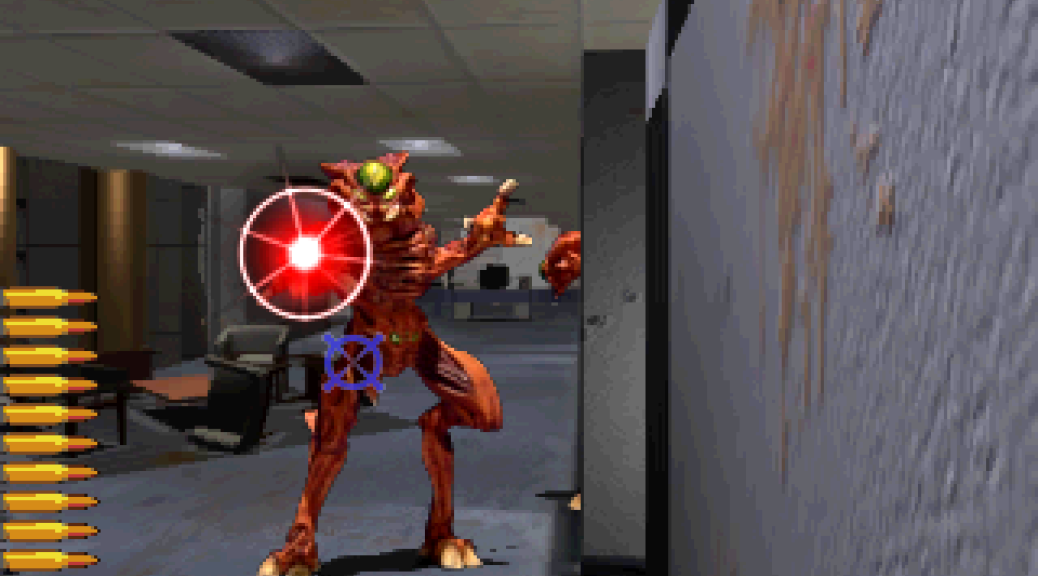
Area 51, Arcade
Developed by Mesa Logic and distributed into arcades by Atari Games in 1995, Area 51 is a lightgun shooter for one or two players where you play as a member of a military incursion team, called the Strategic Tactical Advanced Alien Response (STAAR), which has been sent in to prevent aliens – known as The Kronn – and alien-created zombies, from taking over the infamous Area 51 military facility.

Mechanized Attack, Arcade
Mechanized Attack is a manic, one or two-player lightgun shooter that was released into arcades by SNK in 1989.
On the face of it you could argue that Mechanized Attack is a clone of Taito‘s 1987 hit, Operation Wolf. You could also argue that it’s not a very good clone.

Operation Wolf, FM Towns
The FM Towns conversion of Taito‘s smash hit arcade shooter, Operation Wolf, is both an authentic port of the original, and also a playable and fun game that utilises mouse controls to great effect. It was first published by Ving in 1990.

Operation Wolf, ZX Spectrum
The ZX Spectrum version of Taito‘s classic arcade shooter, Operation Wolf, was developed and published by Ocean Software in 1988.
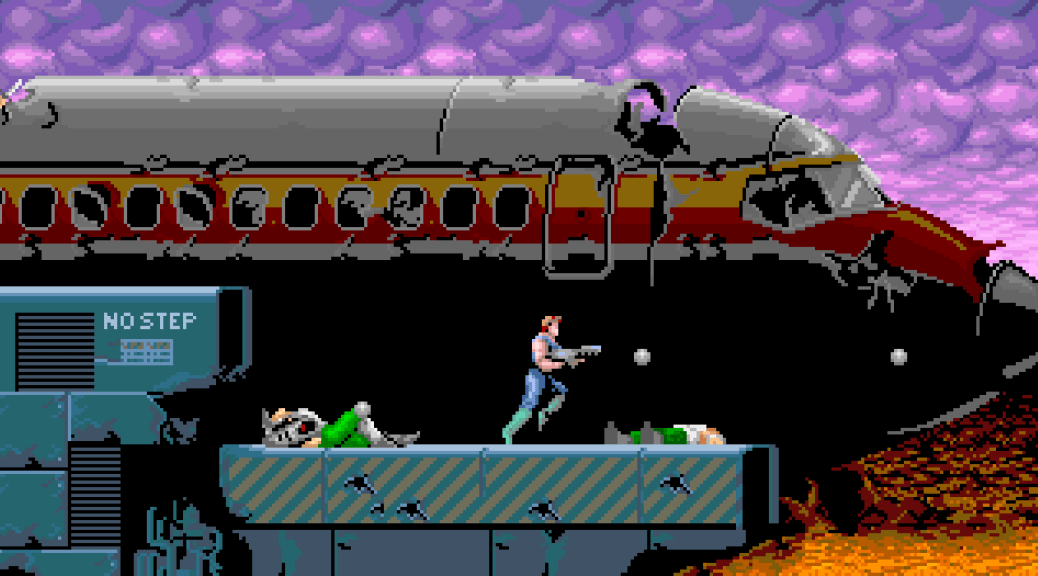
Bay Route, Arcade
This terrible pun of a title (meant to ‘parody’ the word Beirut, the capital city of Lebanon) was developed by Sunsoft and distributed into arcades by Sega in 1989. It’s a one or simultaneous two-player Contra clone scrolling through a futuristic warzone.

Commando, Atari 8-Bit
***CANNED GAME***
The Atari 8-Bit version of Commando was developed by Sculptured Software for Data East in 1989, but unfortunately the game was never released. Thankfully a prototype still exists and is available online, which is good because this is one of the best 8-bit ports of Commando around.

Commando, Apple II
The 1987 Apple II conversion of Capcom‘s Commando was developed by Quicksilver Software, Inc. and published by Data East in North America only, and it is a reasonable port although the play window is probably the smallest out of the all the versions of Commando I’ve played so far.

Commando, BBC Micro
Unfortunately the BBC Micro version of Elite‘s conversion of Commando is an absolute travesty, with terrible graphics and horrible gameplay and the only thing it has in common with the arcade original is the name of the game and the basic scenario.

Commando, MSX
The 1987 MSX version of Commando was a Japan-only release through ASCII Corporation, and – the truth be told – it’s a pretty awful conversion.
If you’re searching for the game you need to look for the title “Senjō no Ōkami” [“Wolf of the Battlefield“], which is the game’s Japanese title, as you’ll not find it under the name “Commando“.
 The King of Grabs