
Inside Outing is an interesting isometric action/adventure game initially published by The Edge in 1988. It was designed by Michael St. Aubyn and converted to a number of different platforms, with this Amstrad version being the original.
Tag Archives: 8-bit

Spindizzy, Apple II
I’m not sure if it’s the game or the emulator – or something else – but controlling the spinning top-like device, GERALD, in the Apple II version of Spindizzy is like trying to navigate Cape Horn in a rowing boat in the depths of winter. It’s suicidal…

Spindizzy, Commodore 64
In my mind: one of the best 8-bit games ever made. Spindizzy is part Marble Madness tribute; part completely original game, with you controlling a spinning top-like device, called GERALD, exploring a large, isometric game world that is suspended in space.
Sabre Wulf, Commodore 64
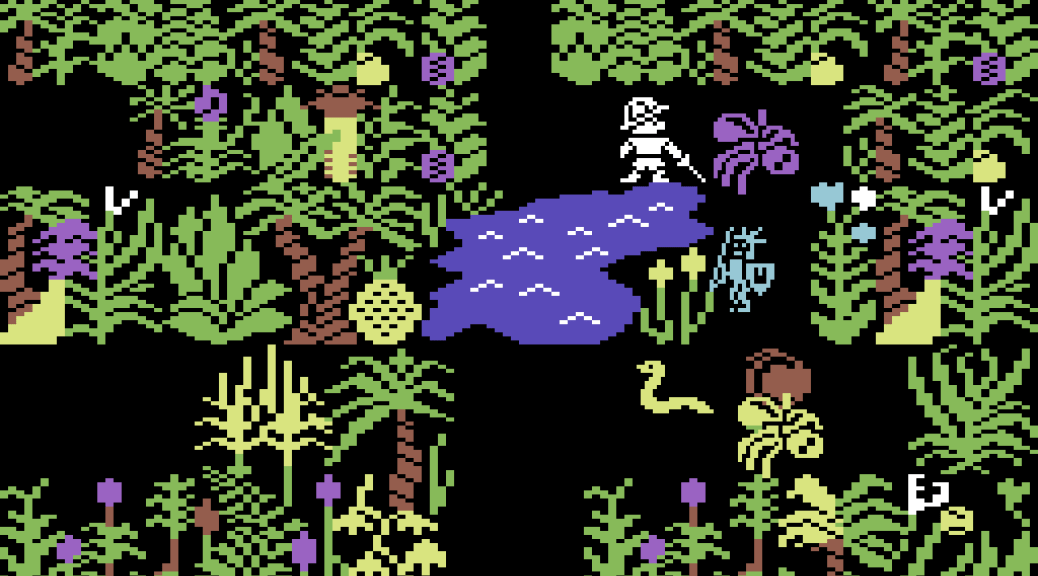
The Commodore 64 version of Ultimate‘s classic Sabre Wulf was made by Greg Duddle of Mr. Micro for Firebird Software, who published the game in 1985.
Sabre Wulf, Amstrad CPC
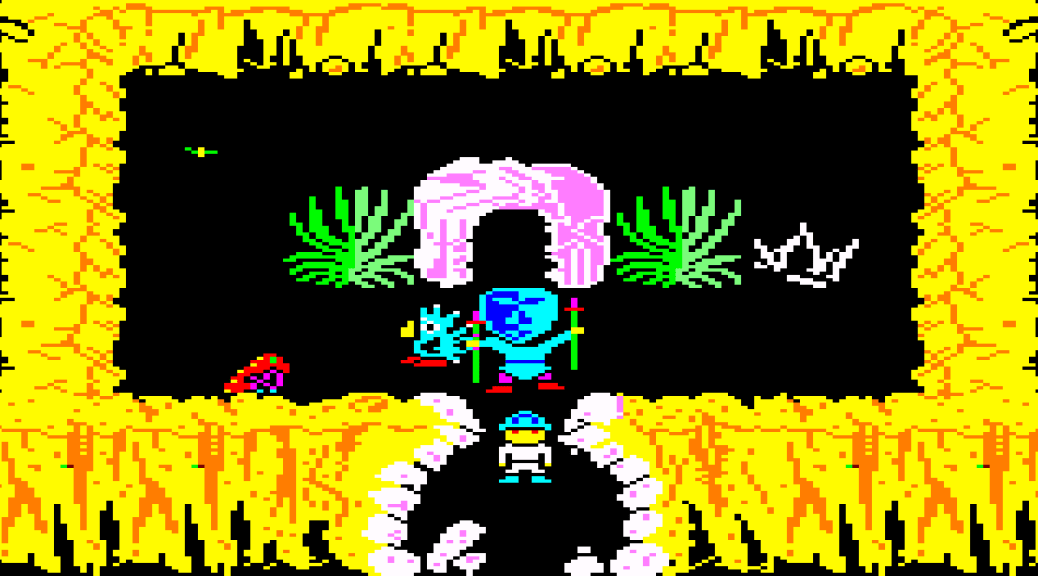
The Amstrad conversion of Sabre Wulf features the same chunky graphics as the BBC version, except with some extra colouring. It does make make a difference though. The Amstrad version doesn’t look quite as harsh as the BBC version.

Sabre Wulf, BBC Micro
The BBC Micro version of Ultimate Play The Game‘s classic Sabre Wulf is so chunky and garish that it hurts the eyes! That said: it plays well enough.

Tales of the Arabian Nights, Commodore 64
Interceptor Software‘s Tales of the Arabian Knights was the first game I ever played on a real Commodore 64, back in 1984.

Frankie Goes To Hollywood, Commodore 64
Back in 1985 gamers were astounded to see the release of an officially-licensed game, based on the pop band Frankie Goes To Hollywood. “Whatever will they think of next?” went the chattering classes. Well, just like the records that were burning up the charts, the Frankie Goes To Hollywood video game license turned out to be ‘gold dust’ to publisher Ocean Software, and the game itself is remembered as being a pretty good one (which is rare for licensed product).

Pentagram, ZX Spectrum
By the time Pentagram came out in 1986, famous development and publishing house – Ultimate Play The Game – had been sold off to US Gold. How much of Pentagram was therefore down to Ultimate‘s designers, and how much was down to US Gold‘s programmers, is still a matter for debate. Most likely, Pentagram was a construct of US Gold, with Ultimate providing only the initial ideas, graphics and game engine (the famous Filmation Engine).

Alien 8, ZX Spectrum
The original ZX Spectrum version of Alien 8 was first released in 1985, not long after Knight Lore had already blown the world away with its incredible isometric graphics and characteristic gameplay.

