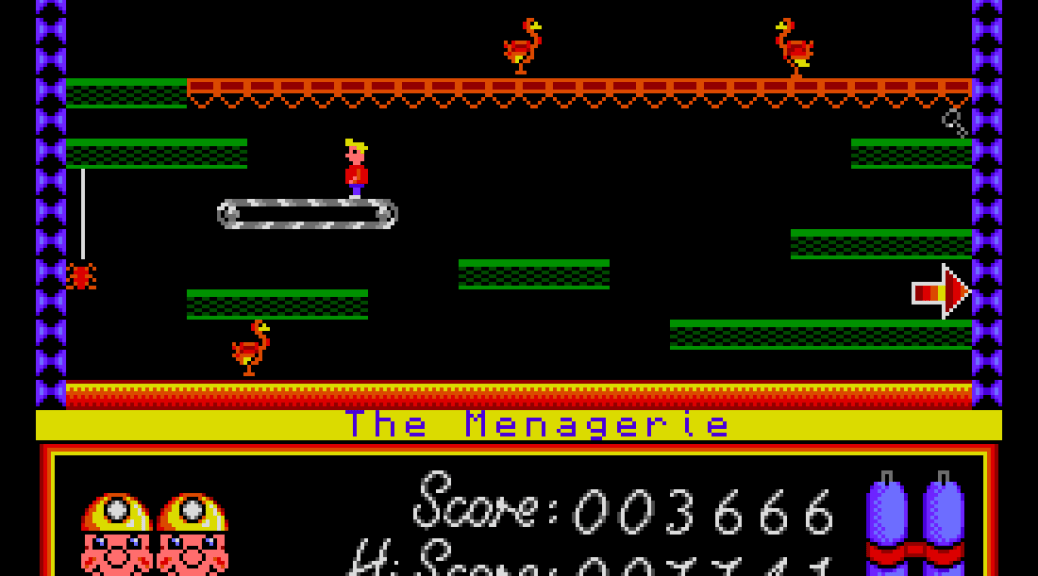
BBC Manic Miner was released by Software Projects in 1984.
Compared to the Spectrum original it is slow and flickery, and isn’t quite as colourful, although it plays pretty much identically so isn’t too bad.
BBC Manic Miner was released by Software Projects in 1984.
Compared to the Spectrum original it is slow and flickery, and isn’t quite as colourful, although it plays pretty much identically so isn’t too bad.
Matthew Smith‘s famous Manic Miner was released for the SAM Coupé in 1992 by Revelation Software. I’m not sure if it’s an official conversion or not.
Actually, there are two versions of Manic Miner that I’ve found for the SAM Coupé. One contains levels that are different to the original (except for the first level), and the other contains three different versions of Manic Miner, including the original levels (three sets of 20 levels, totalling 60).
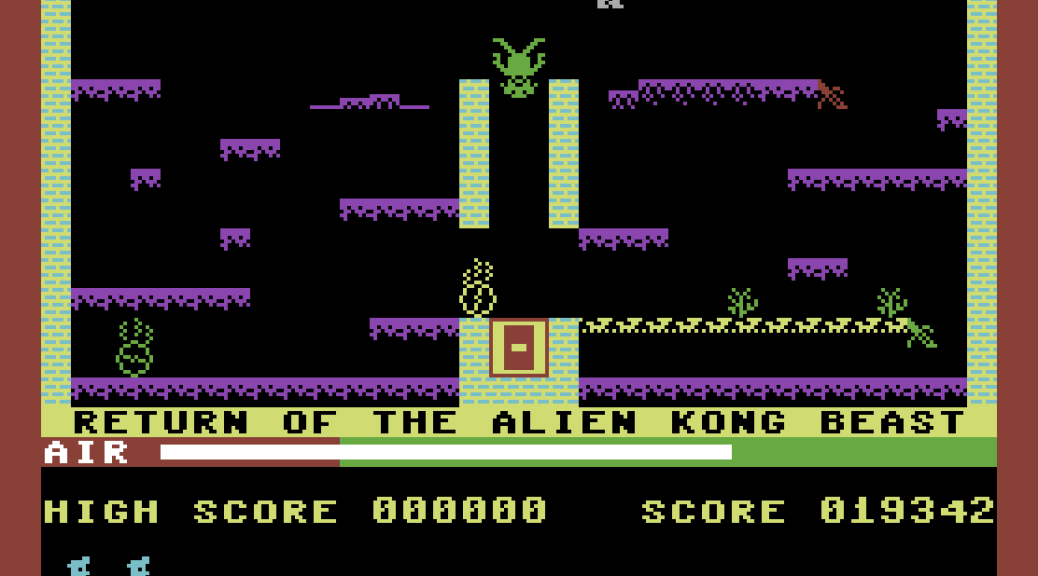
Manic Miner on the Commodore 64 is very close to the ZX Spectrum original, which is fine in my book although at the time I remember magazine critics not liking it because it looked like a Spectrum game. Which I always thought was ridiculous…
The Dragon 32 version of A&F Software‘s classic Chuckie Egg was released in 1983. And – like all Dragon games – it is decidedly green.
The MSX version of Chuckie Egg was produced by A&F Software and released in 1984.
Graphically, the use of colour in this version is strange, but at least Henhouse Harry (the main character in Chuckie Egg) benefits from some extra colour. His animation is a bit stunted though. Harry moves around quickly enough, and the controls are very responsive, so running and jumping feels good – as it’s meant to in Chuckie Egg.
Amstrad Chuckie Egg is not bad, but is somewhat let down by flickery graphics and unrefined gameplay.
I’m not sure why Henhouse Harry has been made as large as he is in the Atari 800 version of Chuckie Egg, but he looks ridiculous…
The Commodore 64 version of A&F‘s Chuckie Egg retains the style and structure of the ZX Spectrum original‘s platforms and ladders, but goes for a chunky Henhouse Harry character sprite. Like in the Atari 800 version: the oversized Harry looks a bit ridiculous, but moves around well enough.
David Hoskins made this BBC Micro conversion of Spy Hunter for Micro Power, Sega and US Gold (not to mention Bally Midway) in 1986.*
It’s a strange conversion overall.
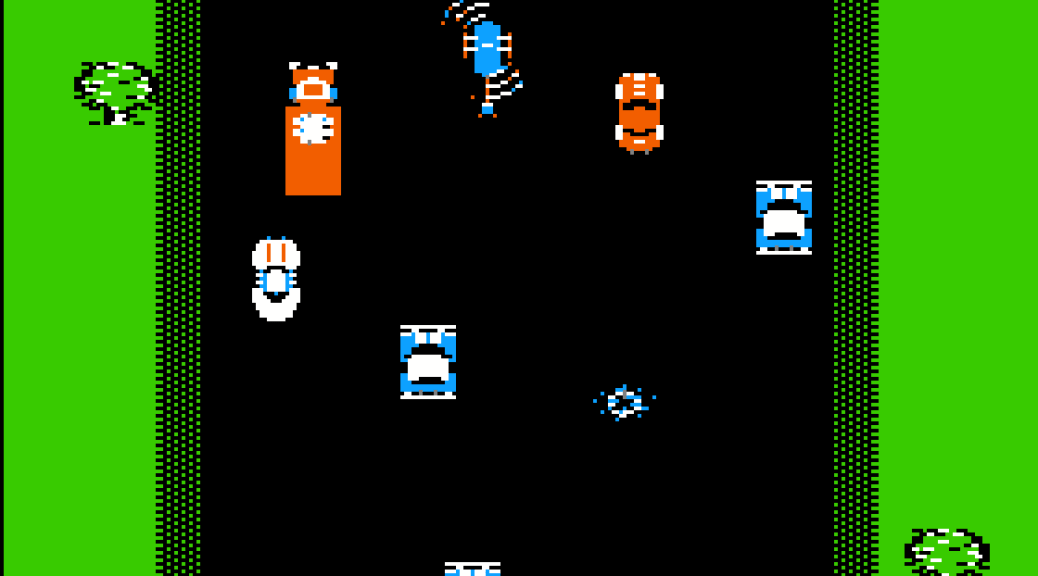
Like the MS-DOS version of Spy Hunter, the Apple II conversion of the classic Bally Midway arcade game is a bit… erm, rubbish.