
Developed by The Bitmap Brothers and published by Renegade Software for the Amiga in 1991, Gods is a stylised platform game in which you play as Hercules, on a quest to make his way through five large stages, themed with Greek mythological motifs.
Tag Archives: Richard Joseph

Cannon Fodder, Amiga CD32
The Amiga CD32 port of Cannon Fodder was developed by Arch Rivals and published by Virgin Interactive in 1994. Of course the game does have mouse support (as if it wouldn’t…), and it plays extremely well. In fact: some may argue that this is the best version of Cannon Fodder ever released.

Cannon Fodder, Megadrive/Genesis
The Megadrive/Genesis version of Sensible Software‘s classic Cannon Fodder is not the one I think of when I think “Cannon Fodder“, but it’s actually a really good port. The game was converted by PanelComp, who also made the excellent SNES version, and it too supports mouse play. Which is important, because without using a mouse it’s impossible to attain the right kind of intensity needed to play Cannon Fodder properly. IMHO.

Cannon Fodder, Super Nintendo
The Super Nintendo version of Cannon Fodder was coded by Andy Onions, John Rocke and Steve Caslin, with graphics conversion by Doug Townsley and sound and music adaptation by Allister Brimble. The SNES port was published by Virgin Interactive Entertainment in 1994 and you’ll be pleased to know that it does indeed support the use of the SNES mouse, which makes all the difference.

Cannon Fodder, 3DO
Sensible Software‘s classic point-and-click shooter, Cannon Fodder, was ported by Krisalis Software and released for 3DO systems in 1994 by Virgin Interactive. And it is a playable and accurate port of the original, but unfortunately there doesn’t seem to be any mouse support – you can only play the game using a gamepad. Which is a little disappointing because Cannon Fodder was designed to be played with a mouse. Thankfully it still works okay with a gamepad*.

Cannon Fodder, PC
The MS-DOS version of Cannon Fodder was ported by Audio Visual Magic Ltd., and was not the first version of Cannon Fodder released (as some seem to think – I’m looking at you, Moby Games). No – the original version of Cannon Fodder was the Amiga version, which was developed by Sensible Software themselves.

Barbarian II: The Dungeon of Drax, Commodore 64
The sequel to 1987’s cult hit Barbarian, Barbarian II: The Dungeon of Drax is a similar fighting game, but with more variety than the first game, and the possibility of exploring the actual world by moving from screen to screen (“wow! What a technological advancement!“). Barbarian II was first released in 1988 by Palace Software. The game was later licensed by Epyx for distribution in North America under the title of “Axe of Rage“.
Continue reading Barbarian II: The Dungeon of Drax, Commodore 64

Barbarian, Commodore 64
Palace Software‘s Barbarian: The Ultimate Warrior is a fondly-remembered and controversial one-on-one fighting game from 1987, where two gladiatorial combatants slug it out to the death in a variety of different locations. Actually, there are two different versions of this game, each with different backgrounds. The first version has a throne room and then a pit. The second version has a meadow and a clearing in a forest. I’m not sure why there are two versions of this game, but that definitely seems to be the case.

Cannon Fodder, Atari Jaguar
Sensible Software‘s classic ‘titchy man’ overhead scrolling shooter, Cannon Fodder, is well-represented on the Jaguar, having been ported by a company called The Dome Software Developments, who did a worthy job with the conversion.
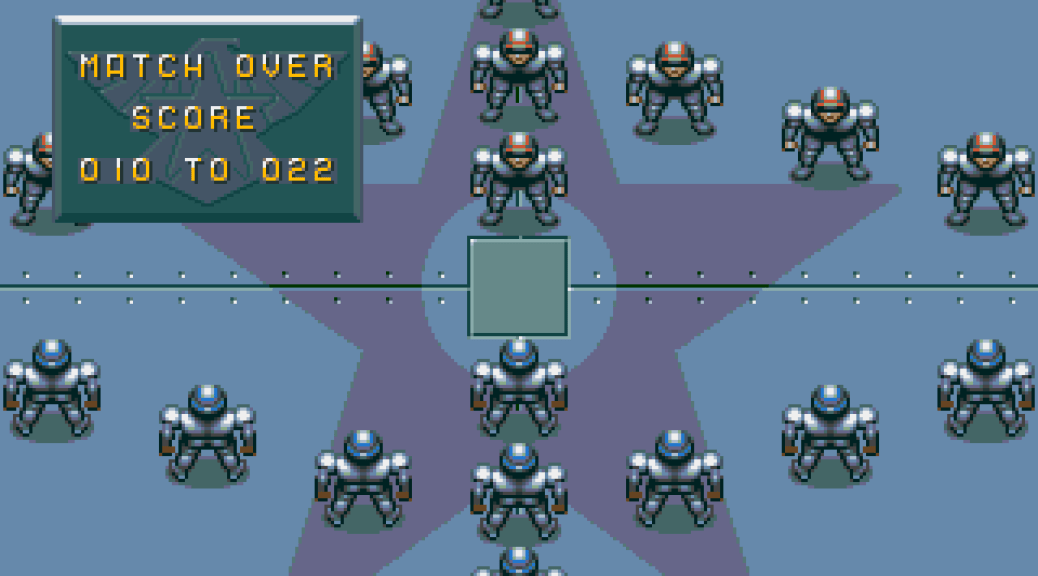
Speedball 2: Brutal Deluxe, Amiga
Speedball 2: Brutal Deluxe is the 1990 sequel to The Bitmap Brothers‘ Speedball. The game makes several changes to the original Speedball, but the main change is that teams now have nine players on-field (eight outfield players and a goalkeeper), instead of the previous five.
 The King of Grabs