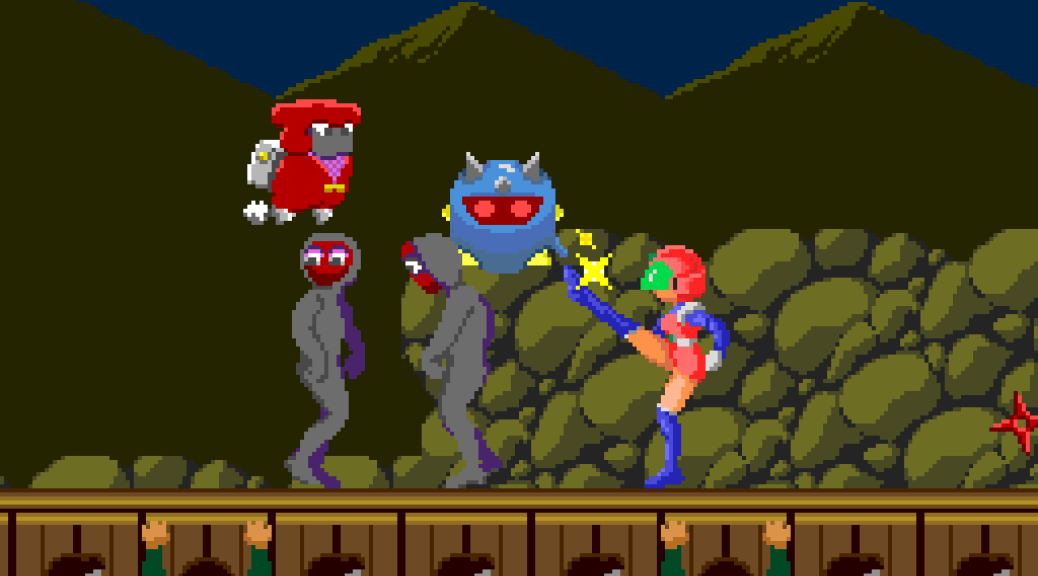
Developed by Namco and published – in Japan only – by NEC Avenue in 1989, Wonder Momo is a conversion of a weird Japanese arcade game featuring a female lead character who must fight off attackers during a theatre stage play. And, if that sounds bizarre, then – well – that’s because it is! Unlike the arcade original, the PC Engine version of Wonder Momo has been fan-translated into English and Spanish, so is more accessible to Western audiences.
Tag Archives: Namcot
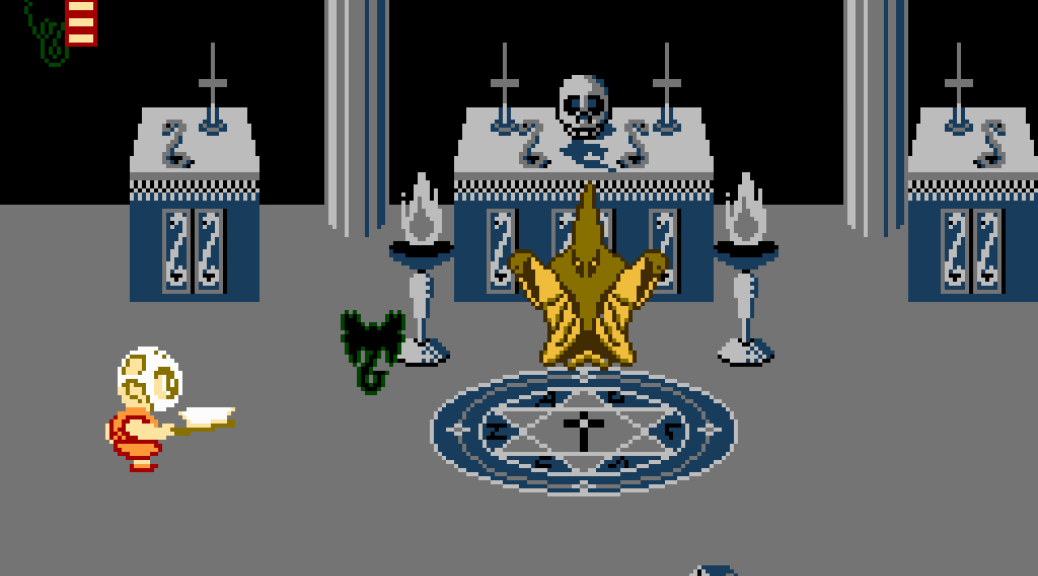
Splatterhouse: Wanpaku Graffiti, Famicom
Splatterhouse: Wanpaku Graffiti is a spin-off from the infamous Splatterhouse series and was a Japan only release, published by Namco for the Nintendo Famicom in 1989.
Rather than take the gruesome approach of the original game, in Wanpaku Graffiti the characters are “super deformed” (and made cute) and the game takes a comical approach to the presentation and gameplay, which was obviously deemed to be more fitting to a Famicom audience.

Digital Devil Story: Megami Tensei II, Famicom
The second game in the Megami Tensei series was developed by Atlus and published for the Nintendo Famicom by Namco in 1990. It’s another Japan-only RPG featuring demon-summoning and turn-based combat and is considered by many to be much better than the first game.
Continue reading Digital Devil Story: Megami Tensei II, Famicom

Digital Devil Story: Megami Tensei, Famicom
This is the very first Megami Tensei game, released for the Nintendo Famicom in 1987, and it looks very basic compared to later Megami Tensei games, but was the foundation on which a successful series was built.
Based on a trilogy of fantasy novels by Japanese author Aya Nishitani, Megami Tensei was originally created as TWO distinct role-playing games. One version (this game) was developed by Atlus and published by Namco in 1987 for the Famicom. A separate version for home computers was co-developed by Atlus and Telenet Japan and published by Telenet Japan the same year.
The original game was never officially released in the West due to its use of religious themes, and Nintendo‘s sensitivity to them, but an English fan translation does exist that can be applied as a ROM hack.
Continue reading Digital Devil Story: Megami Tensei, Famicom

Xevious: Fardraut Saga, PC Engine
A conversion of an MSX2 remake of the classic arcade game, Xevious, published on the PC Engine by Namcot in 1990. And – like a lot of PC Engine shooters – it is a good experience.

Xevious: Fardraut Saga, MSX
Xevious: Fardraut Saga is an enhanced remake of the arcade classic Xevious, developed by Compile and initially published for the MSX2 by Namcot in 1988.
 The King of Grabs