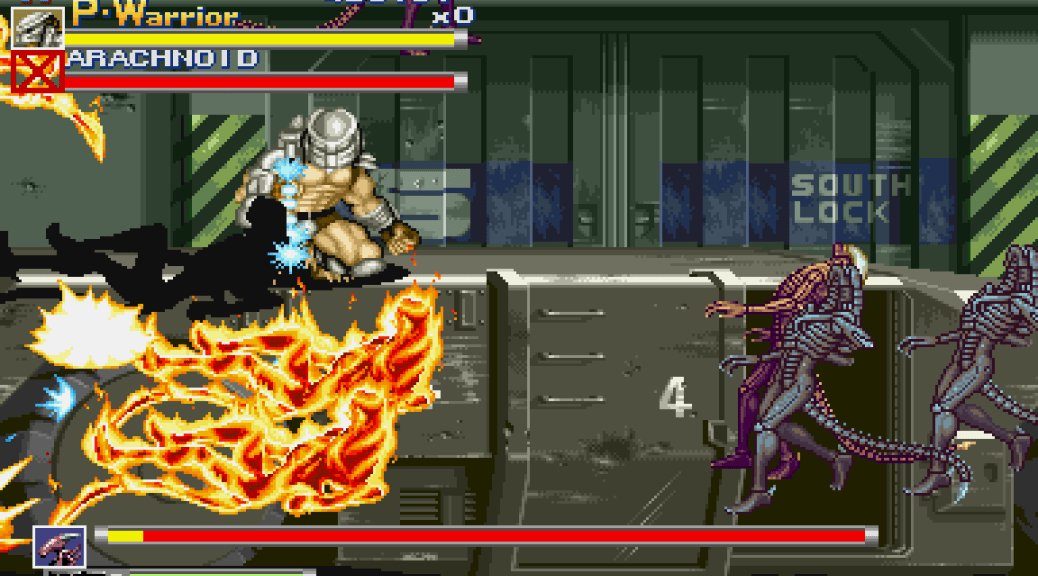
This 1994 arcade game from Capcom is a ridiculously over-the-top beat ’em up in the style of Cadillacs and Dinosaurs – side-scrolling, all-action, with gigantic sprites jumping around all over the place.
Tag Archives: Arcade
Arcade games.

Art of Fighting 3: The Path of the Warrior, Neo Geo
The original Art of Fighting 3 by SNK came out in arcades – and on the Neo Geo AES – in 1996.
Continue reading Art of Fighting 3: The Path of the Warrior, Neo Geo
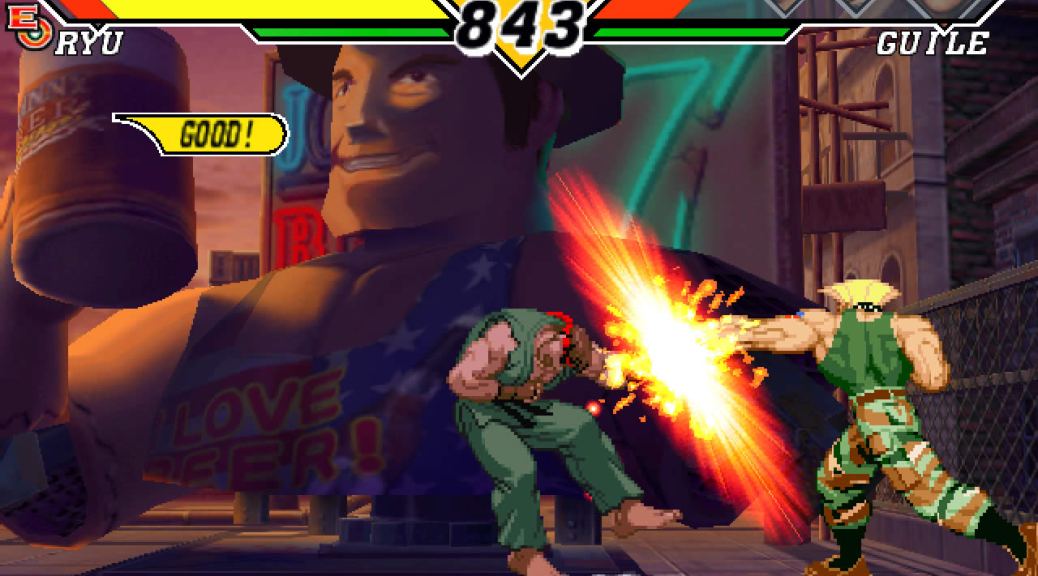
Capcom vs. SNK 2 EO, XBox
The “EO” part of Capcom vs. SNK 2 EO means: “Easy Operation”. Basically, this is the same game as the classic arcade beat ’em up of 2001, but with controls better suited to a gamepad. So, rather than hitting buttons to perform special attacks, you can now move the right analogue stick in a certain direction to activate them instead.

Robotron: 2084, Arcade
Williams Electronics‘ savage and heart-pounding single-screen shoot ’em up, Robotron: 2084 (1982), used twin joysticks to give the player 360 degree firing action, while at the same time allowing full 360 degree movement.

Out Run, Arcade
Sega‘s single-player arcade classic race game – Out Run. Played and enjoyed by millions of people throughout the world.
Out Run was first released in 1986 and took video game arcades by storm with its superfast, colourful graphics, jaunty music, gripping gameplay, and cabinet steering wheel.

Twinkle Star Sprites, Neo Geo
SNK‘s Twinkle Star Sprites was released for the Neo Geo in 1996 and is an interesting mix of vertically-scrolling shoot ’em up and head-to-head puzzle game. Yes, I know that sounds weird, and this game IS weird, but weird in all the right ways…

Congo Bongo, Arcade
Congo Bongo (also known as “Tip Top” in some places) is an isometric platform game developed and released by Sega in 1983.

Liquid Kids, Arcade
Liquid Kids is a bizarre-but-fun platform game by Taito, first released into video game arcades in 1990.

Asteroids, Arcade
Released in November 1979, Atari‘s Asteroids was an instant hit with gamers.
It featured a vector graphic-based, black and white display, with a player-controlled triangular ship, moving in space and firing at moving rocks.

Star Fire, Arcade
Exidy‘s Star Fire is one of the earliest colour video games ever made. It was first released into arcades in 1979, when most arcade games of the time used black and white displays.
 The King of Grabs