
The Commodore 64 version of Starglider was ported by Solid Image and published by Rainbird in 1986. Unfortunately, the developers didn’t manage to convert Starglider‘s unique control method over to the C64 – instead they chose to use a fixed aiming reticule in the centre of the screen, and this results in a rather degraded gameplay experience.
Tag Archives: flying

Starglider, Amstrad CPC
The Amstrad CPC version of Argonaut Software‘s classic 3D shooter, Starglider, was developed by Realtime Games Software, who also coded the excellent ZX Spectrum version. It could be argued that it is even better than the Spectrum version, because it runs faster and also uses more colours in the polygons, although the game does have a smaller cockpit and play window than the Spectrum version.

Starglider, ZX Spectrum
The ZX Spectrum version of Argonaut‘s classic Starglider is actually surprisingly good. Or, rather: the 128K version is very good (the 48K version plays well enough, but it lacks the digitised speech and other enhancements, so is a little plain). And the main reason Starglider on the Speccy is respectable, is because it was converted by Realtime Games Software, who were pioneers in the field of Spectrum-based 3D games, having created the legendary Starstrike, Starstrike II and Carrier Command (among others).

Starglider, Amiga
Argonaut Software‘s Starglider, when it first came out, was a flashy release. It came in a big blue box, with a novella, a manual, and a single floppy disk. Magazines were raving about it, and I remember buying it… for the ZX Spectrum. LOL.

Starglider, Atari ST
The Atari ST version of Argonaut Software‘s pioneering 3D shooter, Starglider, first came out in 1986 – a year before the Amiga version (for some reason – I don’t know why).
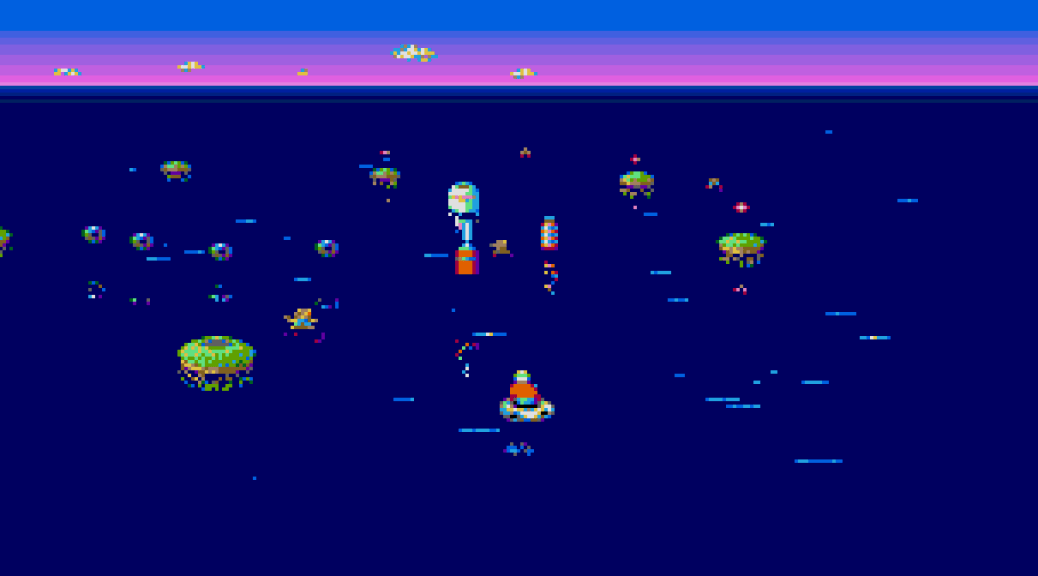
Typhoon Thompson in Search for the Sea Child, Atari ST
Developed by Dan Gorlin Productions and originally released for the Atari ST by Brøderbund in 1988, Typhoon Thompson in Search for the Sea Child is a simple but brilliant shooter/collect ’em up with analogue controls.
Continue reading Typhoon Thompson in Search for the Sea Child, Atari ST

X, Game Boy
This game – called simply “X” – was a Japan-only release, in 1992, on the original black and white Game Boy, but its conception and development would later have a profound effect on Nintendo‘s confidence in producing 3D-based games.
X was created by British developer Argonaut Software (specifically, by Dylan Cuthbert, who was later infamously ‘poached’ by Nintendo from Argonaut), and was a demonstration of their ability to produce 3D-based games on home video game systems. This impressed Nintendo, who then tasked Argonaut with creating a new 3D game on their Super Nintendo console, which eventually became the classic Star Fox. And the rest is history… Sort of.

Krakatoa, ZX Spectrum
Written by Paul W. Reynolds and published for the ZX Spectrum by Abbex Electronics in 1984, Krakatoa – also known as “Escape From Krakatoa” – is a scrolling action game with multiple objectives in which you fly a helicopter in order to rescue people from the infamous erupting volcano.

The NewZealand Story, FM Towns
A conversion of the classic Taito arcade game, featuring the cute Kiwi (Tiki), trying to rescue his girlfriend (Phee Phee) and his other Kiwi friends, from the blue leopard seal who has kidnapped them. The FM Towns version was first released in 1989 by Ving and was ported by Taito themselves.

Kirby’s Dream Land 3, Super Nintendo
Kirby’s Dream Land 3 was developed by HAL Laboratory and published by Nintendo in 1997. It is the successor to Kirby’s Dream Land 2 on the Game Boy, and was the first and only Dream Land adventure on the Super NES.

