
Converted from the ZX Spectrum original by Hudson Soft and published on the C64 by Commodore itself, Stop The Express is both an excellent conversion, and a great little game in its own right.
All posts by Mallo

Mole Mania, Game Boy
This 1996 release on the Nintendo Game Boy is one of Shigeru Miyamoto‘s least known works, although it really is a hidden gem on the system and is well worth finding and playing now if you’ve never seen it.

Christmas NiGHTS into Dreams, Sega Saturn
Some consider this 1996 ‘freebie’ from Sega to be the best Christmas-themed game of all time. And maybe it is, because – let’s face it – there isn’t much competition.
Christmas NiGHTS into Dreams is an adaptation of the classic Sega Saturn game NiGHTS into Dreams (also released in 1996), which was developed by the famous Sonic Team.

Santa’s Christmas Caper, Commodore 64
Developed and published by Zeppelin in 1990, Santa’s Christmas Caper is a rarity: it is a Christmas-themed “Bullet Hell” shooter that is actually not too bad.

One on One: Dr. J vs. Larry Bird, Commodore 64
This classic one-on-one basketball game on the Commodore 64 originated on the Apple II in 1983 and was later converted to other systems courtesy of Electronics Arts.
One on One: Dr. J vs. Larry Bird is remembered as one of the best basketball games of all time and does indeed have a lot of subtlety to it that isn’t obvious until you play it.
Continue reading One on One: Dr. J vs. Larry Bird, Commodore 64

Boot Hill, Arcade
Midway‘s 1977 classic, Boot Hill, actually owes it existence to another game – Taito‘s 1975 arcade game Gun Fight (aka Western Gun in Japan). Boot Hill is an authorised remake of Gun Fight.

Solar Jetman, Commodore 64
Developed by Software Creations for Sales Curve Interactive, Solar Jetman is a legendary ‘lost’ game that was canned by its publisher in 1991 and has since resurfaced and been ‘preserved’ online.

Comix Zone, Megadrive/Genesis
Developed by an American satellite studio of Sega and published for the Megadrive/Genesis in 1995, Comix Zone is a unique and interesting single-player beat ’em up in which battles are fought inside the pages of a comic.

The King of Grabs is Two Years Old
Today, the 21st December 2019, is our birthday. 21st December 2017 was the launch date of this blog, so we are two years old.
Happy birthday to us!
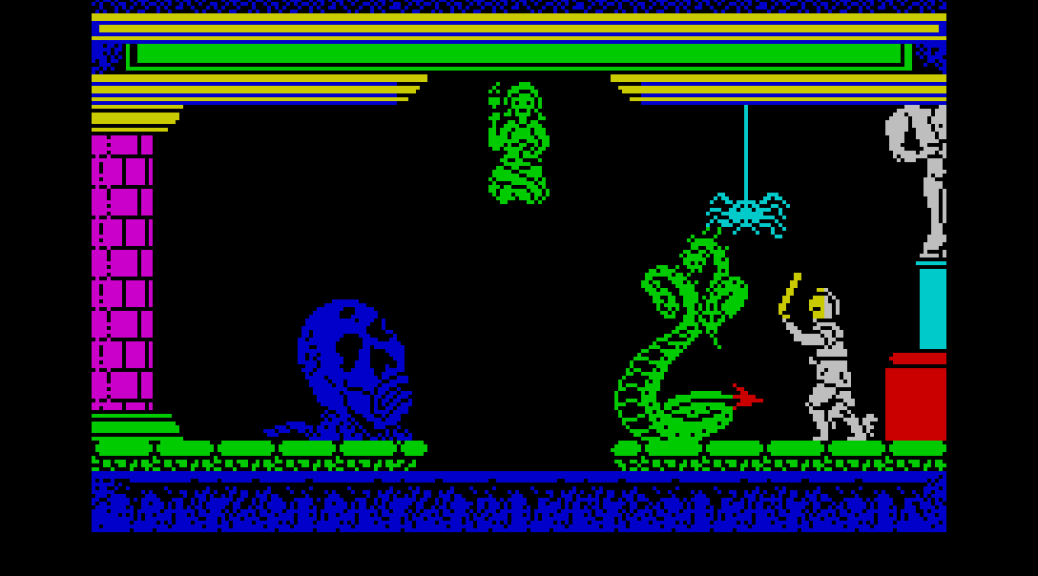
Gift From The Gods, ZX Spectrum
Gift From The Gods is a mythology-based maze game – with impressively-animated, large figures – that was only ever released for the ZX Spectrum. Its origins lie in the infamous cancelled Imagine Software game, Bandersnatch.

