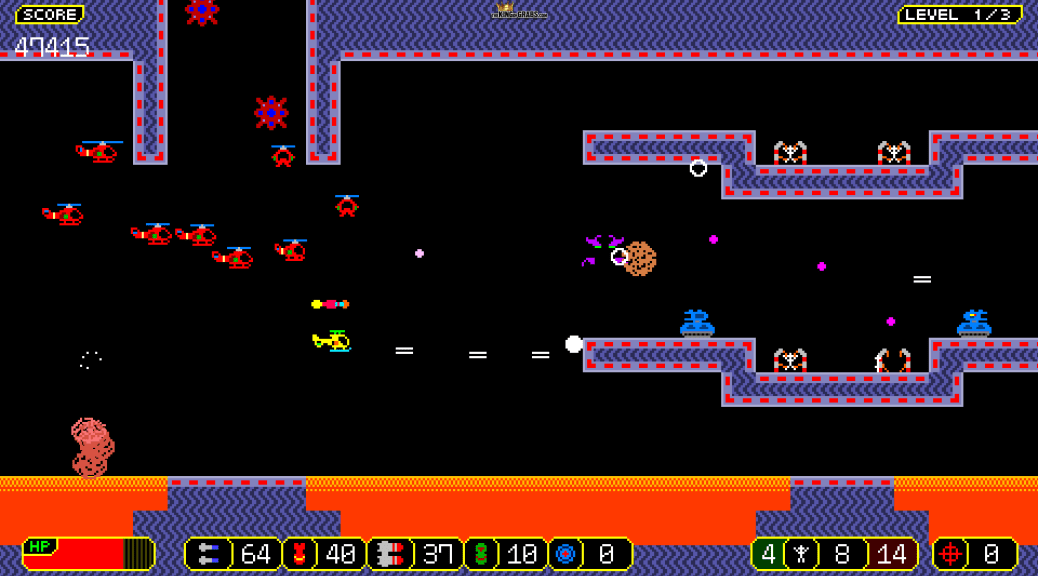
Golden Hornet, by Hijong Park, is an excellent ‘modern retro’-style, ‘twin stick’, helicopter-based shoot ’em up, set in a variety of different scrolling levels.
Tag Archives: helicopter
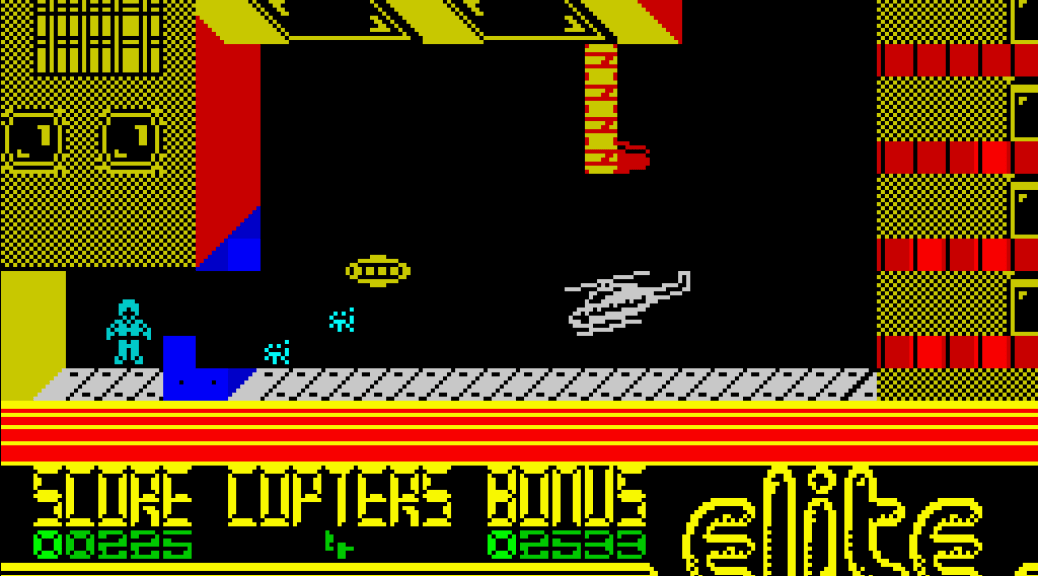
Airwolf, ZX Spectrum
Based on the infamous 1980s TV show of the same name, Airwolf hit the top of the ZX Spectrum sales charts back in 1984, but – in reality – wasn’t a particularly good game.

Choplifter, Apple II
Dan Gorlin‘s classic 2D action game, Choplifter, originated on the Apple II in 1982, courtesy of Brøderbund.

Caliber .50, Arcade
Caliber .50 is an obscure arcade shooter from SETA Corporation, first released in 1989.
It can be played single or simultaneous two-player and is arguably better than the legendary Ikari Warriors. Caliber .50 is like Commando on steroids…

Zombie Zombie, ZX Spectrum
Zombie Zombie is the spiritual successor to Ant Attack, in that: it was created by Sandy White, the guy who made Ant Attack, and it also uses the same kind of isometric graphics style and the same boy/girl sprites.

Fort Apocalypse, Atari 8-bit
Steve Hales‘ superb Fort Apocalypse is a classic American video game that originated on Atari 8-bit home computers in 1982.
The game is a multi-directional, scrolling shooter where you control a helicopter flying around a series of underground caverns looking for men to rescue.

Battle Valley, Commodore 64
A fine side-scrolling action game released in 1988 on the budget Rack-It label (for a mere £2.99), Battle Valley is a hectic mixture of tank blasting and helicopter flying, with a pounding soundtrack and solid graphics.
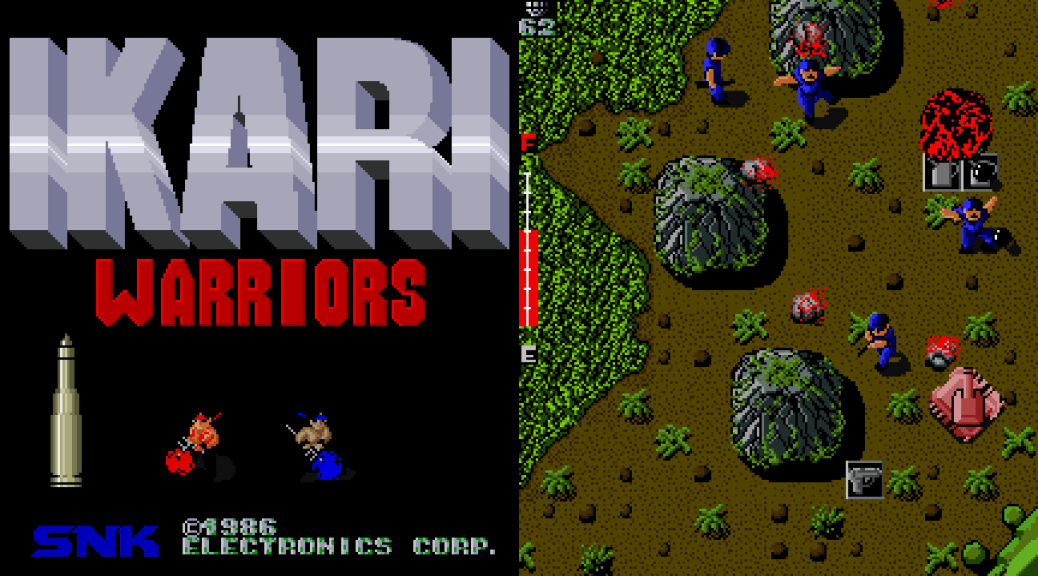
Ikari Warriors, Arcade
SNK‘s famous arcade shooter, Ikari Warriors, was released in 1986 at a time when many Commando clones were saturating the market, but managed to stand out against the competition.

Combat Lynx, Amstrad CPC
The Amstrad CPC version of Combat Lynx looks a bit like the BBC version (ie. chunky), but is thankfully more colourful – and more playable.

Combat Lynx, BBC Micro
Combat Lynx on the BBC Micro is a bit gaudy, compared to other versions, and that’s probably down to the fact that – in this screen mode – the BBC can only display four colours.
 The King of Grabs