
The PC Engine version of Taito‘s classic car chase game, Chase HQ, is pretty decent. It was ported by Daiei Seisakusho for Taito , and is reasonably accurate, although it’s not quite as good as the arcade original itself. No surprises there, really, because the PC Engine (or the North American TurboGrafx-16 counterpart) is a small 8-bit console that was known for punching above its weight, but it wasn’t able to perform miracles.
Tag Archives: Colourful

Rainbow Islands, ZX Spectrum
The ZX Spectrum has an excellent port of Taito‘s classic arcade game, Rainbow Islands, thanks to the developers at Graftgold. It was first published by Ocean Software in 1990.

Quazatron, ZX Spectrum
Quazatron is an isometric action/puzzle game written by Steve Turner of Graftgold and published by Hewson Consultants in 1986. It is essentially a ZX Spectrum remake of Andrew Braybrook‘s Commodore 64 classic, Paradroid.

Pippo, ZX Spectrum
Created by two Italians, Giovanni Zanetti and Paolo Malnati, and first published by Mastertronic in 1986, Pippo is a beautifully-produced puzzle game that plays somewhat similarly to Gottleib‘s Q*Bert.

Impossamole, ZX Spectrum
Impossamole on the ZX Spectrum is a multi-load expanded re-imagining of Gremlin Graphics‘ classic first Monty Mole game: Wanted: Monty Mole. It was developed by Core Design and first published by Gremlin in 1990, which was very late in the Spectrum‘s lifespan.

Three Wonders, Arcade
Three Wonders is an unusual arcade game from Capcom that was first released in 1991. What’s unusual about it is that the game is based around three separate games – each of which you can choose to play in any order, cooperatively with a friend, and that are supposedly linked by the game’s storyline and characters.
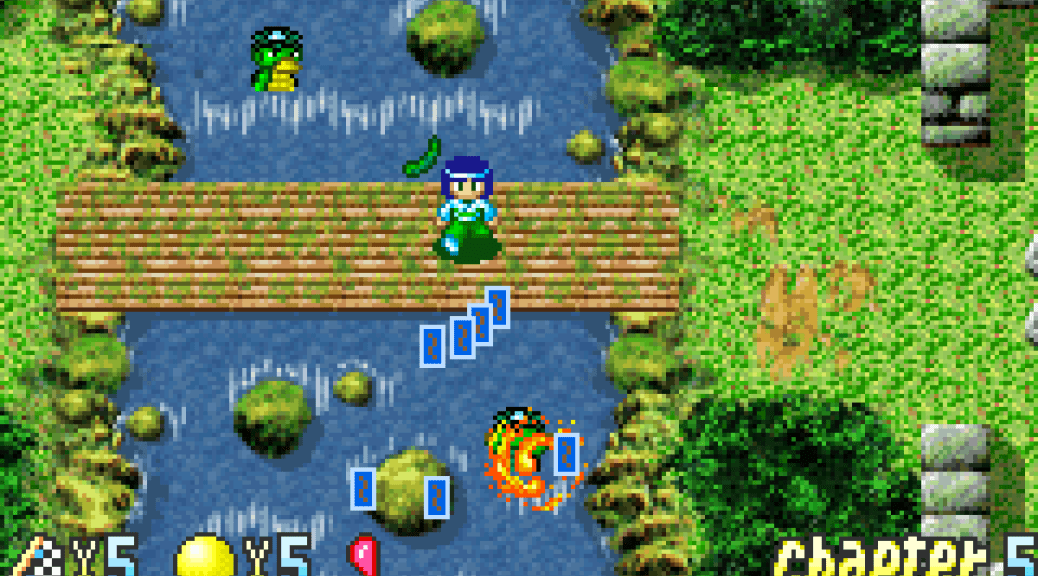
Pocky & Rocky with Becky, Game Boy Advance
Pocky & Rocky with Becky for the Game Boy Advance is the fourth game in the Pocky & Rocky series (following on from Kiki Kaikai, Pocky & Rocky, and Pocky & Rocky 2). The game was developed and published by Altron in Japan in 2001 and was subsequently localized and published by Natsume in North America in 2002.

Pocky & Rocky 2, Super Nintendo
The sequel to Pocky & Rocky (known as Kiki Kaikai in Japan) was developed by Natsume and published by Ocean Software in Europe (by Natsume themselves in Japan and North America). Pocky & Rocky 2 was first released in 1994 and is a similar scrolling shooter to its predecessor, but with multiple companions, instead of just one.

Gates of Zendocon, Atari Lynx
Developed by Epyx and published by Atari Corporation, Gates of Zendocon is a scrolling shooter that was released exclusively for the Atari Lynx in 1989. The game was in fact a launch title for the colour handheld, along with California Games, Blue Lightning, and Electrocop.

Kirby’s Pinball Land DX, Game Boy Color
Kirby’s Pinball Land DX is brilliant ROM hack by “kkzero” that was first released in January 2022. What it does is modify the code of the original Game Boy game to make it playable on the Game Boy Color, in full colour. Which is pretty amazing.
This hack – and kkzero‘s other great Kirby hack, Kirby’s Dream Land 2 DX – turn what were once monochrome games into a riot of colour, and they seriously revitalise these great classics into games that are worth playing (or re-playing) again now.

