
The Amstrad CPC version of Ghosts ‘N Goblins was developed and published by Elite Systems in 1986, and it looks pretty rough, and seems to be missing a good chunk of the original game.
Tag Archives: Nigel Alderton

Ghosts ‘N Goblins, ZX Spectrum
The ZX Spectrum version of Capcom‘s arcade classic, Ghosts ‘N Goblins, was first released by Elite Systems in 1986.
There is some confusion about who programmed the game. The title screen says that it was coded by Keith Burkhill, yet some sources say that Nigel Alderton programmed it. It could be that both worked on the game, but it’s not entirely clear…

Commando, Amstrad CPC
The Amstrad CPC version of Commando – published by Elite Systems in 1986 – is easy to write off, due to its chunky graphics and mostly featureless backgrounds, but it’s actually one of the better 8-bit conversions.

Commando, ZX Spectrum
The ZX Spectrum version of Capcom‘s Commando was programmed by Keith Burkhill and Nigel Alderton, with graphics by Karen Trueman and Rory Green. It was first published by Elite Systems in 1985.
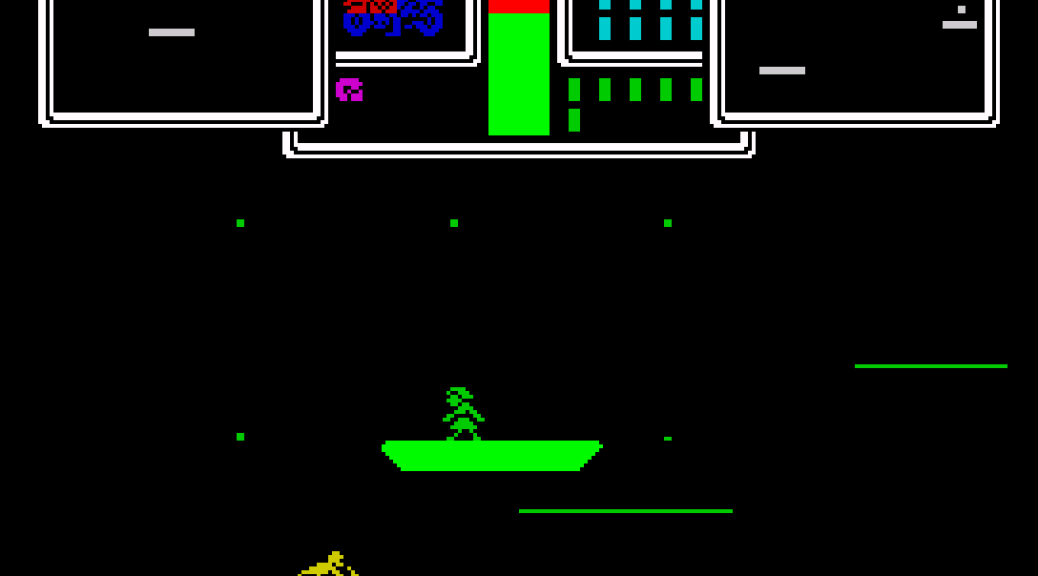
Street Hawk: Subscriber Edition, ZX Spectrum
We may never know the full version of events surrounding this notorious Ocean Software game, but legendary Spectrum programmer Jonathan Smith was almost certainly involved. It does bear a few of his hallmarks, but is a ridiculously simple and quite boring shoot ’em up.
Continue reading Street Hawk: Subscriber Edition, ZX Spectrum

Kong Strikes Back, ZX Spectrum
Ocean Software‘s 1984 release for the ZX Spectrum, Kong Strikes Back, is an unashamed clone of Universal‘s Mr. Do’s Wild Ride, but with elements of Donkey Kong also thrown into the mix.

Chuckie Egg, Dragon 32
The Dragon 32 version of A&F Software‘s classic Chuckie Egg was released in 1983. And – like all Dragon games – it is decidedly green.

Chuckie Egg, MSX
The MSX version of Chuckie Egg was produced by A&F Software and released in 1984.
Graphically, the use of colour in this version is strange, but at least Henhouse Harry (the main character in Chuckie Egg) benefits from some extra colour. His animation is a bit stunted though. Harry moves around quickly enough, and the controls are very responsive, so running and jumping feels good – as it’s meant to in Chuckie Egg.

Chuckie Egg, Amstrad CPC
Amstrad Chuckie Egg is not bad, but is somewhat let down by flickery graphics and unrefined gameplay.

Chuckie Egg, Atari 8-bit
I’m not sure why Henhouse Harry has been made as large as he is in the Atari 800 version of Chuckie Egg, but he looks ridiculous…
 The King of Grabs