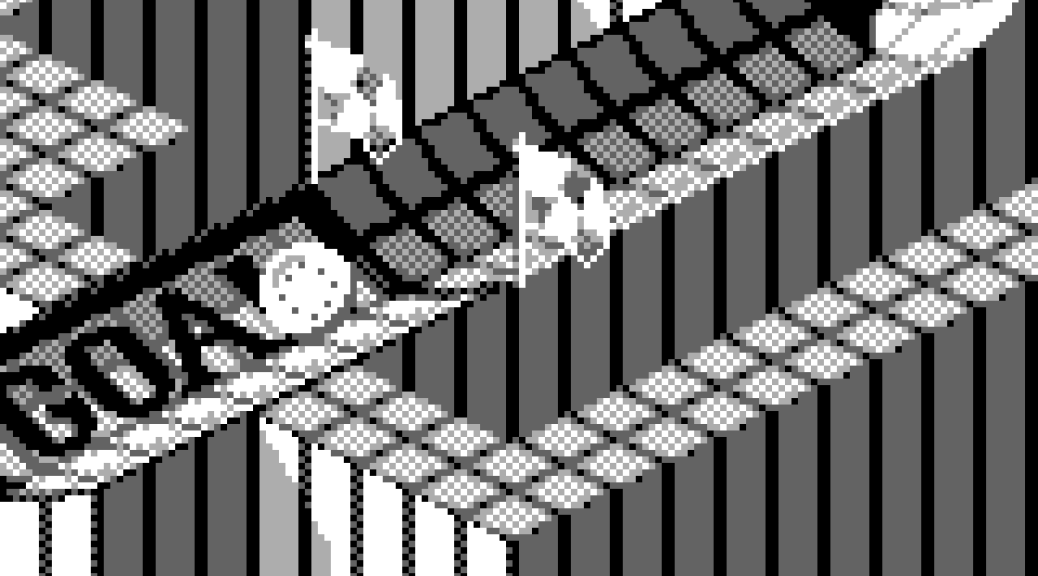
The original black and white Game Boy version of the classic Marble Madness was published by Mindscape in 1991. I’m not a hundred percent sure who developed it, but it could be Tengen as they are mentioned in the copyright small print on the back of the box and on the title screen.
Tag Archives: Marble Madness

Marble Madness, Atari ST
The Atari ST version of Marble Madness was converted by Will Harvey (who also programmed the C64 and Apple II versions – among others), and Jim Nitchals, and was published by Electronic Arts in 1987. It is very similar to the 8-bit ports Harvey produced, rather than the more authentic Amiga version (that he didn’t).

Marble Madness, Apple II
The Apple II port of Atari Games‘ classic Marble Madness was first published by Electronic Arts in 1986. It was converted by Will Harvey of Sandcastle Productions, who also made the Commodore 64 version, of which this is basically a copy. Lack of colour aside, this conversion does have some playability issues that make it frustrating to play.

Marble Madness, PC
The PC version of Marble Madness runs under MS-DOS and was developed by Will Harvey (and a small team of other people at Sandcastle), and was published by Electronic Arts in 1987.
Since they were all coded by the same person, the Commodore 64, Atari ST, Apple II, Apple IIgs and PC versions are all very similar. This one also contains the hidden secret level accessible from the first course, although don’t get too excited about it because it’s not very good.

Marble Madness, Commodore 64
The Commodore 64 version of Marble Madness was developed by Will Harvey and published by Electronic Arts in 1986. It has something unique that most other Marble Madness conversions don’t have, which is: a secret extra level that is accessible from the first stage. It also has the two player mode from the arcade original, where both marbles can race to the goal simultaneously.

Marble Madness, Megadrive
The Japanese Megadrive release of Marble Madness is completely different to the North American and European release of the game and was developed and published by Tengen in 1993. It is far superior to the Western Megadrive/Genesis release and is more authentic to the arcade original. In fact: it is very, very close to the arcade game, in terms of graphics, sound and gameplay. If you didn’t know that the Japanese version of the game was different, I’d recommend checking it out as it may shock you to find out how good it is…

Marble Madness, Megadrive/Genesis
Did you know that there are two completely different versions of Marble Madness on the Megadrive/Genesis? The European Megadrive and North American Genesis versions of Marble Madness were published by Electronic Arts in 1991. They were coded by Michael Schwartz, with sound and music by Steve Hayes, and while they’re excellent ports of the classic arcade game, they’re nowhere near as good as the superior Japanese version, which is a completely different game.

Marble Madness, NES
The NES conversion of Marble Madness was developed by Rare and published by Milton Bradley, in North America and Europe, in 1989. I don’t think the game was ever released in Japan, though. And it’s a very good port, with some small enhancements and decent controls and playability.

Marble Madness, Amiga
The Amiga version of Atari Games‘ classic arcade game, Marble Madness, was converted by Larry Reed and published by Electronic Arts in 1986. It is one of those relatively early 16-bit ports that is a little rough around the edges, presentation-wise, but plays perfectly well.

Marble Madness, Sega Master System
The Sega Master System version of Atari‘s Marble Madness was programmed by Steve Lamb and published by Tengen in 1992 and it is a relatively decent port overall.
 The King of Grabs