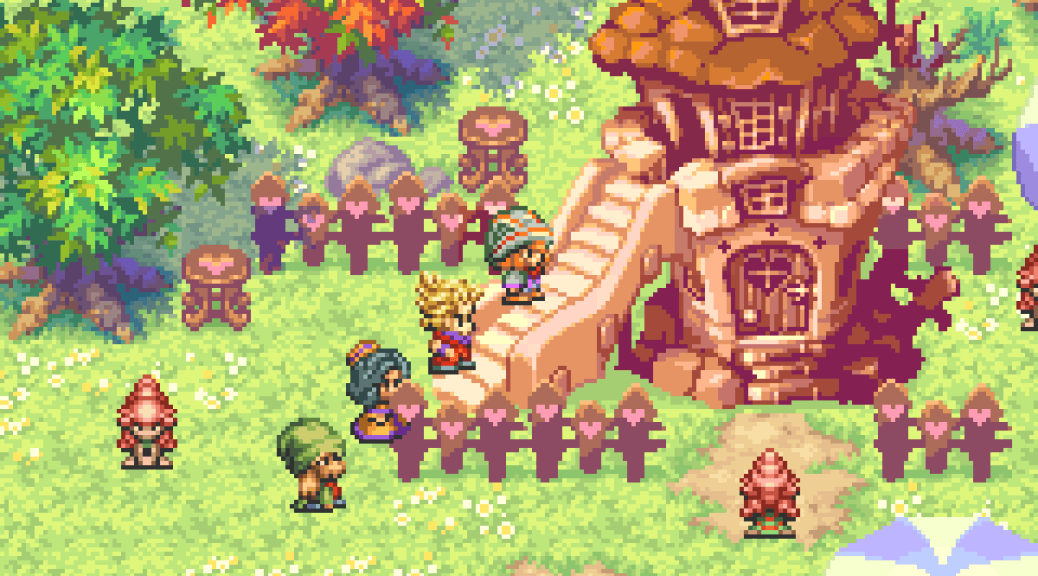
Magical Vacation is a GBA RPG, developed by Brownie Brown and published by Nintendo, in Japan only, in 2001. An English fan translation is available for the game, but it’s unfortunately not yet complete. That said: the majority of the game has been translated, and it’s absolutely worth playing because this is such a beautiful adventure!
The story follows you – a named character in a large party of kids from a magic school that is about to embark on the field trip to the beach. After a short introductory section the shit hits the fan and the kids are thrust into a survival situation in a world they no longer recognise. Random battles start happening at this point in the story and you can form a party from the lost friends that you find as you explore.
The format of Magical Vacation is fairly standard JRPG stuff – a scrolling overworld and turn-based combat, but where it is unique is in its use of magic. The game has 16 different elements from which magic can be cast, and you must choose one of them at the beginning of the game*. Each element is strong against some types of magic, and weak against others (although there is one type that isn’t weak against the others). During battle you can call an elemental spirit to boost your magical strength. Calling a spirit multiple times will also boost your magic exponentially, and this becomes a useful tactic in battle, particularly against bosses. This also applies to all your party members, each of whom you control in combat and each of whom have their own elemental speciality. Enemies can also call elemental spirits in battle too, but you can clear them by attacking with the same type of spirit. If that sounds complicated, that’s because it is, but you gradually get used to it as you play.
*= At the beginning you can only choose between 13 elements – the remainder must be unlocked as you play. Also: the difficulty of the game is dictated by the element that you choose.
Combat itself happens on an isometric stage and is wonderfully realised. Characters predominantly use magic, but can kick, punch or slap enemies, if you want to attack but don’t want to use magic (which gives your characters time to replenish some of their MP). Of course you can also run away, if you want to (and are able to); you can use healing items (or bombs), or simply defend. What you don’t do, though, is use weapons. You can equip armour on your characters, but swords and other weapons are not a thing in this game. Which is a refreshing change from the norm.
As you’d expect from a game where Shigeru Miyamoto was involved, Magical Vacation is packed full of detail, secrets, and features. You can increase the protection of your team by using Stickers on them, and these also help level-up your elemental magic quicker. You can invest money (Bura) with certain NPCs, in order to get a significant return. There are Magic Dolls, that can be built, then imbued with the soul of one of your characters, and these can join your line-up in battle. There are a number of hidden characters who can be found and can join your party. And there are three link-up modes: Let’s Amigo (allows you to recruit friends and broaden your main characters’ magical abilities); Let’s Hot Spring (bring other players to your hot spring for bonus status effects, and also upgrade your hot spring, the more friends that you bring); and Let’s Battle (where you can battle with other players and win titles that give you increasingly better status effects).
Graphically, Magical Vacation is stunning, with lush, colourful backgrounds and superbly-animated characters. It does look a bit like Sword of Mana, which was also developed by Brownie Brown, and the similarity is no bad thing.
Gameplay-wise, I think Magical Vacation is almost perfect. The combat is compelling and the encounter rate is not too high. There is one quest, however, that most players might find tiresome, and that is the errand quest in the Souris tower. There you must take a sequence of stickers to a chain of mice, in order to get to their boss. The mice describe the next person to give a sticker to, but I found that their descriptions did not tally with what I saw in the game, so the process quickly became frustrating. Other than that particular quest, I found the rest of the game to be quite brilliant.
Hopefully one day the translation for Magical Vacation will be fully completed, because this is a game that I would definitely play to the end. But that isn’t possible right now because the ending is “glitched” (according to the romhacking.net page). Please: those who can complete the translation – do so! The world with thank you for it! 🙂
A sequel to Magical Vacation – called Magical Starsign – was released for the Nintendo DS in 2006, and that game is even better, IMHO.
More: Magical Vacation on Wikipedia
More: Magical Vacation on romhacking.net
More: Magical Vacation on GameFAQs


