Developed by Blizzard North and first published by Blizzard Entertainment in 1997, Diablo is a classic point-and-click action/RPG that features quests, monsters, real-time combat, magic, and dungeon-delving, in a way that is meant to appeal to those who prefer a more immediate style of gameplay, than the more ‘hardcore’, turn-based style of many RPGs. And – as a result – Diablo was a smash hit, and spawned a series that still (infamously) persists to this day.
I say “infamously”, because the most recent Diablo game – Diablo IV – has become known for its use of paid-for loot boxes and in-game transactions. Diablo one – this game – couldn’t be further from that; coming from a time when in-game microtransactions were (thankfully) never a thing.
In Diablo you get to choose to play as one of three types of characters: a Warrior, a Rogue, or a Sorcerer, and must explore an isometric world, slowly building up your power and resources to be able to eventually take on the great demon, Diablo, himself and rid the land of his evil presence. The rather ropey introductory cut sequence gives you a preview of what you’re up against, and it doesn’t look pretty…
You begin in a small town with a number of NPCs to talk to. Here you can buy, sell and repair weapons and armour at the blacksmith; heal and buy potions from the healer; buy and sell magical items from the local witch, and identify magical items through the town elder. There are other characters too, but not all of them provide services. Speaking to each will either discuss a quest, or allow you to catch up on local gossip. Just outside of town is the entrance to an old church, which leads down into the dungeon where your adventure begins proper.
Diablo is an easy game to play, but one that can lead you into a false sense of security and result in you being overwhelmed by too many monsters – unless you’re careful. Everything is controlled using a mouse. You left-click on the ground to move to that place, and left-click on monsters (usually outlined in red when the cursor is over them), to attack. Right-clicking on monsters will fire magic at them (if you meet the prerequisites for casting, and have enough mana in your reserves). Your health is shown as a red sphere at the bottom of the screen, and the blue sphere represents your mana pool. Shift-clicking a monster will attack without moving towards them, which is useful for characters using ranged weapons, like bows and arrows. Holding the cursor over a monster will give you its name and some basic information about it. Above the information panel is a row of eight ‘quick use’ slots, into which you can put items such as health and mana potions, and ‘Town Portal’ scrolls. These Town Portal spells allow you to open a magic door back to town, so you can repair, buy and sell items, re-fill your health (for free), and buy extra healing potions. The Town Portals will stay open until you return to the dungeon, after which they disappear.
Pressing the Tab key, when inside a dungeon, brings up a map overlay that helps you figure out where you’re going and where you’ve yet to venture. Inventory, Character, Spells and Quests screens can also be brought up by either clicking the buttons on the panel at the bottom of the screen, or by pressing the associated hotkeys.
Exploration in Diablo is tense, but totally absorbing. The dungeons themselves are randomly-generated, and the quests you get in a playthrough are randomly selected from a pool of possibilities, so each game you play is different. There are also mandatory quests, like the one to destroy Diablo himself, which are assigned in every game. The contents of loot boxes are also randomly assigned with each new game.
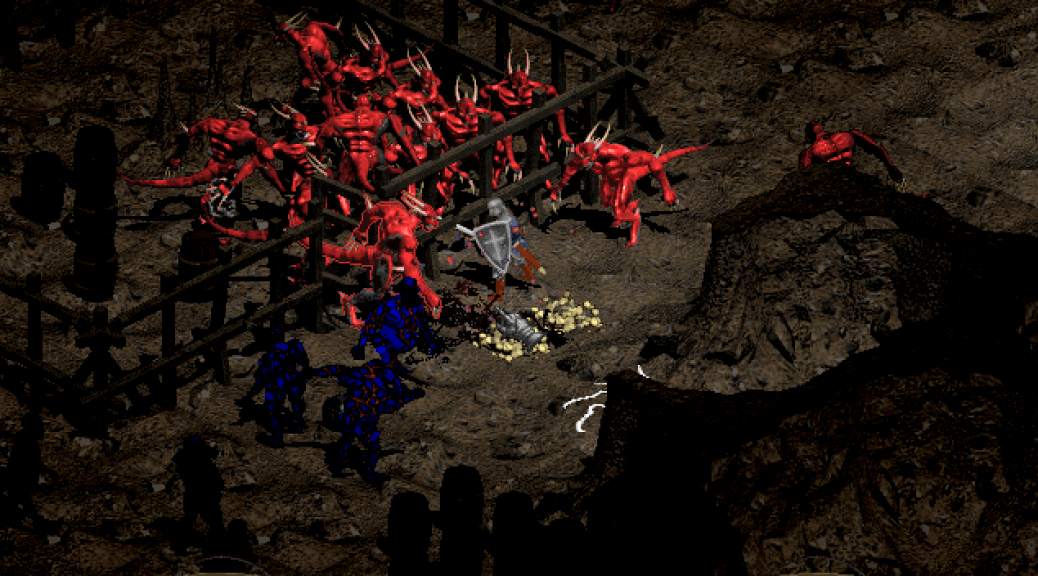
What makes Diablo interesting, in my opinion, are two things: the combat is simple, but does require a deft touch (and the intelligence to know when to run away when you find yourself in trouble), and the various items you can collect make looting fun. Diablo is clever enough to throw plenty of unique, named monsters at you, as well as generic ones, and the difficulty curve of the game is very well-judged. The music is also particularly good, generating an atmosphere of dread, and the graphics are decent, if a little dated and drably-coloured.
If I had any criticisms of Diablo, it would be that your inventory space is very small, and that there doesn’t seem to be anywhere to store your loot, other than on the ground (where thankfully it seems to stay).
The game also has a kind of “New Game Plus” mode, whereby you can re-play the game with the character attributes and carried inventory items you load from a previous game. Diablo‘s single-player campaign has obviously been designed with replayability in mind.
The game also has a multiplayer component, but I haven’t tried it, so I don’t know if it still works or not, or what it entails.
Diablo is still available to buy on GOG.com and Blizzard‘s own Battle.net (although I’m not going to link to the latter because I object to their unethical forced arbitration policy), and also comes with the expansion pack, Hellfire, as part of the package. I have noticed that Diablo is rarely ever on sale, though, and if it is (I think I’ve only ever seen it on sale once over the span of the past three or four years), it’s only for a very small percentage off. That said, I think Diablo is a game that’s still worth buying and playing today. I bought it (at full price), and enjoyed playing it a lot. In fact, I found it difficult to put down. Which is a sign of a sure-fire classic.
More: Diablo on Wikipedia
GOG: Diablo on GOG.com


 The King of Grabs