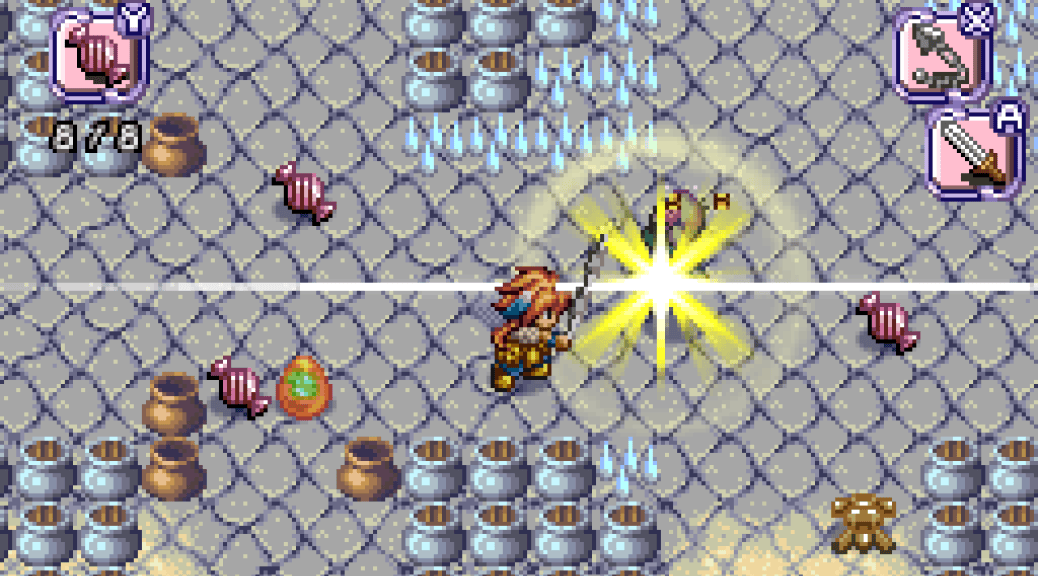
Also known as “Seiken Densetsu DS“, Children of Mana is a beautiful JRPG set in the ‘Mana‘ universe, except this time it uses dual screens (which is always handy). Children of Mana was developed by Nex Entertainment and first published by Square Enix in 2006. It is also the first entry in the “World of Mana” subseries.
You can choose between four different characters to play as, and you can re-name them. After a short story-based intro, you can then take on quests at nearby monster hotspots. And, after completing them, you return to your home village. Combat is real-time, as it is in all Seiken Densetsu games, and you can take out one of eight different elemental spirits with you, for magical support.
One thing to say about Children of Mana is that it isn’t an open-world exploration game as such. The story will open up new places to go to, but in general you are visiting and re-visiting the same key places over and over again. That’s not to say that they’re always the same when you visit – they aren’t. There’s a random element that makes a dungeon different every time, although you can return to a previous dungeon if you wish (presumably the game keeps track of the seed numbers of dungeons, which allows this to happen).
The game gives you four weapons, each with their own unique abilities: sword, flail, bow and arrow, and hammer. You can equip two different weapons at once and these are bound to the A and B buttons. Each weapon has a standard attack, special attacks, and fury attacks. The fury attacks are the strongest and require a full Fury Gauge to use. The Fury Gauge is shown in the bottom right of the screen and it slowly fills up as you defeat enemies and take damage. When activated, you have a short time to take advantage of the extra power the Fury Gauge gives you.
In each dungeon you must find an egg-shaped object called a “Gleamdrop“, and carry it to a warp point to progress the game. The Gleamdrop can be hidden in a chest, or a monster could be carrying it, but you must find it. While you’re carrying it you’re vulnerable and can’t use your weapons, so you have to be careful.
Other important gameplay features are: The Gem Rack, which holds a certain number of magical gems that can boost your abilities; deflecting enemy arrows by standing guard; using the flail as a hookshot, to pull yourself across gaps or to snag items that are out of reach, and buying larger knapsacks to increase your inventory capacity.
Breaking things that block your way is an important gameplay element. Each dungeon has many small pots that you can break with a single swing, but larger pots, and some statues, can only be broken by hitting enemies into them, and you need to learn how to do this effectively. Luring enemies towards an item you want to break becomes a problem in this game, and it can sometimes get tiresome.
There is one unique thing about Children of Mana that I don’t think I’ve seen before – even in other Seiken Densetsu games – and that is that you cannot rearrange your inventory or equipment while out on a quest. Unless the game is kind enough to give you the opportunity to do so.
“Jobs” are also a major thing in Children of Mana. These are short sub-quests with specific objectives. Some are randomly generated, and some are specific to certain characters. You can only do one at a time and each has a reward at the end. They’re a good opportunity to gain more experience, equipment and money.
Finally, Children of Mana has a cooperative multiplayer mode for up to four players. Which is a huge bonus. I haven’t tried it, but it sounds like a lot of fun.
More: Children of Mana on Wikipedia


I abandoned completely the handhelds around 5 years ago, when I started to need glasses. Can’t see the things clearly as they used to be in the mini screens… and, I am a huge fan of big television screens, since ever!
LikeLiked by 1 person