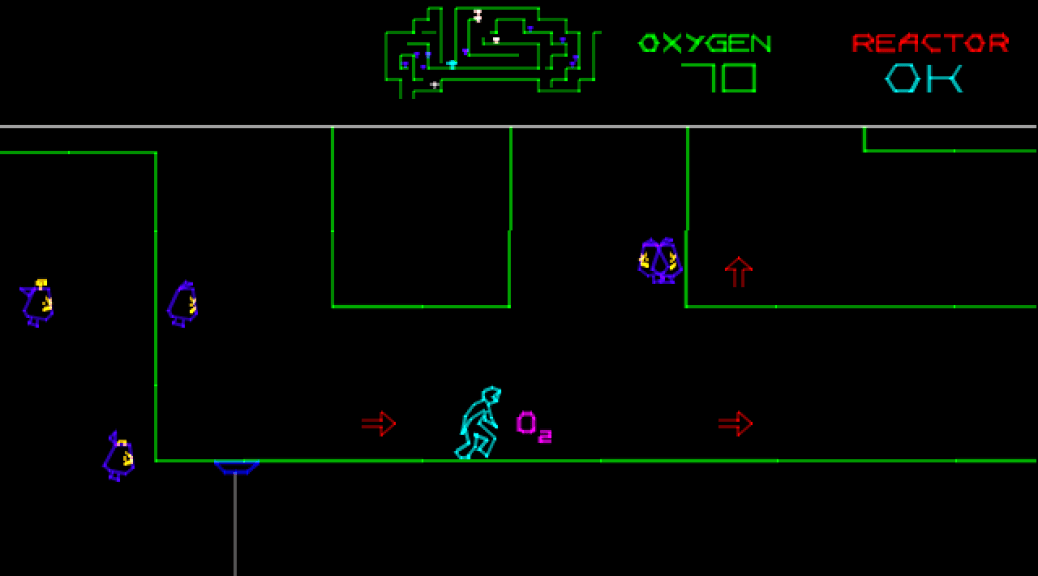
Major Havoc has one task: to destroy a series of space stations. That task has been divided into three parts for each station. Part one: defeat the robots that are protecting it. Part two: safely land on the space station. And part three: go into the space station, activate the self-destruct, then get back to your ship and escape. Do that four times and you just might save humanity from enslavement…
The reason I say “four times” is because, when the game shows the robot attack wave, you can clearly see four space stations, and the Earth, on the far left, above the level number.
Being a colour vector game, you wouldn’t expect platforming sections in this type of game, but they’re there in Atari‘s Major Havoc, and they work quite well. To get to them, though, you must first beat the shoot ’em up wave, and then land using the Lunar Lander clone wave. 🙂
Every time you successfully destroy a space station, though, the individual stages become harder. The robot attackers in the shoot ’em up section start moving in more complex patterns; the landings get more difficult, and the maze inside the space station becomes bigger and more dangerous.
The game has some nice touches, like the amazing mini-map, or Major Havoc standing there with his arms crossed if you just leave the controls alone. Or the animated transition scenes, which are excellent.
If I’m not mistaken, the first Major Havoc cabinets Atari put out all used trackball controls, but I think there are joystick variants of this game too. Major Havoc was also sold as a conversion kit for Tempest cabinets, making use of the dial controls as well. So lots of different control configurations available for this.
Major Havoc wasn’t a success for Atari. I don’t remember ever seeing one during my visits to arcades in the 1980s. Playing Major Havoc now, though, is a lot of fun, and I highly recommend it. It’s different and it’s playable.
More: Major Havoc on Wikipedia


