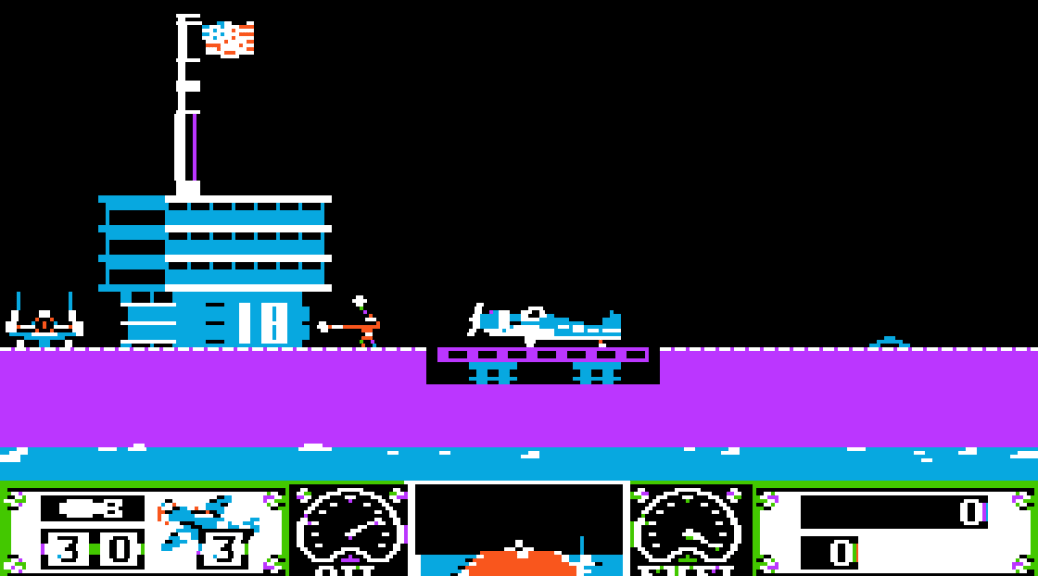
Designed and programmed by Steve Waldo, and first published by Brøderbund in 1987, Wings of Fury is a pioneering and influential side-scrolling shooter in which you pilot an American F6F Hellcat during World War II.
The aim of the game is to take off from your aircraft carrier, safely, and then attack enemy targets that are designated to you. You can choose to load bombs, rockets or torpedoes onto your plane as your secondary weapon, depending on your objectives, but your primary weapon is your front-mounted machine gun.
Your first sortie will no doubt put the fear of God into you, when you realise that the enemy fire back, and that it’s not that easy to get used to the F6F‘s handling. Eventually, you’ll get better at it, but flying the plane takes subtle mastery of the controls. And hitting ground (or sea) targets means having to figure out what the “use secondary weapon” button is… (it’s the second joystick button – you need a two-button Apple II joystick to play this game, according to the manual).
There are seven different skill levels, each with different objectives, and you can choose to play each level from the main menu, rather than having to fight through them all one by one. Which is good because Wings of Fury is a tough challenge.
Steve Waldo knew he had a good concept with Wings of Fury, but bringing it to fruition, with good controls, was not a given. But he managed it with aplomb and created a classic Apple II game in the process. So well done, Steve. 🙂
There are so many great touches that elevate this game above the norm, like the aircraft carrier bobbing up and down in the water; the zoomed-out, miniature view when you climb out of range of the ground (which is useful for planning your dive-bombing); the dynamic smoke and explosions; the little men running out of buildings when they’re hit with bombs, and the small first-person viewpoint on the info panel at the bottom of the screen.
Wings of Fury is so good that it was converted to many other systems, including: for PC MS-DOS, Sharp X68000, Amiga, Commodore 64, Amstrad CPC and Game Boy Color. The Game Boy Color version came out in 1999 – over ten years after the Apple II original.
More: Wings of Fury on Wikipedia


