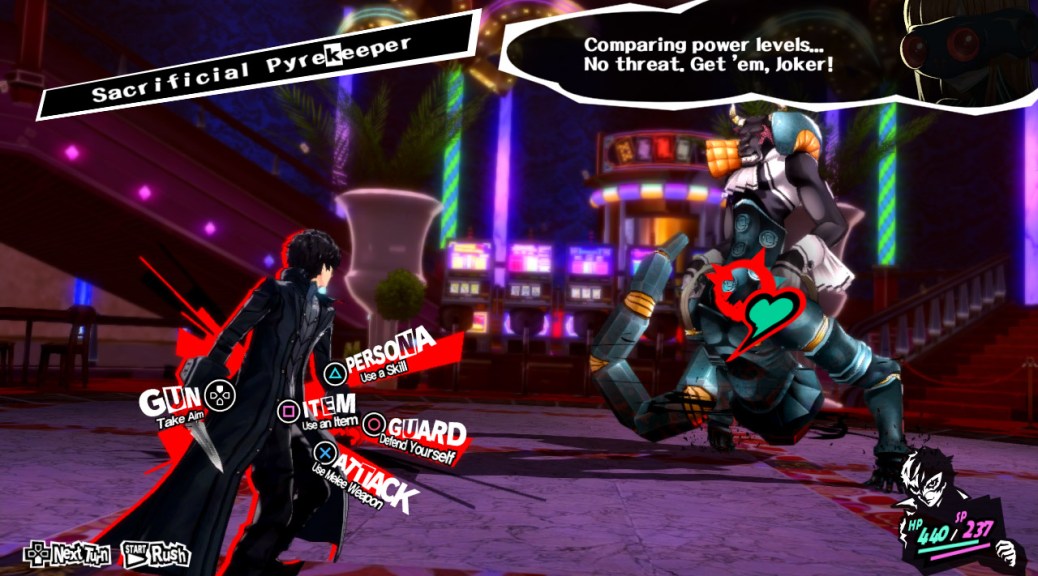
Persona 5 was developed by “P-Studio” and was published by Atlus in Japan and North America, Deep Silver in PAL territories, and Sega everywhere else, in 2016. It is a Role-Playing Game set in contemporary Japan, featuring monsters, the occult, and the supernatural. Oh, and turn-based combat (but don’t let that put you off).
You play a ‘troubled’ schoolkid who is adjusting to a new school, and the beginning of the game introduces his life – a mixture of drudgery, public transport and burocracy.
The story unfolds via a series of cut scenes, dialogues, flashbacks, quests, and through exploration. When you’re able to, you explore and move around the 3D environment in third-person, using the ‘X’ button as a multi-purpose action button to look at things and do stuff.
You get a taste of combat early on, but it’s all too brief, and then you have to work your way through the story for a while until weird events start to happen. Eventually Persona 5 explains that certain people have a ‘rebel soul’, a magical ‘persona‘ that will fight for them in combat. As per previously in the Persona series. And only really from that point does the combat – and levelling – kick in.
Every time you sleep in Persona 5, time passes and events change, and you can visit The Velvet Room in your dreams. “What is The Velvet Room?” you ask. It’s a reoccuring place in Persona. It’s prison in your heart, where you obtain the Metaverse Navigator – an app that allows you to switch between the real world and the fucked-up world. Eventually you learn that a ‘distortion’ in the real world is amplified in the alternate world, and points to the true nature of the ‘evil’ you’ll eventually have to deal with in the real world.
You can still recruit monsters to fight with you in Persona 5, although it’ll take a while to get to that point in the game. There’s a cute cat-like creature that fights with you early on, but she (Morgana) is more of a guide, and a useful exposition manager than anything.
Battles are mostly scripted, although there are areas where it is also random. Boss and sub-boss battles are also fairly frequent in the context of the overall game. Persona 5 has four difficulty levels, two of which reduce the combat to almost nothing. The encounter rate isn’t very high in Persona 5 anyway, so there’s little to worry about if you don’t like turn-based combat.
Although the anime style of Persona 5 may not appeal to everyone, the game does have a lot going for it. Great details like the people changing during travel cut scenes, and the pace of the game being beautifully set. If you like creepy, weird, Japanese RPGs, then there’s very little out there better than Persona 5.
More: Persona 5 on Wikipedia


