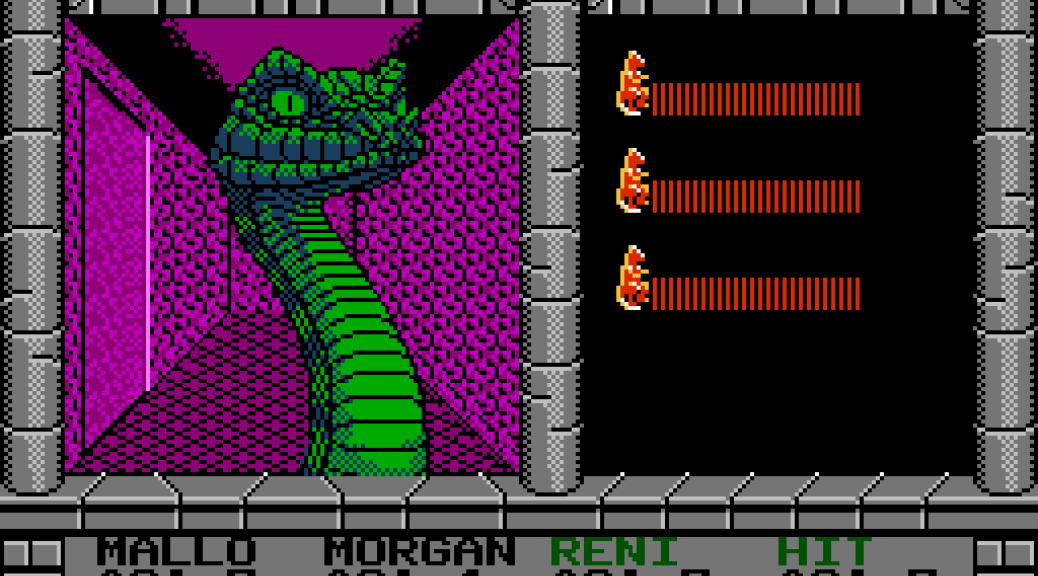
Developed by Interplay Productions and published by Acclaim Entertainment in 1990, Swords and Serpents is a first-person, party-based RPG with tile-based movement for up to four players. You can either build a party of four characters yourself, in single-player mode, or up to four different players can control one party member each in multiplayer mode*.
*= An adapter, like the ‘NES Satellite‘, or another four-player expansion peripheral, is required if you’re going to play with that many players (but, let’s face it, very few will, although it’s nice – and fairly unique – to have the option to do that).
Characters can be Warriors, Magicians, or Thieves. Warriors have the highest strength and the strongest defence, but no magical ability; Magicians have low strength and defence but can use magic spells to attack or heal; Thieves have medium strength and defence, but have high agility and the special ability to land a critical hit that has the chance to kill a single enemy regardless of how much health they have left.
The screen is divided into three main areas: top-left is the party view; top-right is the automap (or, during combat, it shows the health bars of enemies), and at the bottom are the health bars of your party members (plus the mana levels of magic users), plus any messages the game presents to you are shown at the bottom too. The automap fills in as you explore, showing walls, doors and other important elements of the map.
There are sixteen levels in total and the aim is to defeat the serpent at the end of the final level. Random battles happen as you explore and combat is turn-based.
During combat the ‘A’ button is used to attack, and you can change your attack type by holding different directions on the d-pad and pressing ‘A’. The ‘B’ button is used to cast magic; the Select button brings up the character menu (so you can access inventories and attribute pages), and the Start button allows you to “save” the game (although in reality it just provides passwords that you have to write down and re-enter to continue).
You find new spells (usually written on walls) as you explore, and these are automatically added to a magic user’s spellbook. You’ll also encounter NPCs who’ll give you information too; and teleporters, called “Zoom Tubes“, that will transport you up and down levels.
You’re told that there are healing temples on the first, fifth and tenth levels, and these become important to your survival. Since these temples are well spaced-out it can be risky to venture too far, without at least building your levels first, so the abovementioned Zoom Tubes can transport you back to the first level to heal at the temple there if you need to.
Although Swords and Serpents looks relatively plain, it’s actually quite an absorbing and enjoyable game to play – if you like old school RPGs. If you don’t, then it’s unlikely to change your mind.
Swords and Serpents is currently available on the online retro gaming service Antstream (at the time of writing), and it’s still worth playing today.
More: Swords and Serpents on Wikipedia


 The King of Grabs