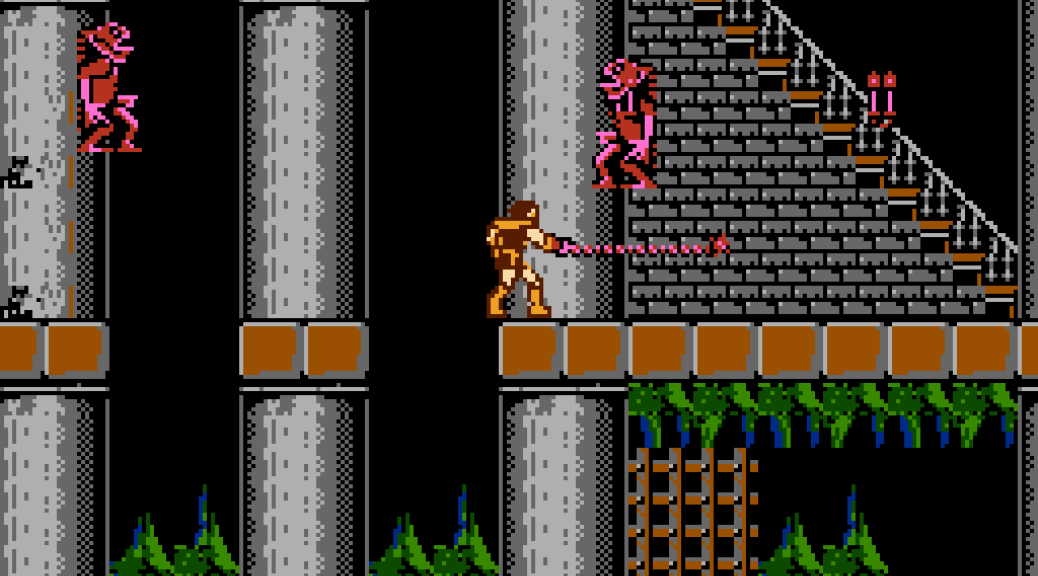
The first Castlevania game was initially released in Japan, by Konami, under the title of “Akumajō Dracula” in 1986. Versions for the MSX2 and Famicom Disk System were developed simultaneously, with the Famicom version coming out on 26th September, and the MSX version a month later, on 30th October. That same game was later released in Europe on 30th October 1987 – translated into English – under the title of “Vampire Killer“.
When it came time to convert the game to the Nintendo Entertainment System for a North American release it was decided to re-title the game as “Castlevania“*. This turned out to be a significant decision as it became a big hit and grew to become a popular and well-known series of video games. The name “Castlevania” entered into the lexicon of classic, instantly-recognisable game titles, later becoming a portmanteau of “Metroid” and “Castlevania” (“Metroidvania“) to describe an entire sub-genre of action/platform games that all share similar gameplay features.
*= Although it’s not clear who actually came up with the name “Castlevania” it has been reported that the change was due to Konami of America senior vice president Emil Heidkamp‘s discomfort with the religious connotations of the title “Akumajō Dracula“, which he believed translated as “Dracula Satanic Castle” (although some argue that it translates as “Demon Castle Dracula“).
The North American release of Castlevania was released on 1st May 1987 as a cartridge, was a critical and commercial hit. A European release followed on 19th December 1988 and was also successful. It seemed that Konami had a significant hit on its hands and was keen to keep the ball rolling with a number of sequels. Castlevania II: Simon’s Quest followed in 1987, with Castlevania III: Dracula’s Curse in 1989. The original Castlevania was also re-released in Japan as a Famicom cartridge game in 1993, under its original title, and again sold very well.
While there’s no doubting that the first Castlevania is a pioneering and influential game, and has stood the test of time quite well, it does have some issues. The first, and probably most obvious, is the sprite tearing and sprite flicker, which is quite bad at times. The second, less obvious, problem is the game’s difficulty, which is insane. Like many difficult games, it starts off hard-but-manageable, but as the levels progress it becomes hair-tearingly frustrating. The sheer number of enemies flying at you in some parts of the game make it feel like an exercise in sadism at times. That said: some people (usually players who have a deep understanding of the game’s mechanics and timings) actually like the high level of difficulty. Your average gamer – even those who are very competent players – will probably struggle to complete this game. I only got as far as I did by using quicksaves, and even then I found the going very tough. I resisted using cheats, but there are plenty of those available if you find the game too hard to be playable.
There are other alternatives to cheating, though. Like many of the early Castlevania games, this has a number of hacks and re-makes available, some of which have been designed to make the game easier to play. There are some hacks, though, that actually make the game more difficult. If you’re determined to play Castlevania all the way through you should maybe look at the available hacks and find out which suit your tastes. There are some excellent ROM hacks around, and also the tools to make your own, should you be so inclined.
More: Castlevania on Wikipedia
More: Castlevania on romhacking.net
Steam: Castlevania on Steam
Steam: Castlevania Anniversary Collection on Steam
GOG: Castlevania 1, 2 & 3 on GOG.com


 The King of Grabs
11 thoughts on “Castlevania, NES/Famicom”