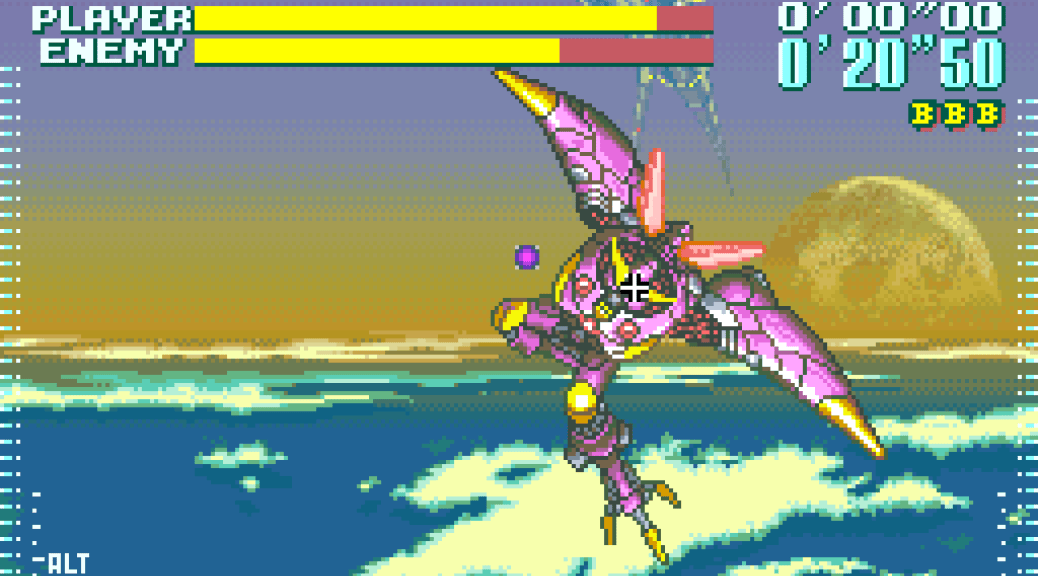
This sequel to Battle Clash was released only in Western regions in 1993 (USA) and 1994 (Europe), for the Super Nintendo. It was developed by the same team at Intelligent Systems who made the first game, and it is called: Metal Combat: Falcon’s Revenge. It features lightgun-style shooter gameplay and uses the Nintendo Super Scope.
Taking place three years after the events of the previous game, you are the acting gunner of the Standing Tank (ST) “Falcon”, piloted by Mike Anderson, fighting the returning emperor Anubis; the invading Eltorian alien race, and a group of chiefs in the Battle Game. Blah, blah – whatever… 😉
This time there are Battle, Time Trial and Combat game modes. There’s also a compulsory training mode (the first time you play the game), which is fine because you need to understand the subtle gameplay changes that have been implemented.
With the gun, you have three types of fire: single shot (press fire once), turbo shot (hold fire down), and energy bolt (wait for meter to fill and then press fire). You can now charge energy bolts up to three times (when the player isn’t firing), and can fire a treble shot when all three power meters are filled. Hitting an enemy with a treble shot will force it to reveal its weakness…
In Battle Mode the gameplay is the same as before: defeat a succession of shit-talking Mecha opponents, one after the other, then take on a boss. Repeat until done. Time Trial Mode is also pretty much the same as before.
Combat Mode is a new two-player versus mode, where one player controls the gun using the Super Scope, and the other player controls the opponent using a SNES controller.
Falcon’s Revenge is more of the same cartoonish futuristic action, with you shooting robots and Mecha suits (but not at people); so no blood, and certainly no gore. It has more detail and variety than the previous game. The ‘charged shots’ feature from Battle Clash has been suped-up in this sequel, to great effect. Which makes this the better of the two games, IMHO.
More: Metal Combat: Falcon’s Revenge on Wikipedia


One thought on “Metal Combat: Falcon’s Revenge, Super Nintendo”