This first-person adventure/RPG was developed by KEMCO (a subsidiary of Kotobuki Engineering & Manufacturing Co.), and published by Seika Corporation in Japan, North America and Europe in 1989. In it, you play as Prince Theo, who is on a quest to challenge his insane, power-mad father for rule of the kingdom.
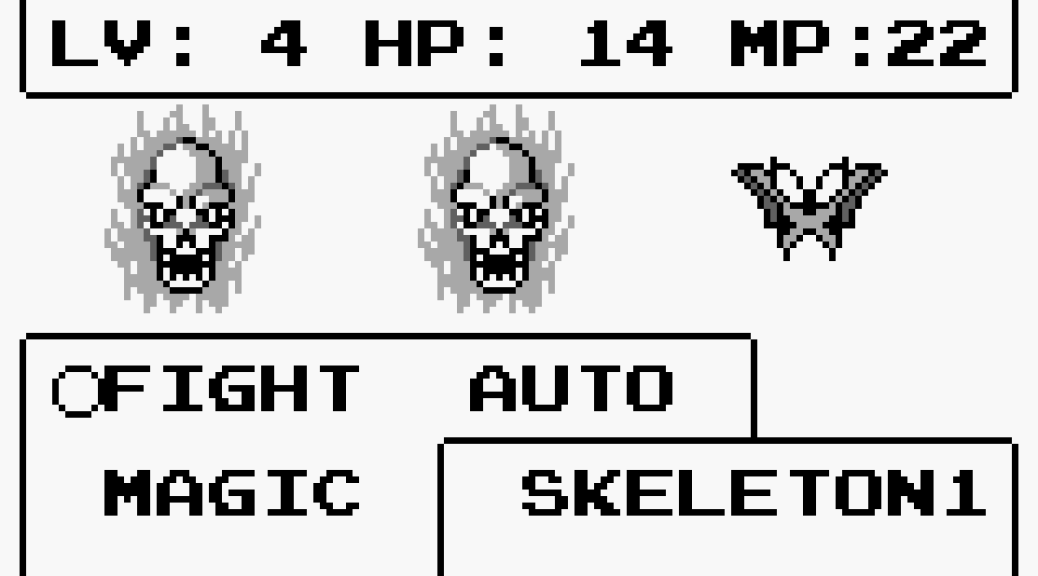
The Sword of Hope is a relatively simple game, but is quite absorbing when you get into it. Movement is made by choosing from available exits, and other actions are performed by choosing from a text menu list. A graphical representation of your view is shown at the top of the screen, as are: your current level, your gold and Experience Points, your Hit Points and your Magic Points.
As you explore you’ll be attacked by various creatures and monsters, and combat in Sword of Hope is turn-based, in true JRPG fashion. You can choose to either attack with a physical weapon, or cast magic spells. Most enemies (and bosses) have a weakness to a particular type of attack, so it makes sense to try to leverage that fact.
There are NPCs to talk to, and puzzles to solve. Conversations do suffer a bit because of their brevity and simplicity (and the rather wobbly translation to English), and this is one of those games that truncates certain words and names (for example “Front Door” becomes “FRNTDOOR”), which can be a little frustrating at times.
One good thing about The Sword of Hope is that it does at least have a system that allows you to continue where you left off. Looking into a crystal ball will give you a password that you can write down and use to return to that point in the game later. While it’s not as convenient as battery backup saves, it is at least something.
The Sword of Hope is a rather antiquated game by today’s standards, but does have some value and is worth playing by those who like old, obscure RPGs. It also spawned a sequel – The Sword of Hope II – which came out in 1992.
More: The Sword of Hope on Wikipedia


 The King of Grabs
One thought on “The Sword of Hope, Game Boy”