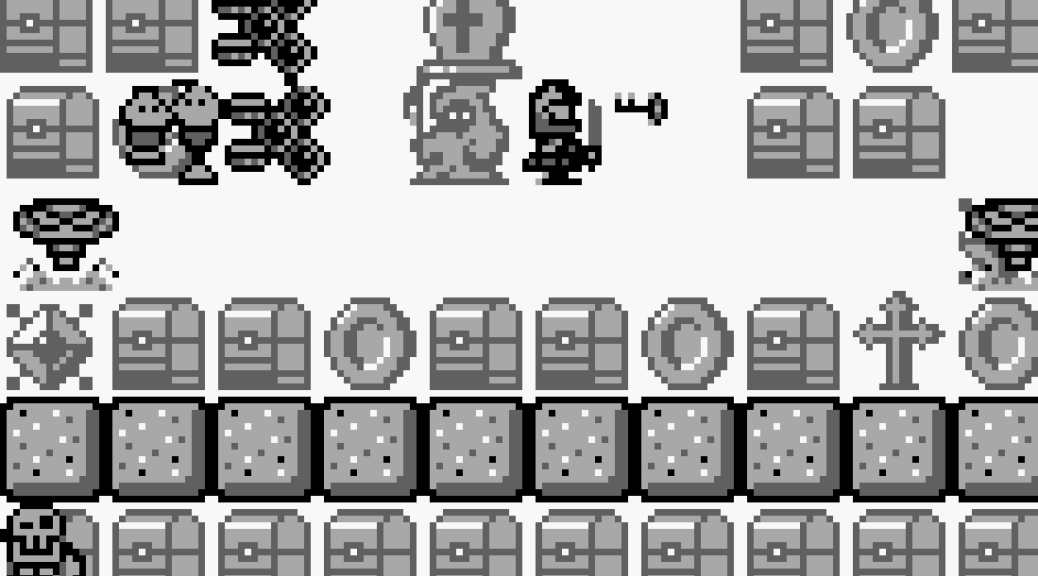
A Game Boy port of Falcom‘s maze-based fantasy action game, Dragon Slayer, was developed by Epoch Co., Ltd. and published by Falcom – in Japan only – in 1990. While Dragon Slayer is an ideal match for Nintendo‘s monochrome handheld marvel, this conversion does leave a bit to be desired.
The game’s biggest problem is the sluggish movement of the main character, which I’m sure could’ve been easily remedied by using slightly different timings. For my tastes, though, the game’s controls seem unresponsive and slow.
Also: the in-game music is too high tempo; is very repetitive, and is likely to get on your nerves fairly quickly. Again: this could easily have been remedied with a bit more thought. I ended up muting the sound because it was so annoying.
The basic gameplay is the same as the original Dragon Slayer. You explore a maze full of monsters, searching for money, power orbs, weapons, potions, and magic rings. Each level is large and complicated, making survival difficult. The aim is to defeat a dragon and return four crowns to your small house (located where you start the game).
Dropping power orbs onto your house increases your fighting strength, allowing you to take on higher-levelled monsters. However, before you can fight effectively you need to find a sword, and these are hidden somewhere in the maze.
Returning coins to your house increases your HP; collecting potions gives you access to magic spells; pushing blocks while holding a ring will make them move; headstones spawn monsters; crucifixes prevent monsters from crossing over them; ghosts steal items out of your hand and move stuff randomly around the dungeon floor; pressing Start makes camp and shows your stats.
Pressing the ‘B’ button brings up your spell list, and what you can cast depends on how many much EXP you’ve accrued. There’s a useful map spell; a return home spell; a jump spell (that’ll teleport you somewhere random if you’re in trouble), and various other spells, including one that allows you to fly, that is required to complete the game.
The key to winning in Dragon Slayer is to not go hog wild killing all the monsters you see. This is because every monster you kill will spawn a new one at a higher level. So if you kill a level one monster, a level two monster will spawn from a nearby headstone. So you need to be careful what you kill. You also need to keep taking money and power orbs back home, so you can keep building your levels. If you don’t do that, and keep killing monsters, then you’ll soon find yourself out of your depth, surrounded by unkillable high-level monsters. So you need to take your time and dodge monsters, only killing them when you have to.
Overall, in spite of the game’s slowness, Dragon Slayer on the Game Boy is an absorbing game. I played it for a number of hours recently and quite enjoyed it, even though I felt like I was nowhere near completing the first phase. The game does feel a bit like a ‘find-the-needle-in-a-haystack’ simulator at times, and it’s easy to find yourself in deep trouble if you kill too many monsters too quickly. Dragon Slayer is worth a look if you like a serious challenge, though.
Dragon Slayer series on The King of Grabs:
Dragon Slayer (MSX), Dragon Slayer (Game Boy), Xanadu: Dragon Slayer II (MSX), Faxanadu (NES/Famicom), Romancia: Dragon Slayer Jr. (MSX), Romancia: Dragon Slayer Jr. (NES/Famicom), Dragon Slayer IV: Draslay Family (MSX), Legacy of the Wizard (NES/Famicom), Sorcerian: Dragon Slayer V (PC), Sorcerian: Dragon Slayer V (MSX), Dragon Slayer: The Legend of Heroes (PC Engine), Xanadu Next (PC).
More: Dragon Slayer on Wikipedia


 The King of Grabs
9 thoughts on “Dragon Slayer, Game Boy”