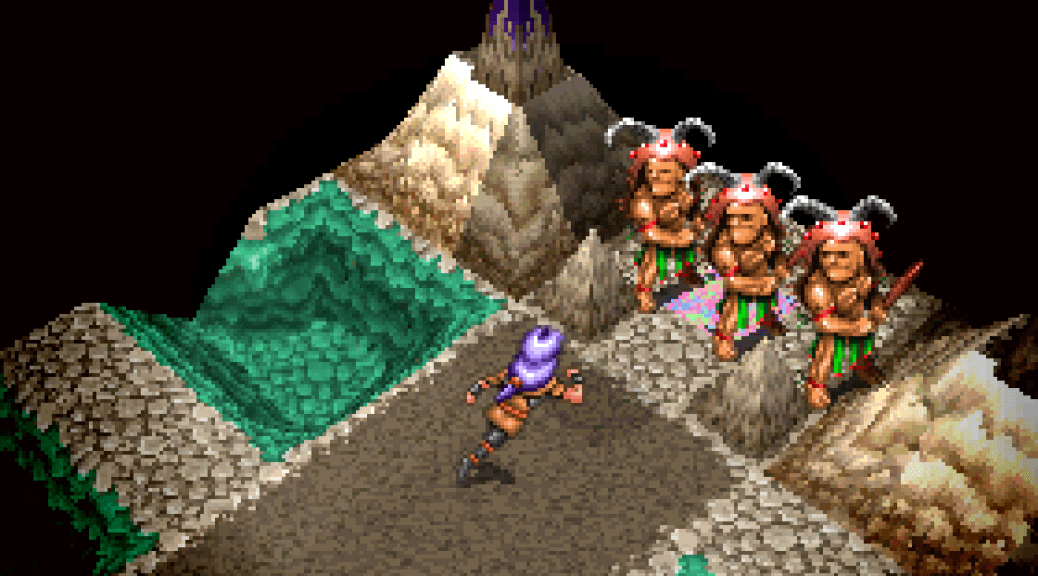
Lucienne’s Quest is a Japanese Role-Playing Game developed by Microcabin for the 3DO. It is, in fact, the only traditional JRPG released for the 3DO and was initially released in Japan in 1995. The game was localised into English and released in North America in 1996 by Panasonic.
Lucienne’s Quest uses a mixture of 3D graphics for the environments and interiors and 2D graphics for the characters, monsters and other objects.
You play as Lucienne, a teenage girl and wizard’s apprentice who sets off on an adventure to help a man cure his lycanthropy. You explore the world, moving from town to town, fighting monsters in random battles of turn-based combat.
The combat itself is a bit strange. You first choose a direction to attack in (towards the enemy is ideal), but if there are trees in the way you’ll attack the trees first… Which is bizarre! You’re supposed to direct yourself around them to attack enemies, or wait and let the enemies waste a turn hitting the trees (and when they fell the tree you then have a clear path for a proper attack). When you get used to the combat system it works well enough, though.
The music in the game is high quality red book audio that streams from CD, but to be honest I often found the choice of themes in the game to be too bombastic and completely lacking subtlety. Battle music, for example, I thought was too high-tempo; too loud, and quickly became annoying. In the end I just turned the volume down.
Weapons and armour play a major role in progressing through the game and there are always shops on the way that are always selling upgrades. Thankfully the purchasing and equipping system make it easy to see who can and cannot equip certain items, and whether an item will increase or decrease their stats as a result of using it. This all makes the process of figuring out what’s worth buying to be easy, and it saves time.
Lucienne’s Quest does have some really nice touches, like day and night cycles with different lighting effects; different camera views to cycle through; clouds in the sky in the overworld view; arrow shots hurting multiple enemies that are lined-up; a simple and intuitive armour and weapon equipping process; a magic system that is different to the norm, but easy to understand; and some laugh-out-loud humour.
The game does have a few rough edges, though, like black areas where the edge of the 3D view is clipped, and fairly low-res textures, but overall they’re relatively minor issues.
I didn’t expect much from Lucienne’s Quest but found myself pleasantly surprised by it. Once you get past the first hour or two, and get used to the combat system, then the game becomes absorbing. The story and dialogue improve too, which is good. For RPG-loving 3DO fans, this is a must-own game. For everyone else: it’s still an RPG worth playing today.
An enhanced version of Lucienne’s Quest was ported to the Sega Saturn in 1996 under the title “Sword & Sorcery“.
More: Lucienne’s Quest on Wikipedia


 The King of Grabs