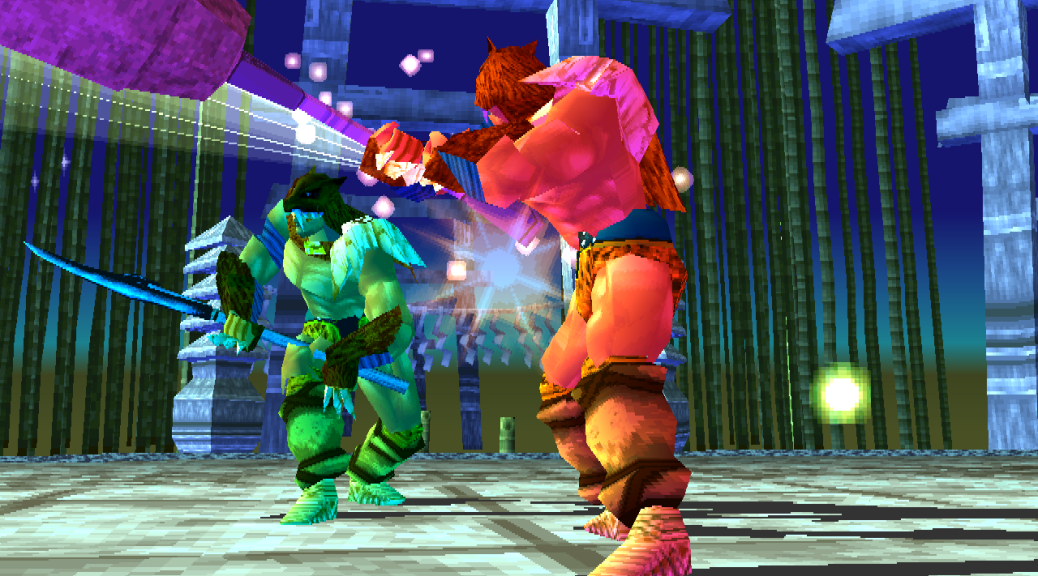
Released in December 1996 in Japan, and in 1997 in North America and Europe, Soul Blade is the PlayStation port of Namco‘s Soul Edge arcade fighting game – the predecessor to the Soulcalibur series.
Soul Edge was a pioneering early attempt at using Motion Capture in a fighting game – for the realistic animation of the combatants – and it had quite an impact on fighting game fans when it was first released.
The PlayStation version of Soul Edge has a variety of different play modes: Training, Versus (one-on-one battle mode), Survival (take on a stream of opponents until you’re unable to continue), Time Attack (fight through a set number of enemies in the shortest time possible), and Team Battle (four fighters take on an opposing group of four, and the last man standing wins it for the team). There’s also an interesting single-player mode, called “Edge Master“, where the player can guide one of the ten main characters in a story-like manner, while obtaining and using a variety of weapons.
Soul Blade also has a “Weapon Room” and very detailed options that even allow you to increase or decrease the size of the fighting ring.
Soul Blade has pretty much everything Soul Edge had – and much more besides. Except that it’s occasionally lacking in fidelity in places. For example, if you compare the grass in the PlayStation version to the grass in the arcade version, you’ll see a marked difference in quality. The PlayStation grass isn’t nearly as well-animated, or as well-coloured, as the arcade grass. While this is just a small fault, the effect is noticeable, which brings into question other small aspects of the conversion.
Overall, Soul Blade is a close enough interpretation of the arcade game, with numerous extra play modes to experiment with. The single-player “Edge Master” mode is worth the admission alone.
The fighters are relatively ‘lo-fi’ in terms of polygon counts, but the animation and control system is spot on. Which is what really counts.
Soul Blade has been described as “one of the best PlayStation games ever made“, which I wouldn’t argue with, really. Special mention must go to the soundtrack, which is exceptional in places.
Soul Blade does have alternate costumes to unlock, like Sophitia in a swimsuit (ie. hidden fan service), and unlockable playable characters, like Soul Master/Soul Edge, the final boss. And, it also has multiple and alternate endings; and you can control the camera on ending sequences, too. Which are both nice touches.
A limited special edition of Soul Blade came complete with the fighting game-specialised “Namco Joystick” controller.
The PlayStation version of Soul Edge had an arguably wider reach than the arcade version, and therefore helped spread word-of-mouth more, about this great fighting game series.
Soul Blade PlayStation = 11 playable characters:
Hwang Sungkyung, Seung Mina, Taki, Li long, Voldo, Sophitia Alexandra, Siegfried Schtauffen, Rock and Heishiro Mitsurugi. Unlockable final boss: Edge Master/Soul Edge.
More: Soul Blade on Wikipedia
More: Soul Blade on YouTube


 The King of Grabs
2 thoughts on “Soul Blade, PlayStation”